Sign up to view full details
Create a free account to unlock payouts, financials, company analysis and more.
- Security Cover
- The value of assets backing the bond per ₹1 of principal owed (e.g. 1.5X = ₹1.5 of cover for every ₹1). A higher cover means more protection for investors.
- Yield to Maturity (YTM)
- Yield to Maturity (YTM) refers to a bond's expected rate of return if held until maturity.
- Coupon Rate
- Coupons are usually fixed interest rates on face value payable monthly, quarterly, yearly or at maturity.
- Nature of Instrument
- Backed by assets which can be liquidated to repay lenders in case of default
- Credit Rating
- An independent agency’s assessment of the issuer’s ability to repay on time. Higher ratings (e.g. AAA) indicate lower credit risk; lower ratings carry higher risk and usually higher yields.
NCD Type
Listed
Credit Rating Agency
ICRA Limited
Coupon Rate
10.2% p.a
Security Cover
1.00X of POS
Date of Rating
—
Debenture Trustee
Catalyst Trusteeship Limited (Formerly GDA Trusteeship Limited)
Min. Investment
₹10,002.10
Face Value
₹10,000.00
Issue Size
₹50 Cr
ISIN
INE2LQA07032
Nature of Instrument
Secured
Issue Date
29 Sep, 2026
Maturity Date
29 Sep, 2029
Put Date
—
Call Date
—
Coupon Type
Fixed
Interest Payment Frequency
Monthly
Principal Payment Frequency
Structured
Payout Summary
Payout Frequency
Monthly
Number of Payouts
—
Total Principal
₹10,000.00
Total Interest
₹2,551.72
Total Payout
₹12,551.72
See the full installment-by-installment schedule under View Detailed Payouts in the Investment Summary.
Saarathi is a Reserve Bank of India (RBI)-registered Non-Banking Financial Company (NBFC) focused on providing secured MSME financing and improving access to credit for small businesses across India. Promoted by Mr. Vivek, former CFO of InCred, the company aims to bridge the financing gap faced by micro, small and medium enterprises (MSMEs), particularly those operating in Tier 2 and Tier 3 cities and underserved markets. The company raised around ₹477 crore in equity funding since inception to support the launch and expansion of its lending business. Following the receipt of its NBFC registration in April 2025, Saarathi has scaled its loan book to over ₹450 crore. The company is rated A- by ICRA, reflecting its external credit rating. Saarathi offers secured and unsecured business loans designed to meet the working capital and growth requirements of small businesses. Its lending proposition emphasizes flexible repayment tenures, convenient EMIs, streamlined processing and minimal documentation, with no mandatory ITR or GST documentation as per its stated offering. Through its pan-India reach and doorstep service in Tier 2 and Tier 3 markets, the company seeks to make formal credit more accessible to businesses that may face challenges obtaining financing through traditional channels.
Incorporated: 02-08-2024 Visit Website
- The company reported a net worth of ₹475.16 crore as of March 31, 2026, supported by approximately ₹477 crore in equity raised from the founder, marquee investors including TVS Capital, Evolvence, Lok Capital and Paragon Partners, and other investors.
- Saarathi operates across 6 states through 75 branches, with sourcing and collections largely managed in-house. Over the next 2–3 years, the company plans to strengthen its presence in existing markets, focusing on semi-urban and rural areas near MSME hubs before gradually expanding into additional states.
- As of March 31, 2026, SFCPL’s loan portfolio consisted almost entirely of secured loans backed by mortgages. Its product offerings include secured business loans of ₹3–25 lakh and unsecured business loans of ₹0.5–3 lakh, with a target steady-state portfolio mix of 85:15 between secured and unsecured lending.
- The company reported a profit of ₹2 crore in FY26, while its net worth increased from ₹20.57 crore in FY25 to ₹475.16 crore in FY26.
Mr. Vivek Bansal
Chief Executive Officer
Mr. Vivek Bansal is the Founder and Chief Executive Officer of Saarathi Finance, bringing extensive leadership experience across the Indian and international financial services sectors. He is a Chartered Accountant (CA), Chartered Financial Analyst (CFA), and Company Secretary. Prior to establishing Saarathi, he served as Whole-Time Director and Group CFO at InCred Financial Services, Deputy CFO and Group Head Finance at YES Bank, and Director Finance at Fidelity in London. Drawing on his extensive experience in financial management, strategic planning and capital markets, Mr. Bansal leads Saarathi’s vision of expanding access to formal credit for underserved entrepreneurs and MSMEs across India. Having grown up in a small town in Rajasthan, he developed a firsthand understanding of the challenges small businesses face in accessing finance. This experience informs his focus on building a customer-centric lending institution that promotes financial inclusion and supports small-business growth.
Mr. Ashish Singhal
Chief Financial Officer
Mr. Ashish Singhal is the Chief Financial Officer at Saarathi Finance, with extensive experience in resource mobilization, treasury management, financial planning, and strategic management. He has significant experience across the NBFC and manufacturing sectors, particularly in treasury and financial management. Prior to joining Saarathi Finance, he served as Director and Head of Group Treasury at InCred Financial Services, where he held multiple roles and progressed from Vice President to Senior Vice President over a period of approximately 2 years and 5 months. Before InCred, he spent over 14 years with Magma Fincorp Ltd. (now Poonawalla Fincorp Ltd.) and Jai Balaji Industries Ltd., where he worked across treasury and finance functions, focusing on financial management, analysis, and resource mobilisation. His experience across NBFCs and manufacturing businesses provides him with a strong background in treasury operations, fundraising, liquidity management, financial analysis, and strategic planning, supporting Saarathi Finance's financial and business growth.
Mr. Imran Hashmi
Chief Business Officer
Mr. Imran Hashmi is the Chief Business Officer at Saarathi Finance, with extensive experience in MSME lending, branch led business development, and fintech partnerships. He holds an MBA in International Business from GITAM Institute of Foreign Trade. At Saarathi, he is responsible for building and scaling business verticals, leveraging his experience in developing lending businesses and strategic partnerships. Prior to joining Saarathi, Imran served as Digital Business Officer at Grihum Housing Finance, where he managed business development and fintech tie-ups and partnerships. He was also a Regional Manager Affordable Housing at Home First Finance Company (HFFC) and served as Regional Manager Business Excellence, SME Banking at National Bank of Oman in Muscat. Earlier in his career, he gained experience handling SME business at Dhanlaxmi Bank and Fullerton India Credit Company.
FY'26
| Revenue | ₹81.37 Cr |
| Profit After Tax | ₹2 Cr |
| PAT Margin | 2.46% |
| Net Worth | ₹475.16 Cr |
| Total Assets | ₹836.66 Cr |
| Return on Equity | 3.26% |
| Assets Under Management | ₹455 Cr |
| Borrowings | ₹252.23 Cr |
| Cash & Bank Balances | ₹111.24 Cr |
| NIM | 10.04% |
| CRAR | 65.46% |
| Net NPA (%) | 0.0% |
- Rating Rationale Download ↓
- Information Memorandum Download ↓
- Payouts Download ↓
Total Issue Size
₹50 CrCompany Financials (FY'26)
Frequently Asked Questions
Corporate Bonds are debt instruments issued by public and private corporations. These bonds are issued to raise capital for various business needs such as constructing new facilities, purchasing equipment or expanding operations. When you buy a Corporate Bond in India, you lend money to the issuing company. In return, the company commits to repaying the principal amount at a predetermined maturity date and pays interest until that date.
Fixed Interest Payments
Corporate Bonds have a fixed coupon rate/interest rate. The issuer of Corporate Bonds offers regular interest payments, providing a steady income stream for investors.Principal Repayment
At maturity, bondholders receive the principal amount. This principal repayment provides the return of the initial investment.Maturity Periods
Corporate Bonds come with various maturity periods. They can range from short-term (less than five years) to long-term (up to 30 years or more), offering flexibility based on your investment goals.Yield
Yield measures the return on a bond investment. It helps you compare different company bonds. Unlike the bond's fixed coupon rate, the yield fluctuates with changes in bond prices due to varying interest rates.Secondary Market Trading
Listed Corporate Bonds in India provide liquidity as they can be bought or sold on the secondary market before their maturity date. This flexibility allows you to adjust the investment strategy based on market conditions or liquidity needs.Credit Ratings
Corporate Bonds in India are assigned credit ratings by agencies such as ICRA, CRISIL, CARE, etc. based on the issuer's creditworthiness. Higher credit ratings indicate lower credit risk and vice versa. You can also compare them with Treasury Bills for safer options. For related reading, see types of government securities.
Attractive Interest Rates
Corporate Bonds typically offer attractive interest rates, facilitating a potentially higher yield.Potential for Capital Appreciation
While bonds are primarily designed to provide fixed income, listed Corporate Bonds in India may also offer potential capital appreciation. You may have the opportunity to sell your Corporate Bonds at a price higher than the purchase price in the secondary market.Diversification of Investment Portfolio
Including Corporate Bonds in an investment portfolio can enhance diversification and may help reduce overall portfolio risk. Corporate Bonds often have different risk-return profiles compared to stocks. They provide a balanced approach when it comes to portfolio management.Predictable Income Stream
Corporate Bonds issued by reputable companies with high credit ratings may offer a relatively safe investment option. They provide a predictable income stream and the assurance of principal repayment at maturity, mitigating the risk of capital loss.
Corporate Bonds are significantly influenced by changes in interest rates. When interest rates fall, the value of existing Corporate Bonds rises. Conversely, when interest rates rise, the value of Corporate Bonds tends to decrease. Because of this inverse relationship new bonds issued at higher interest rates make existing bonds with lower rates less attractive, thus decreasing their market value. Therefore, selling a bond before it matures can result in a price different from the initial purchase price, depending on the prevailing interest rates.
The degree of price volatility is generally higher for bonds with longer maturities. However, if you hold a bond until its maturity date, these price fluctuations become less of a concern as you will receive the bond's par or face value at maturity while reinvestment risk remains.
Wide Range of High-Quality Investments
Altifi provides access to a diverse array of Corporate Bonds in India from high-quality companies. Our platform allows you to explore various opportunities in the debt market. Learn more in our guide on Investing in Bonds: Types, Features and Benefits.Seamless Investment Process
Through Altifi, you can easily and securely invest in Corporate Bonds in India. Our platform supports quick registration and KYC verification process with multiple payment modes to make the investment process convenient and efficient. It simplifies your experience with a streamlined digital onboarding process, saving your valuable time.User-friendly Platform
Designed for Altifi's user convenience, our bond investment platform allows you to effortlessly explore, compare, and invest in various assets. With an intuitive interface that provides in-depth information on interest rates, maturity dates, and credit ratings, you can make informed decisions with confidence.Real-Time Portfolio Monitoring
Altifi offers tools to monitor the performance of your investment portfolio anytime, ensuring you stay informed and in control of your investments.Part of Northern Arc Group
Altifi, backed by Northern Arc, a top Indian NBFC, is a cutting-edge platform for fixed-income investments. We streamline bond buying through an intuitive interface, offering a variety of instruments. With real-time market data and expert insights, Altifi opens-up the bond market platform, enabling you to diversify and discover new investment opportunities. Northern Arc empowers investors by providing access to data-driven technology, deep sector expertise, and a democratized investment platform like Altifi.Impact Investing Opportunities
Altifi lets you align your investments with your values. You can invest in companies that are making a positive impact on underserved sections of society through our platform. Explore ethical investments like Sovereign Gold Bonds.
The types of Corporate Bonds include:
Fixed Rate Bonds
Fixed rate bonds offer fixed interest payments, known as coupon payments. The interest rate is determined at the time of issuance as a percentage of the bond's face value. These bonds can be considered if you are seeking sustained returns and prefer certainty in cash flows, as the interest payments remain constant throughout the bond's life.Floating Rate Bonds
Floating rate bonds have their interest rates tied to a benchmark rate, such as a government bond yield or MIBOR (Mumbai Interbank Offered Rate). As the benchmark rate changes, the interest rate on the bond adjusts accordingly.Convertible Bonds
Convertible bonds combine features of both debt securities and equities. You can get regular interest payments like regular bonds. However, you can convert the bond into a predetermined number of equity shares of the issuing company at a predetermined date or under specific conditions.Non-Convertible Debentures (NCDs)
NCDs cannot be converted into equity shares and remain purely debt instruments, providing fixed income without the prospect of equity ownership.Secured Bonds
Secured bonds are backed by the assets of the issuing company. In case the company defaults, bondholders have a claim on these assets. These bonds offer lower risk since they are protected by collateral, providing more security for your investments.Unsecured Bonds
Unsecured bonds are not backed by any collateral, which means bondholders do not have a claim on the company's assets if they fail to meet their obligations. These bonds carry relatively higher risk compared to secured bonds but may offer higher interest rates to compensate for the additional risk.Callable Bonds
Callable bonds give the issuing company the right to redeem the bond before its maturity date. This usually happens when interest rates fall, allowing the company to refinance the debt at a lower rate.Puttable Bonds
Puttable bonds give the investor the option to sell the bond back to the issuer before its maturity date, providing flexibility if market conditions change or the issuer's credit profile weakens. This feature offers additional protection by allowing early exit from the investments.
Investment Corner
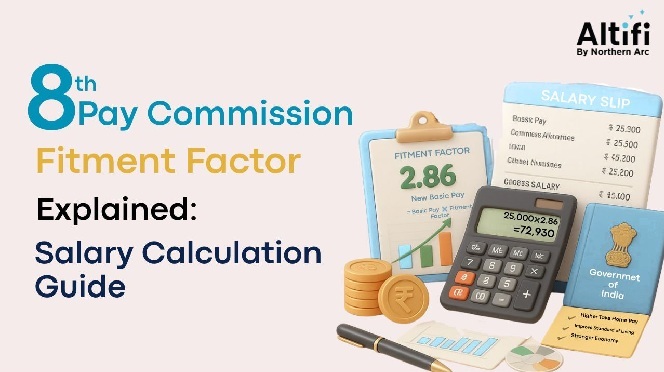
8th Pay Commission Fitment Factor: Expected Hike, Salary Calculation & Latest Updates (2026)
One of the most highly anticipated events by government officials and pensioners of India is the implementation of the 8th Pay Commission. Formed on 3…
View Similar Products
Disclaimer
Altifi is operated by Northern Arc Securities Private Limited “NASPL”, a SEBI registered Stock Broker and Online Bond Platform Provider “OBPP” operating under the brand name “Altifi” in the NSE/BSE Debt segment.
Fixed returns do not constitute guaranteed or assured returns. Investments in corporate debt securities, municipal debt securities/securitised debt instruments are subject to credit risks, market risks and default risks including delay and/or default in payment. Read all the offer related documents carefully. *The bond inventories offered on the platform provide fixed returns ranging from 8% to 14% p.a, subject to availability and market conditions.
Mutual Fund investments are subject to market risks, read all scheme related documents carefully. Mutual Funds, Fixed deposits, PMS & AIFs are not Stock Exchange traded products and NASPL is only acting as distributor.
NASPL is a wholly owned subsidiary of Northern Arc Capital Ltd. (“NACL”). NACL may also be a seller of securities on the platform. Though all transactions involving NACL and NASPL are carried out on an arm's length basis there is a possibility that interests of NACL or NASPL (or both) may conflict with interests of the users of Altifi. Please review all offer documents including issuer details etc prior to investing.
#This percentage reflects the proportion of the portfolio available on the Platform.
Important Information
Investor Charter · Investor complaints · Grievance Redressal · Privacy Policy · Terms Of Use
Important Links
SMARTODR & SCORES · NSE · BSE · SEBI · Refund Policy · Disclaimer and Regulatory Information · AMFI · CDSL · NSDL · PFRDA · RBI
Contact us:
Northern Arc Securities Private Limited (NASPL) | SEBI Registration No.: INZ000318831 | AMFI Registered Mutual Fund Distributor - ARN 311499 | APMI Registered PMS Distributor - APRN04867
NSE Membership No: 90387 | BSE Registration No: 6895
Compliance officer: J Sornamukhi | Telephone No.: +91 22 66687555
Email ID: support@altifi.ai (for any compliance & grievance related complaints)
CIN - U66120TN2023PTC158583
Registered Office: 10th floor, No.1, IITM RESEARCH PARK, Kanagam Rd, Kanagam, Tharamani, Chennai, Tamil Nadu 600113