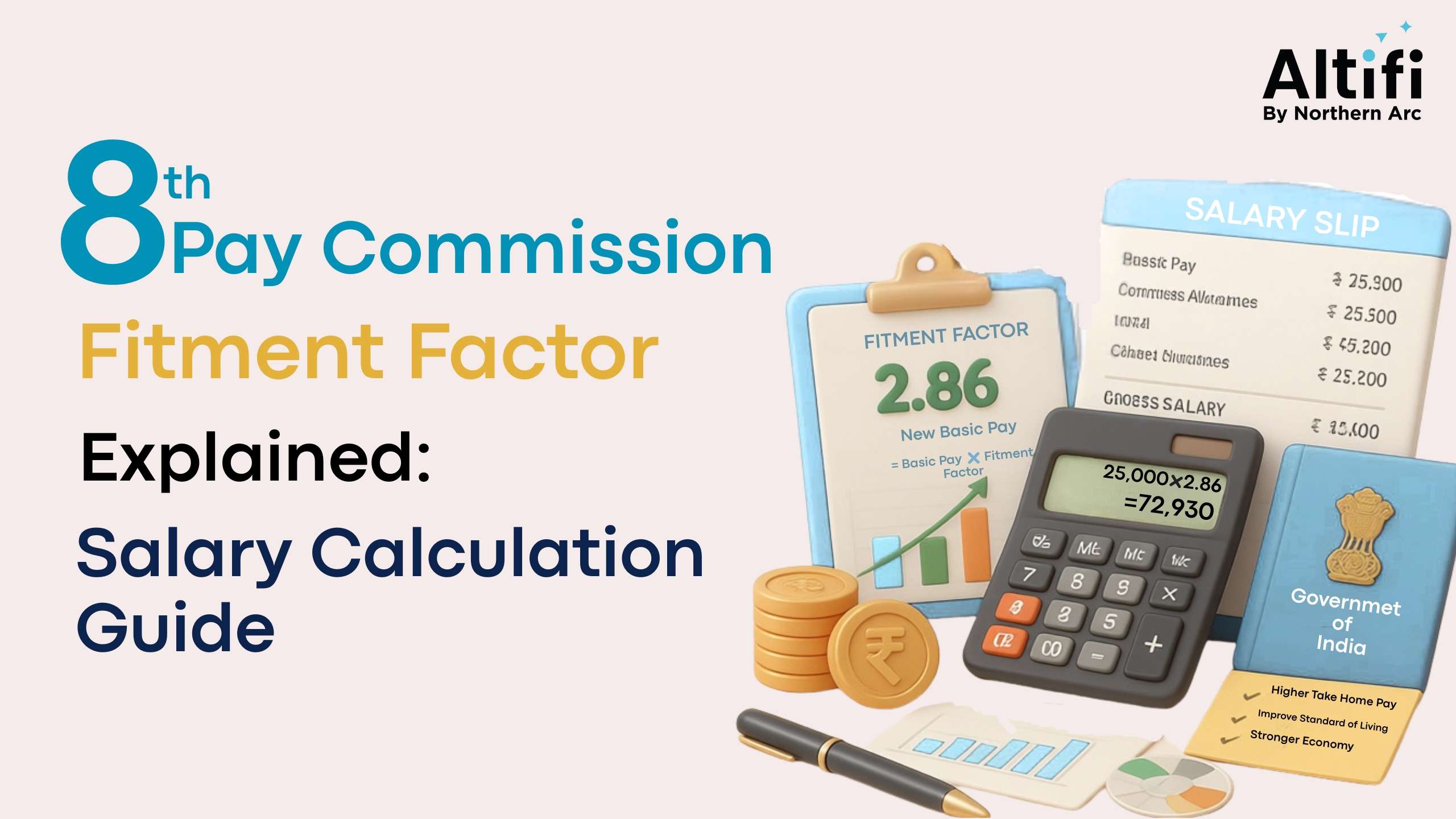
One of the most highly anticipated events by government officials and pensioners of India is the implementation of the 8th Pay Commission. Formed on 3rd November 2025, the pay commission is currently in the consultation process and is not yet implemented. At the centre of many discussions lies the fitment factor that determines the rate at which the basic salary, pension, and allowances will be increased following the implementation of the pay commission. The article explains the meaning of the fitment factor, how it is calculated, the various estimates being considered, and the impact of the increase on family budgeting.
What is the Fitment Factor?
The fitment factor may be termed as the multiplying factor which, when multiplied with the basic pay of the employee as per the 7th Pay Commission, yields the revised basic pay as per the 8th Pay Commission. In simple terms, the factor multiplies the existing basic pay to obtain the revised basic pay. For example, if your basic pay is ₹18,000 and the fitment factor selected is 2.57, then your revised basic pay will be ₹46,260. The value is not random but is calculated based on various considerations.
How Does the Fitment Factor Work?
- The commission studies inflation trends, dearness allowance levels and past pay commission patterns.
- It reviews memorandums submitted by employee unions and pensioner associations.
- A draft fitment factor is proposed and tested against government revenue and fiscal deficit targets.
- Once approved by the Cabinet, the factor is applied uniformly to basic pay across all levels of the pay matrix.
- Dearness Allowance, which had accumulated under the previous commission, resets to zero and starts building afresh from the new base.
How to Calculate Your Revised Salary Using the Fitment Factor
The formula is straightforward:
Revised Basic Pay = Current Basic Pay (7th CPC) × Fitment Factor
Worked example: Suppose your current basic pay under the 7th CPC is ₹35,400 (Level 4 of the pay matrix). If the fitment factor is set at 2.57, your revised basic pay would be:
₹35,400 × 2.57 = ₹90,978 (approximately)
If the factor were instead 2.86, the same basic pay would move to roughly ₹1,01,244.
Current Basic Pay (7th CPC) | At 2.28 | At 2.57 | At 2.86 |
₹18,000 | ₹41,040 | ₹46,260 | ₹51,480 |
₹35,400 | ₹80,712 | ₹90,978 | ₹1,01,244 |
₹56,100 | ₹1,27,908 | ₹1,44,177 | ₹1,60,446 |
How Will the Fitment Factor Affect Salaries and Pensions?
A higher fitment factor raises not just take-home pay but every allowance calculated as a percentage of basic pay, along with pension entitlements for retirees.
Impact on In-Hand Salary
House Rent Allowance, Travel Allowance and other components are usually calculated as a percentage of basic pay, so a rise in basic pay lifts the total salary by a proportionally larger amount.
Impact on Pensions
Pensions are based on basic pay, so if a fitment factor of 3.83 is approved, the minimum pension could rise from ₹9,000 to somewhere between ₹25,000 and ₹34,500. Even a moderate factor of 3.0 would push minimum pension up to around ₹22,500.
Impact on Arrears
Since 1 January 2026 is the official reference date, any implementation after that date is likely to result in retrospective salary and pension arrears paid as a lump sum once the revision is finalised.
Evolution of the Fitment Factor: 6th, 7th & Expected 8th Pay Commission
Looking back helps put the current estimates in context.
Pay Commission | Fitment Factor | Minimum Basic Pay |
6th CPC | 1.86 | ₹7,000 |
7th CPC | 2.57 | ₹18,000 |
8th CPC (expected) | 1.92 – 2.86 (union demand up to 3.83) | ₹34,560 – ₹51,480 (or higher, per union figures) |
The 8th Pay Commission was officially constituted on 16 January 2025, with its recommendations expected to take effect from 1 January 2026. History gives a useful pointer on timing too: the 7th CPC was set up in 2014, submitted its report in late 2015, and was actually implemented in August 2016, seven months after its reference date, with arrears settled as a lump sum for the gap period.
Grade Pay, Pay Bands and Pay Matrix: Understanding the Evolution
While the 6th Pay Commission used the Pay Band and Grade Pay method for calculating salaries, this was a complex process since there were two parts to the salary that needed to be calculated separately. The 7th Pay Commission did away with the Pay Band and Grade Pay method and replaced it with the Pay Matrix method, which ensured that each level had its own basic pay and comparisons between jobs became simpler. The upcoming 8th Pay Commission will also follow the pay matrix method, but only alter the levels of the pay matrix by using the new fitment factor.
How the 8th Pay Commission Salary Hike Can Impact Your Financial Planning
A salary revision of this scale changes how much surplus income is available each month, and that surplus needs a home. Three broad scenarios are worth considering.
Conservative scenario
A fitment factor near 2.0 gives a modest rise. Employees may prefer to route the extra income into safer instruments and build an emergency fund first.
Moderate scenario
A fitment factor around 2.5–2.8, similar to the 7th CPC, gives room to increase existing SIPs or add a fixed-income instrument to the portfolio.
Optimistic scenario
A fitment factor above 3.0 frees up a larger surplus, which could be split across debt and market-linked instruments depending on individual risk appetite.
Fixed Deposits
Fixed deposits remain a reliable choice for the portion of arrears or salary hike that an employee does not wish to expose to market movement. Rates vary by bank and tenure, so it is worth comparing a few options before locking in funds.
Debt Mutual Funds
Debt mutual funds offer better liquidity than a fixed deposit in most cases, along with potentially better post-tax returns depending on the holding period and fund category chosen.
Corporate Bonds
Corporate bonds can offer a slightly higher yield than government paper, though they carry credit risk depending on the issuer's rating. Suitable for investors comfortable assessing that risk.
Government Securities
Government securities carry the lowest credit risk among fixed-income options and suit employees who want capital protection above all else, particularly for pension-linked planning.
Conclusion
Pay Commission fitment factor for 8th Pay Commission shall determine the amount that the central government employees and pensioners would get after the revision process is done. Even though the estimates lie between less than 2.0 to more than 3.5 at the moment, all of this is speculation before the report of the pay commission and approval of the government comes into effect. It thus is essential to follow up on the developments.
FAQs on 8th Pay Commission
Will DA be merged with basic pay under the 8th Pay Commission?
Dearness Allowance, projected to reach around 70% by January 2026, is expected to be merged into the base salary for revised calculations, though this has not been formally confirmed.
Why does DA reset to zero when a new Pay Commission takes effect?
Because DA is meant to offset inflation against a specific base pay. Once that base pay is revised upward through the fitment factor, the old DA percentage no longer applies, and a fresh calculation begins from the new, higher basic pay.
What is the expected range of fitment factor for 8th CPC?
Estimates currently range from roughly 1.83 to 2.86, with a union demand of 3.83, compared with 2.57 under the 7th CPC.
What is the minimum basic pay under 8th Pay Commission?
Minimum basic pay could rise from ₹18,000 to somewhere between ₹34,560 and ₹51,480, depending on which fitment factor is eventually approved.
Disclaimer:
The information contained in this newsletter (“Newsletter”) is for general informational purposes only. Northern Arc Capital Limited (“Northern Arc”) does not make any warranties about the completeness, reliability, and accuracy of this information. Any action you take upon the information contained in this Newsletter is strictly at your own risk, and Northern Arc will not be liable for any losses and damages in connection with the use of our Newsletter.
The data included in this Newsletter has been obtained from sources that are believed to be reliable and accurate at the time of publication. However, Northern Arc does not guarantee the accuracy or completeness of any information, nor does it assume any responsibility or liability for any errors or omissions therein. Any opinions expressed herein are subject to change without notice and Northern Arc is under no obligation to update or keep current the information contained in this Newsletter.
This Newsletter is not intended to constitute, and should not be construed as, investment advice or a recommendation to purchase, sell, or hold any security or to engage in any investment strategy or transaction. Readers should not rely solely on the information provided in this Newsletter for making investment decisions and should conduct their own due diligence or seek the advice of a qualified professional.
The content of this Newsletter is for informational purposes only and is not a solicitation or an offer to buy or sell any securities or financial instruments. Northern Arc is not responsible for any investment decisions made by the recipients of this Newsletter. Readers should take independent financial advice from a qualified professional in connection with, or independently research and verify, any information that is provided in this Newsletter and wish to rely upon, whether for the purpose of making an investment decision or otherwise.
Northern Arc and its affiliates, directors, employees, and agents expressly disclaim any and all liability for any direct or indirect losses, damages, or expenses of any kind arising out of or relating to the use of this Newsletter, including but not limited to, any losses related to the accuracy, completeness, timeliness, or reliability of such information.
This Newsletter may contain forward-looking statements that are based on current expectations, estimates, forecasts, and projections about the markets in which Northern Arc operates, as well as management’s beliefs and assumptions. Forward-looking statements are not guarantees of future performance and involve certain risks and uncertainties, which are difficult to predict. Past performance is not indicative of future results.
This report is intended solely for the recipient and is not for further circulation. Any distribution, modification, reproduction, or disclosure of the contents of this Newsletter, in whole or in part, without the prior written consent of Northern Arc, is strictly prohibited.