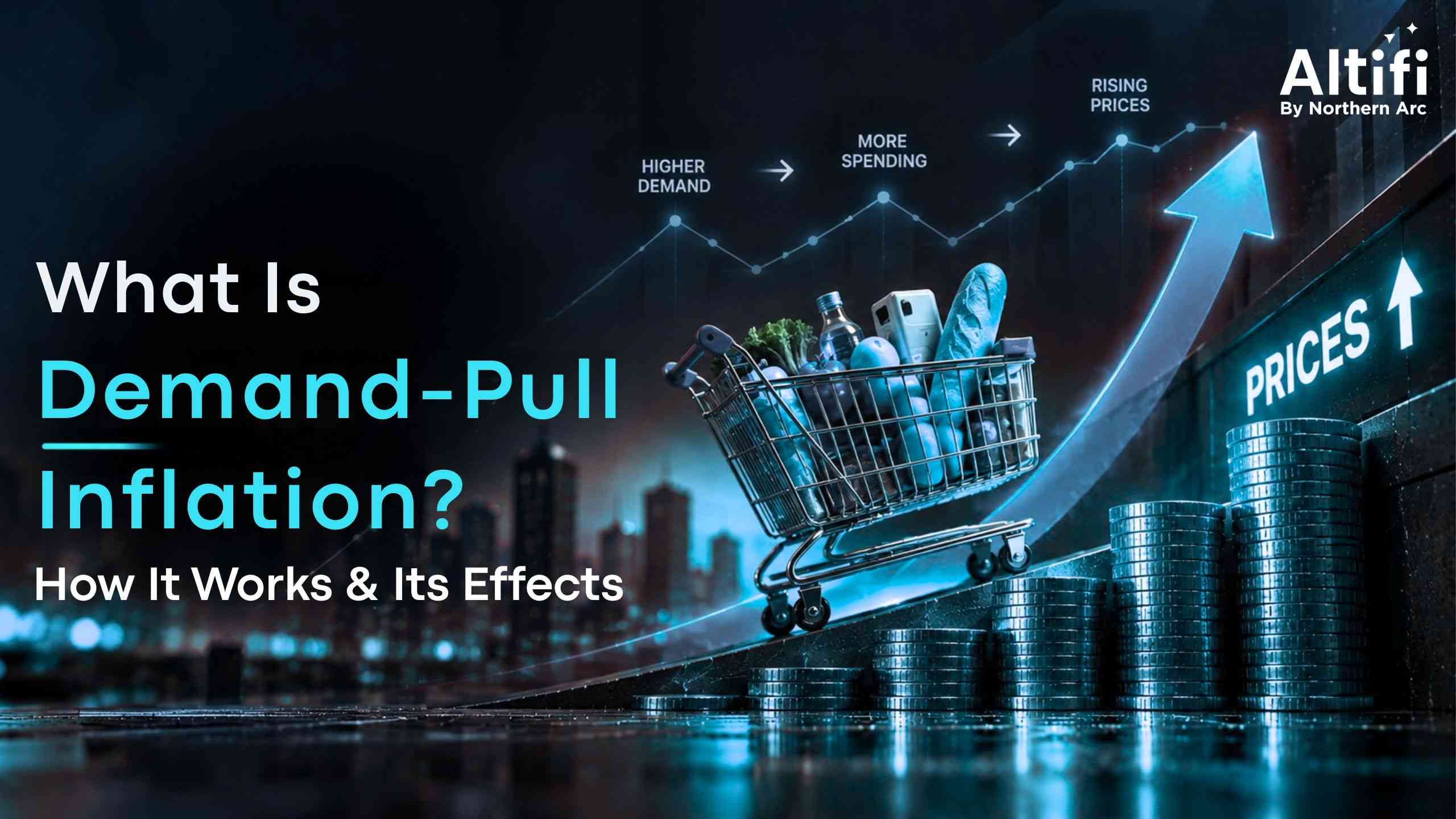
Demand-pull inflation happens due to the increase in demand for goods and services which exceeds supply. This implies that whenever the number of people and businesses wanting the products exceeds its production capacity, the prices will rise.
There are two types of inflation, one of them is the demand-pull inflation. It influences consumer prices, costs for the businesses, savings and investments.
What Is Demand-Pull Inflation?
Demand-pull inflation is defined as the increase of general price level because of high aggregate demand in an economy.
Suppose in an economy, the demand for cars rises quickly. Car makers' failure to supply the demand may lead to a price increase. If such conditions prevail in other sectors of the economy, this might lead to inflation.
There is a relationship between aggregate supply and aggregate demand and it has something to do with demand-pull inflation. Aggregate demand is the sum of demands for goods and services in an economy, and aggregate supply is the sum of the output of the producers.
How Does Demand-Pull Inflation Happen?
Demand-pull inflation generally develops when spending in an economy increases.
The process can be understood in a few simple steps:
Higher demand → Pressure on supply → Shortages or capacity constraints → Higher prices
For example, if households have more disposable income, they may increase their spending on housing, travel, electronics and other products. Businesses may also increase spending on equipment and expansion.
If producers can meet the higher demand, prices may remain relatively stable. However, if production cannot increase quickly enough, demand can exceed available supply. Businesses may then raise prices.
If this pattern continues across several sectors, it can contribute to higher overall inflation.
Want to know how inflation affects your fixed deposits? Read here.
What Causes Demand-Pull Inflation?
Several factors can increase demand in an economy.
1. Higher Consumer Spending
When people have more disposable income, they may spend more on goods and services. This can increase overall demand.
2. Higher Government Spending
Increased government spending on infrastructure, public services and other projects can add to aggregate demand.
3. Lower Interest Rates
Lower interest rates can make borrowing less expensive. Households and businesses may borrow and spend more, increasing demand.
4. Increase in Business Investment
Businesses may increase investment when economic conditions are favourable. Higher investment spending can add to aggregate demand.
5. Increase in Exports
Higher demand for a country's goods and services from overseas buyers can increase demand for domestic production.
6. Easy Availability of Credit
When loans and credit are easily available, consumers and businesses may increase their spending. This can put additional pressure on supply.
Demand-Pull Inflation Examples
Inflation due to Demand pull is one such situation where the demand for certain goods or services increases, and the business houses cannot meet this increase in demand.
For instance, if there is an increase in demand for housing due to increased availability of loans to people who can afford them, then housing prices could increase.
A similar situation can occur during strong economic growth. Consumers may spend more on cars, travel, restaurants and electronics. Businesses may also increase investment and hiring. If production capacity is already close to its limit, rising demand can put upward pressure on prices.
Demand-pull inflation can therefore affect individual sectors or become broader when demand remains strong across the economy.
What are the Effects of Demand-Pull Inflation?
Demand-pull inflation can affect consumers, businesses and the wider economy.
Higher Prices
The most direct effect is an increase in the prices of goods and services. Consumers may need to spend more to maintain the same level of consumption.
Lower Purchasing Power
When prices rise faster than income, purchasing power decreases. The same amount of money can buy fewer goods and services.
Higher Business Revenue
Businesses selling products in high demand may see higher sales and revenue. However, their operating and input costs may also increase.
Changes in Interest Rates
Persisting inflation can affect the monetary policy decisions. The central bank may use the interest rate and other methods in controlling inflation.
Impact on Savings and Investments
Inflation can affect the value of the savings and investment earnings. An investor may take inflation into account while calculating the returns on investment.
How Can Demand-Pull Inflation Be Controlled?
Governments and central banks can use monetary and fiscal measures to manage inflationary pressure.
Monetary Policy
The Reserve Bank of India (RBI) can use monetary policy tools to influence borrowing, spending and liquidity in the economy.
For example, higher interest rates can make borrowing more expensive. This may reduce demand for loans and moderate spending.
Fiscal Policy
The government can also use fiscal measures to influence demand. Changes in government spending and taxation can affect overall spending in the economy.
Increasing Supply
The inflationary pressure may further reduce when companies produce more and increase supply. Infrastructure improvements and productivity gains may assist the economy in fulfilling the increased demands.
Demand-Pull Inflation and the Indian Economy
Demand-pull inflation is a key factor to consider when the growth in economic activity and spending is faster than the growth of supply of goods and services.
The inflation in India is calculated on price indices like Consumer Price Index (CPI). The Reserve Bank of India takes inflation into consideration while framing monetary policies.
Demand is only one factor affecting inflation. Food prices, fuel costs, supply disruptions, commodity prices and other factors can also influence overall inflation.
Therefore, a rise in inflation cannot always be attributed to demand-pull factors alone.
Conclusion
Demand pull-inflation takes place due to the rapid rise of the demand of goods and services compared to the supply. An increase in consumer spending, increased government expenditure, business investments, exportation, and easy credit availability might cause an increase in the demand. Some consequences that may arise as a result of this type of inflation are high prices and reduced purchasing power. Inflation may be controlled through monetary, fiscal, and supply-side policies. An understanding of the demand pull-inflation is useful in explaining why prices tend to increase during times of high economic performance.
FAQs on Demand-Pull Inflation
How is demand-pull inflation different from cost-push inflation?
When there is excess demand in an economy compared to the supply, then demand-pull inflation is said to occur. Cost-push inflation is where production costs rise leading to increased prices of commodities.
What are the effects of demand-pull inflation on consumers?
It leads to high prices of products in the market. If income does not increase at a similar rate, then it means that the consumers will face low purchasing power.
How does the RBI control demand-pull inflation?
The RBI uses monetary policy tools in controlling demand-pull inflation. The measures could include policy interest rate changes, among other factors. These measures are considered based on inflation and other economic conditions.
What are the main causes of inflation?
There are various factors that contribute to inflation. Some of these factors include strong demand, increased production costs, disruption of supply, increase in commodity prices, and economic condition changes.
Is demand-pull inflation always harmful?
No, not necessarily. Some amount of price rise may happen during the growth period of an economy when the demand is high. But continued inflation could cause problems by lowering the purchasing power of people.
Disclaimer:
The information contained in this newsletter (“Newsletter”) is for general informational purposes only. Northern Arc Capital Limited (“Northern Arc”) does not make any warranties about the completeness, reliability, and accuracy of this information. Any action you take upon the information contained in this Newsletter is strictly at your own risk, and Northern Arc will not be liable for any losses and damages in connection with the use of our Newsletter.
The data included in this Newsletter has been obtained from sources that are believed to be reliable and accurate at the time of publication. However, Northern Arc does not guarantee the accuracy or completeness of any information, nor does it assume any responsibility or liability for any errors or omissions therein. Any opinions expressed herein are subject to change without notice and Northern Arc is under no obligation to update or keep current the information contained in this Newsletter.
This Newsletter is not intended to constitute, and should not be construed as, investment advice or a recommendation to purchase, sell, or hold any security or to engage in any investment strategy or transaction. Readers should not rely solely on the information provided in this Newsletter for making investment decisions and should conduct their own due diligence or seek the advice of a qualified professional.
The content of this Newsletter is for informational purposes only and is not a solicitation or an offer to buy or sell any securities or financial instruments. Northern Arc is not responsible for any investment decisions made by the recipients of this Newsletter. Readers should take independent financial advice from a qualified professional in connection with, or independently research and verify, any information that is provided in this Newsletter and wish to rely upon, whether for the purpose of making an investment decision or otherwise.
Northern Arc and its affiliates, directors, employees, and agents expressly disclaim any and all liability for any direct or indirect losses, damages, or expenses of any kind arising out of or relating to the use of this Newsletter, including but not limited to, any losses related to the accuracy, completeness, timeliness, or reliability of such information.
This Newsletter may contain forward-looking statements that are based on current expectations, estimates, forecasts, and projections about the markets in which Northern Arc operates, as well as management’s beliefs and assumptions. Forward-looking statements are not guarantees of future performance and involve certain risks and uncertainties, which are difficult to predict. Past performance is not indicative of future results.
This report is intended solely for the recipient and is not for further circulation. Any distribution, modification, reproduction, or disclosure of the contents of this Newsletter, in whole or in part, without the prior written consent of Northern Arc, is strictly prohibited.