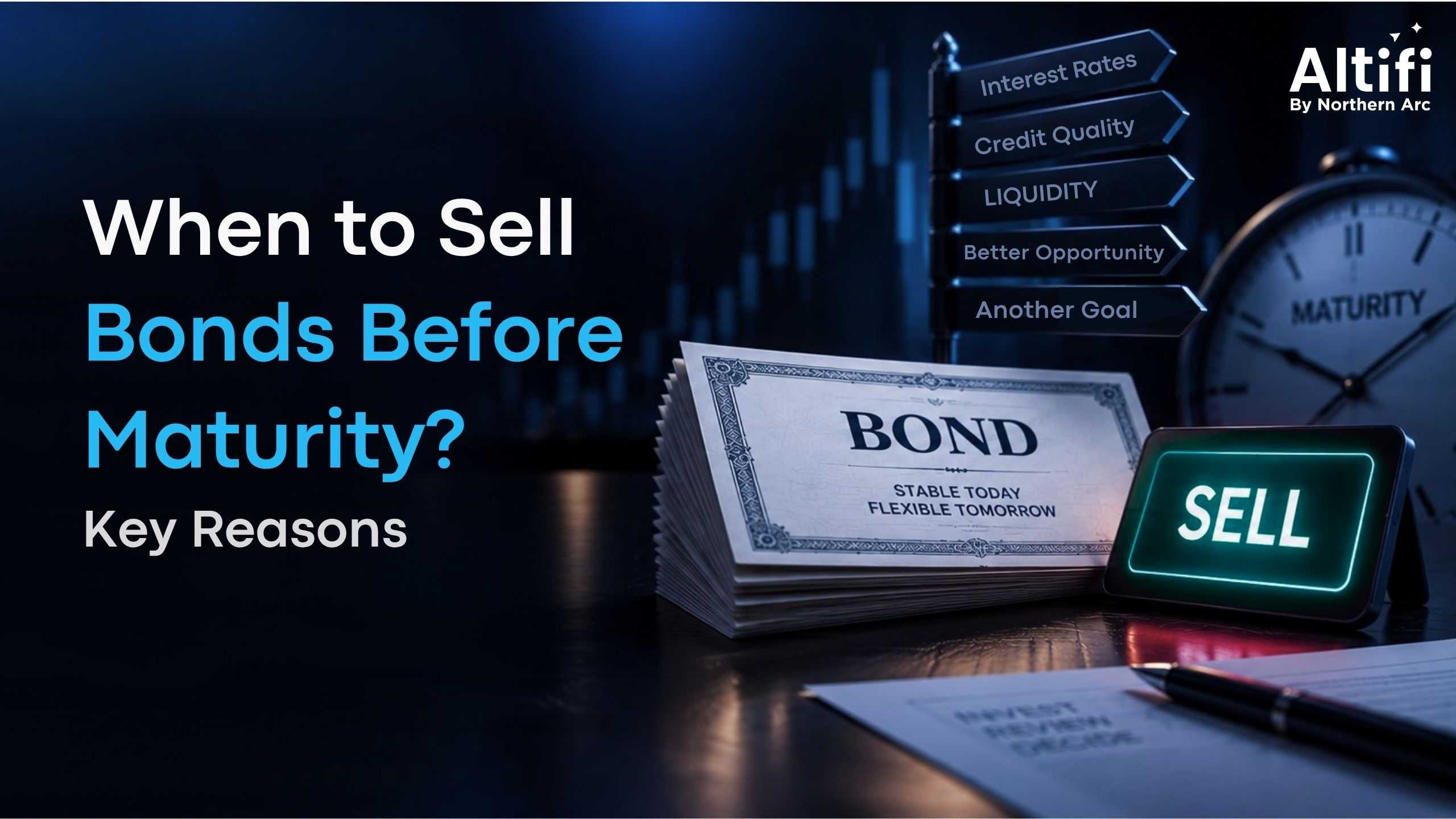
Selling a bond before maturity can be useful when market conditions, personal cash needs or the bond's risk profile changes. The Indian corporate bond market remains active: SEBI data shows that 28.42 lakh corporate bond trades worth about ₹22.07 lakh crore were settled in FY 2025-26. By July 2026, FY 2026-27 had already recorded another 14.46 lakh trades worth about ₹7.76 lakh crore. These numbers show that India's secondary bond market is active overall. However, liquidity varies significantly across issuers and bond issues, so some bonds may still be difficult to sell quickly or at the existing market price. Before selling a bond, investors should assess its current market price, yield, credit quality, liquidity, tax impact and their own financial needs. In some cases, holding until maturity may make more sense than selling early.
What Does Selling a Bond Before Maturity Mean?
When an investor sells a bond before maturity, the security is sold to another market participant through the applicable secondary-market mechanism. The seller receives the sale proceeds instead of continuing to hold the bond until maturity. The bond seller gets the market price instead of waiting for the bond issuer to redeem its principal amount on maturity.
The market price may be higher or lower compared to the initial investment amount. This depends on many factors, including interest rates, the bond's creditworthiness, demand, and maturity period.
What Happens When You Sell a Bond Before Maturity?
If the clean market price falls to ₹97,000 and you sell at that price, the capital loss is ₹3,000 before adjusting for accrued interest, brokerage and applicable taxes.
The process is usually:
- Check the bond's current market price.
- Review the latest yield and credit rating.
- Check whether there are buyers in the market.
- Place a sell order through the relevant platform or intermediary.
- Receive the sale proceeds after settlement.
The actual amount received may differ from the displayed price because of accrued interest, transaction costs and market movements.
Why Might an Investor Sell a Bond Early?
There is no single reason to sell a bond before maturity. Common reasons include:
- Interest rates have changed, and a better opportunity is available.
- The issuer's credit position has weakened.
- The investor needs cash.
- The bond has become difficult to sell.
- The investor wants to reduce exposure to a particular issuer.
- A different bond offers a better risk-adjusted yield.
- The investor wants to rebalance the portfolio.
Key Signs It May Be Time to Sell a Bond
There are several conditions that might make a bond less valuable or suitable for investment over time. Some of them are listed below.
Interest Rates Have Risen Sharply
Bond prices and market rates generally have an inverse relationship. High interest rates can make existing bonds less desirable to own, causing bond prices to drop.
Selling will be justified if a more profitable alternative is available. However, selling after price drops would result in a loss, thus taking into consideration remaining maturity and expected income from the bond is important.
The Issuer's Credit Quality Has Weakened
Financial weakness can lead to additional risks when investing in a certain bond.
Increase in leverage, cash flow problems, delays in payments or reduction in credit rating can impact the bond price in the market. The bond rating is not a sign of default.
It might be reasonable to sell a bond that is no longer suitable for your risk profile.
You Need the Money for Another Goal
Your financial needs can also be a reason to sell.
If you need cash before the bond matures, selling can help you access the money. Before doing so, compare the expected sale proceeds with your cash requirement and account for any gain or loss.
A Better Investment Opportunity is Available
A bond may become less attractive when another investment offers a better risk-adjusted return.
For example, you may find another bond with a similar credit profile but a higher yield. Before switching, compare the sale price, taxes, transaction costs and potential loss on the existing bond.
The Bond Has Poor Liquidity
Liquidity refers to how easily a bond can be sold at a reasonable market price.
A listed bond may still have limited trading activity. If you expect to need the money soon, check recent trading activity before selling. Low liquidity can make it harder to find a buyer at your preferred price.
Should You Sell or Hold a Bond? A Practical Decision Framework
There is no fixed rule for when to sell. A simple comparison can help.
| Factor | Holding may make sense when | Selling may make sense when |
|---|---|---|
| Interest rates | Rates are stable or expected to fall | Rates have risen and better yields are available |
| Credit quality | Issuer remains financially strong | Credit risk has increased |
| Liquidity | You do not need immediate cash | You need funds before maturity |
| Yield | Current yield remains attractive | Another suitable bond offers better value |
| Tax impact | Selling creates an avoidable tax cost | The overall exit still makes financial sense |
| Investment goal | You want regular interest until maturity | Your financial goal has changed |
Factors To Check Before Selling a Bond
Before placing a sell order, check:
- Current market price
- Yield to maturity
- Coupon rate
- Remaining maturity
- Credit rating
- Issuer's financial position
- Recent trading activity
- Accrued interest
- Capital gain or loss
- Applicable taxes
- Transaction costs
- Alternative investment options
A quick check of these points can prevent an unnecessary sale.
When Does Holding Until Maturity Make More Sense?
It can also be a good strategy if the company continues to be financially healthy, the bond still fits well within the objectives of the investor, and the investor does not need cash right away.
For instance, an investor who purchased a bond for ₹1,00,000 expecting the company to return the same ₹1,00,000 can opt for holding instead of selling it off for ₹97,000 in times of high interest rates.
Holding the bond until maturity can avoid realising a market price loss, provided the issuer meets its payment obligations. However, this does not eliminate credit or other risks, so the issuer’s financial position should still be monitored.
When Does Selling Before Maturity Make More Sense?
Selling can be considered when the bond no longer fits the investor's needs.
This may happen after a meaningful change in interest rates, a decline in credit quality, a change in cash requirements or the availability of a more suitable investment.
The key is to compare the total outcome from selling today with the expected benefit of continuing to hold the bond.
What are the Tax Implications of Selling a Bond Before Maturity?
Selling a bond before maturity can result in a capital gain or capital loss.
For example, if a bond bought for ₹1,00,000 is sold for ₹1,05,000, the investor has a ₹5,000 capital gain before considering applicable adjustments and costs.
The tax treatment depends on the type of bond, whether it is listed or unlisted, the date of transfer and the applicable tax provisions.
The 2024 capital gains changes set the long-term capital gains rate for listed bonds and debentures at 12.5%, while unlisted bonds and debentures are subject to the applicable rules under the specified provisions. The Government also removed indexation for the relevant long-term capital gains framework.
Investors should check the tax rules applicable to their specific bond before selling.
How to Sell a Bond Before Maturity in India
The exact process depends on how the bond is held and where it is traded. A typical process is:
- Check whether the bond is tradable.
Confirm its listing and available trading mechanism. - Check the current market price.
Compare the quoted price with your purchase price and the bond's face value. - Review liquidity.
Check recent trading activity before deciding on the selling price. - Calculate the likely outcome.
Include accrued interest, transaction costs, and possible tax. - Place the sell order.
Use the relevant trading platform or intermediary. - Review the settlement details.
Keep the contract note and transaction records for tax reporting.
NSE notes that yield is an important measure for comparing bonds and assessing their return.
Conclusion
It might be the right time to sell a bond if it is no longer aligned with an investor's objectives and risk profile. The reasons that would make the sale more justified would be an increase in interest rates, a drop in credit quality, lack of liquidity, the need for money, and better opportunities to invest elsewhere. Selling before maturity can result in a capital gain or loss, while limited secondary market liquidity may make it difficult to sell at the expected price. It is important to understand the significance of several elements such as price, yield, credit quality, liquidity, taxation, and financial objectives.
FAQs on Selling Bonds Before Maturity
What happens when you sell a bond before maturity?
The bond is sold in the secondary market at its prevailing market price. The amount received can be higher or lower than the original investment.
Should I sell bonds when interest rates rise?
Not necessarily. Rising rates can reduce existing bond prices, but selling immediately may lock in a loss. Compare the potential benefit of moving to a higher-yielding investment with the loss and costs of selling.
Why would an investor sell a bond before maturity?
An investor may sell because of changing interest rates, higher credit risk, a need for cash, poor liquidity, portfolio rebalancing or a more attractive investment opportunity.
What is the biggest risk of selling a bond early?
The main risk is selling below the purchase price and locking in a capital loss. Limited liquidity can also make it harder to find a buyer at the desired price.
Can I sell a bond before its maturity date?
Yes, if the bond is transferable and there is a suitable secondary-market mechanism and buyer. The ease of selling depends on the bond and its liquidity.
How do I know if selling a bond is profitable?
Compare the expected sale proceeds with your purchase cost, accrued interest, transaction costs and applicable taxes. Also compare the return from selling with the income you could earn by continuing to hold the bond.
Disclaimer:
The information contained in this newsletter (“Newsletter”) is for general informational purposes only. Northern Arc Capital Limited (“Northern Arc”) does not make any warranties about the completeness, reliability, and accuracy of this information. Any action you take upon the information contained in this Newsletter is strictly at your own risk, and Northern Arc will not be liable for any losses and damages in connection with the use of our Newsletter.
The data included in this Newsletter has been obtained from sources that are believed to be reliable and accurate at the time of publication. However, Northern Arc does not guarantee the accuracy or completeness of any information, nor does it assume any responsibility or liability for any errors or omissions therein. Any opinions expressed herein are subject to change without notice and Northern Arc is under no obligation to update or keep current the information contained in this Newsletter.
This Newsletter is not intended to constitute, and should not be construed as, investment advice or a recommendation to purchase, sell, or hold any security or to engage in any investment strategy or transaction. Readers should not rely solely on the information provided in this Newsletter for making investment decisions and should conduct their own due diligence or seek the advice of a qualified professional.
The content of this Newsletter is for informational purposes only and is not a solicitation or an offer to buy or sell any securities or financial instruments. Northern Arc is not responsible for any investment decisions made by the recipients of this Newsletter. Readers should take independent financial advice from a qualified professional in connection with, or independently research and verify, any information that is provided in this Newsletter and wish to rely upon, whether for the purpose of making an investment decision or otherwise.
Northern Arc and its affiliates, directors, employees, and agents expressly disclaim any and all liability for any direct or indirect losses, damages, or expenses of any kind arising out of or relating to the use of this Newsletter, including but not limited to, any losses related to the accuracy, completeness, timeliness, or reliability of such information.
This Newsletter may contain forward-looking statements that are based on current expectations, estimates, forecasts, and projections about the markets in which Northern Arc operates, as well as management’s beliefs and assumptions. Forward-looking statements are not guarantees of future performance and involve certain risks and uncertainties, which are difficult to predict. Past performance is not indicative of future results.
This report is intended solely for the recipient and is not for further circulation. Any distribution, modification, reproduction, or disclosure of the contents of this Newsletter, in whole or in part, without the prior written consent of Northern Arc, is strictly prohibited.