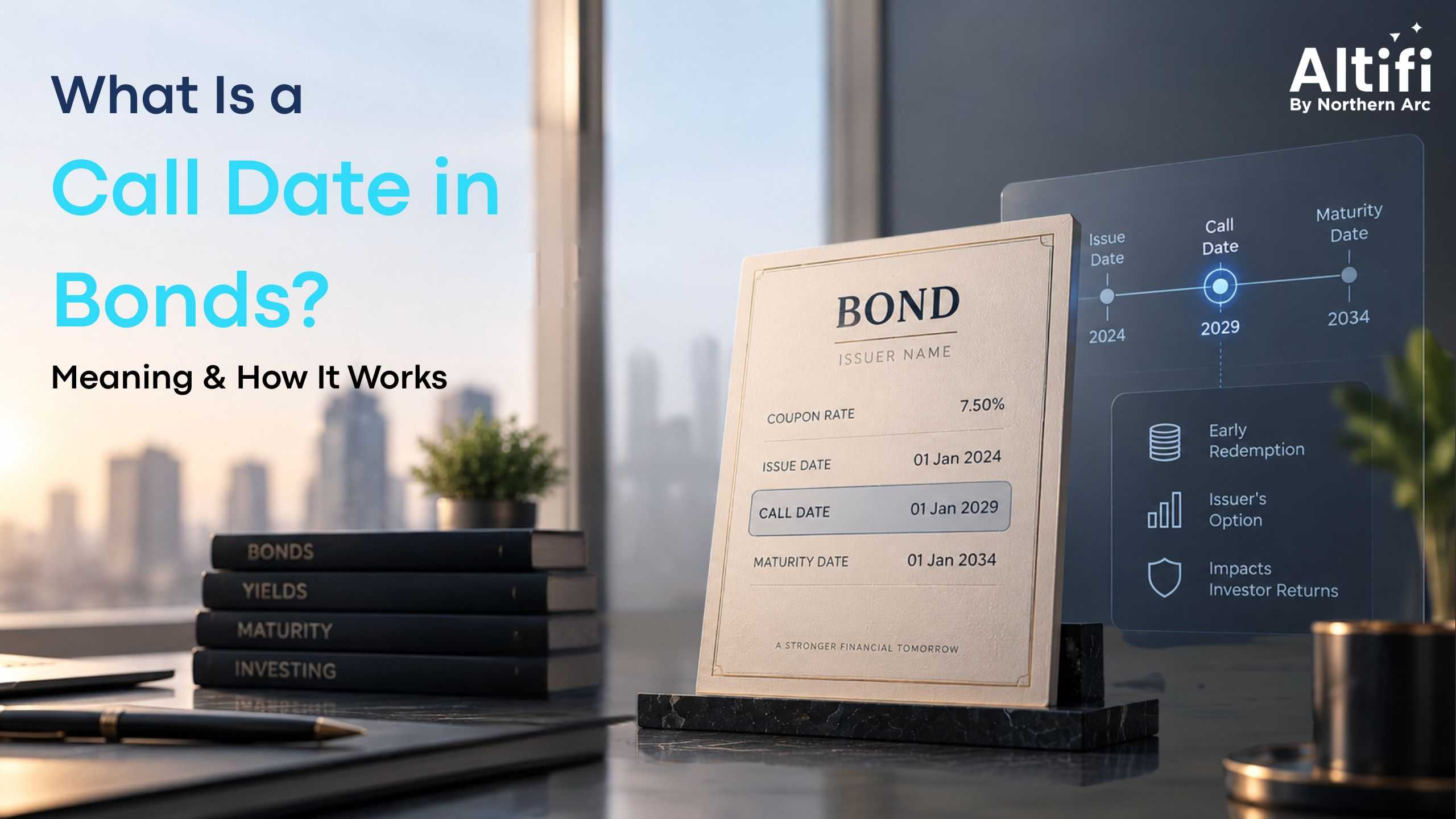
A call date can change how long an investor remains invested in a bond and when the principal may be repaid. This feature is relevant when a bond gives the issuer the option to redeem the security before its scheduled maturity date. Understanding the bond call date, call price, call protection period and associated risks can help investors interpret the terms of a callable bond more clearly.
What is a Bond Call Date?
A bond call date is the date from on which the issuer of a callable bond may exercise its right to redeem the bond before its scheduled maturity date, subject to the terms of the issue. This option is available only when the bond terms include a call provision.
When an issuer calls a bond, it repays the outstanding principal according to the stated call terms. The investor then stops receiving future coupon payments from that bond.
A bond can have one or several call dates during its tenure. The applicable dates, call price, and other conditions are generally stated in the bond documents.
The first date when the issuer can redeem the bond is called the first call date. Some bonds also include a call protection period before the first call date.
How Does a Bond Call Date Work?
After understanding what is a call date, let's understand how it works:
1. Bond Includes a Call Provision
The bond is issued with a provision that gives the issuer the right to redeem it before maturity. The terms of this provision are set out in the relevant issue documents.
2. Call Protection Period Applies
Some callable bonds include a period during which the issuer cannot exercise the call option. The first eligible call date comes after this period ends.
3. Issuer Evaluates the Call Option
As a call date approaches, the issuer may assess factors such as prevailing interest rates, funding requirements and the terms of the existing debt.
4. Issuer Exercises the Call Option
If the issuer decides to redeem the bond, it follows the applicable process and provides notice according to the issue terms.
5. Principal Is Repaid
When the call is completed, the call price is the amount the issuer pays to redeem the bond under the call provision. It may equal the face value or include a call premium, depending on the bond's terms.
The exact process can differ depending on the bond structure and issue documentation.
Bond Call Date Example: How Does an Early Redemption Work
Consider a hypothetical callable bond with a face value of ₹10,000 and a maturity of seven years. Suppose the bond allows the issuer to redeem it after five years at a specified call price.
If the issuer exercises the call option after the five-year period, the bond may be redeemed at the stated call price instead of continuing until the original seven-year maturity.
For an investor, this means the investment period may end earlier than initially expected. The investor may receive the applicable redemption amount but would no longer receive the bond's scheduled payments for the remaining period.
The actual outcome depends on the bond's call terms, including the applicable price, payment schedule, notice period and other conditions.
How to Find the Call Date of a Bond
The bond call date is generally available in the bond's offer document, information memorandum, term sheet or other relevant issue documentation.
Investors reviewing a callable bond can look for the following details:
- Call Date: The date or dates on which the issuer may exercise the call option.
- First Call Date: The earliest date on which the issuer can redeem the bond under the call provision.
- Call Price: The amount payable when the issuer exercises the call option.
- Call Schedule: The sequence of dates and corresponding redemption terms, where multiple call dates apply.
- Call Protection Period: The period during which the issuer cannot exercise the call option.
- Notice Period: The period and procedure specified in the issue terms for notifying investors of an issuer's decision to exercise the call option.
Reviewing these details alongside the maturity date can provide a clearer picture of the possible investment timeline.
What is the Call Protection Period?
The call protection period is the period during which the issuer is restricted from exercising the call option on a callable bond.
For example, a bond may have a maturity of several years but provide that it cannot be called during its initial period. Once the protection period ends, the issuer may become eligible to exercise the call option on the specified call date.
The presence and duration of call protection depend on the terms of the particular bond.
Why Do Bond Issuers Exercise the Call Option?
An issuer may exercise a call option for several reasons connected with its financing requirements and prevailing market conditions.
Refinancing at a Lower Cost
If market interest rates decline below the bond's coupon rate, the issuer may refinance the debt by issuing new bonds at a lower borrowing cost.
Managing Existing Debt
An issuer may use the call provision as part of its broader debt-management strategy, particularly when its funding requirements or capital structure change.
Replacing Existing Securities
A callable bond may be redeemed when the issuer has an opportunity to replace the existing borrowing with another funding arrangement under different terms.
Responding to Funding Conditions
Changes in interest rates, liquidity conditions and the issuer's financial position can influence how the issuer evaluates the available call option.
However, the existence of a call date does not mean that the issuer will necessarily redeem the bond on that date. The decision remains subject to the applicable terms and circumstances.
What Does a Bond Call Date Mean for Investors?
A call date can affect investors because it introduces uncertainty around the actual duration of the investment.
The Investment May End Before Maturity
If the issuer exercises the call option, the bond may be redeemed before its original maturity date. This can change the expected investment period.
Future Payments May Stop
Once the bond is redeemed, investors generally stop receiving payments associated with the security for the remaining period.
Reinvestment Risk May Arise
If a bond is called when market yields have fallen, the investor may have to reinvest the redemption proceeds at lower prevailing yields. This is known as reinvestment risk.
Call Premium May Affect Redemption Value
Some callable bonds may provide a call premium, meaning the issuer pays an amount above the face value when redeeming the bond. The applicable amount depends on the issue terms.
Expected Returns Can Differ
If a callable bond is redeemed early, the investor’s realised return may differ from the Yield to Maturity (YTM). In such cases, Yield to Call (YTC) may provide a more relevant return measure based on the specified call scenario.
How Does a Call Date Affect Bond Yields, Returns and Reinvestment Risk?
The bond call date can influence how investors assess the potential return and risk of a callable bond.
| Factor | Possible Impact of a Call Date |
|---|---|
| Yield | The realised yield may differ if the bond is redeemed before maturity. |
| Investment Period | The actual holding period may be shorter than the stated maturity. |
| Payments | Future payments may stop once the bond is redeemed. |
| Reinvestment Risk | Investors may need to reinvest the proceeds under prevailing market conditions. |
| Call Premium | A premium may increase the amount received on early redemption, depending on the terms. |
| Interest Rate Risk | Falling market interest rates generally increase the likelihood that an issuer will exercise the call option, while rising rates generally reduce that likelihood. |
For callable securities, investors may therefore consider the call schedule alongside the coupon, maturity, credit quality, YTM and other relevant bond characteristics.
Bond Call Date vs Maturity Date
A call date and a maturity date represent different points in a bond's life.
| Feature | Bond Call Date | Maturity Date |
|---|---|---|
| Meaning | Date on which the issuer may have the right to redeem the bond early | Scheduled date on which the bond reaches its contractual maturity |
| Applicability | Applies to callable bonds | Applies to bonds with a defined maturity |
| Who initiates redemption | Issuer, subject to the call terms | Redemption occurs according to the maturity terms |
| Timing | May occur before maturity | Represents the scheduled end of the bond's tenure |
| Investment duration | May shorten if the call option is exercised | Generally continues until the stated maturity |
| Investor consideration | Call risk and reinvestment risk may be relevant | Maturity and repayment terms remain central |
The two dates therefore serve different purposes. The maturity date indicates the scheduled end of the bond, while a call date creates a possibility of earlier redemption.
Conclusion
A bond call date is an important feature of callable debt securities because it can affect the investment period, future payments and reinvestment considerations. Investors evaluating such bonds can review the first call date, call schedule, call price, call protection period and maturity date alongside credit quality and yield-related measures. Since the issuer may or may not exercise the call option, understanding the contractual terms can provide a clearer view of the potential outcomes associated with a callable bond.
FAQs on Bond Call Dates
Do all bonds have a call date?
No, only callable bonds have call dates. Non-callable bonds generally remain outstanding until their scheduled maturity, subject to their terms.
What happens when a bond is called before maturity?
The issuer redeems the bond according to its call terms. Investors receive the applicable amount and stop receiving future coupon payments.
How is the call price of a bond determined?
The call price is specified in the bond's issue documents and may vary by call date, potentially including a premium over face value.
What is a call premium on a bond?
A call premium is an additional amount that may be paid above the bond's face value when the issuer redeems a callable bond early.
Why would an issuer call a bond before maturity?
An issuer may call a bond to manage financing costs, refinance existing debt, adjust its capital structure or respond to changing market conditions.
Disclaimer:
The information contained in this newsletter (“Newsletter”) is for general informational purposes only. Northern Arc Capital Limited (“Northern Arc”) does not make any warranties about the completeness, reliability, and accuracy of this information. Any action you take upon the information contained in this Newsletter is strictly at your own risk, and Northern Arc will not be liable for any losses and damages in connection with the use of our Newsletter.
The data included in this Newsletter has been obtained from sources that are believed to be reliable and accurate at the time of publication. However, Northern Arc does not guarantee the accuracy or completeness of any information, nor does it assume any responsibility or liability for any errors or omissions therein. Any opinions expressed herein are subject to change without notice and Northern Arc is under no obligation to update or keep current the information contained in this Newsletter.
This Newsletter is not intended to constitute, and should not be construed as, investment advice or a recommendation to purchase, sell, or hold any security or to engage in any investment strategy or transaction. Readers should not rely solely on the information provided in this Newsletter for making investment decisions and should conduct their own due diligence or seek the advice of a qualified professional.
The content of this Newsletter is for informational purposes only and is not a solicitation or an offer to buy or sell any securities or financial instruments. Northern Arc is not responsible for any investment decisions made by the recipients of this Newsletter. Readers should take independent financial advice from a qualified professional in connection with, or independently research and verify, any information that is provided in this Newsletter and wish to rely upon, whether for the purpose of making an investment decision or otherwise.
Northern Arc and its affiliates, directors, employees, and agents expressly disclaim any and all liability for any direct or indirect losses, damages, or expenses of any kind arising out of or relating to the use of this Newsletter, including but not limited to, any losses related to the accuracy, completeness, timeliness, or reliability of such information.
This Newsletter may contain forward-looking statements that are based on current expectations, estimates, forecasts, and projections about the markets in which Northern Arc operates, as well as management’s beliefs and assumptions. Forward-looking statements are not guarantees of future performance and involve certain risks and uncertainties, which are difficult to predict. Past performance is not indicative of future results.
This report is intended solely for the recipient and is not for further circulation. Any distribution, modification, reproduction, or disclosure of the contents of this Newsletter, in whole or in part, without the prior written consent of Northern Arc, is strictly prohibited.