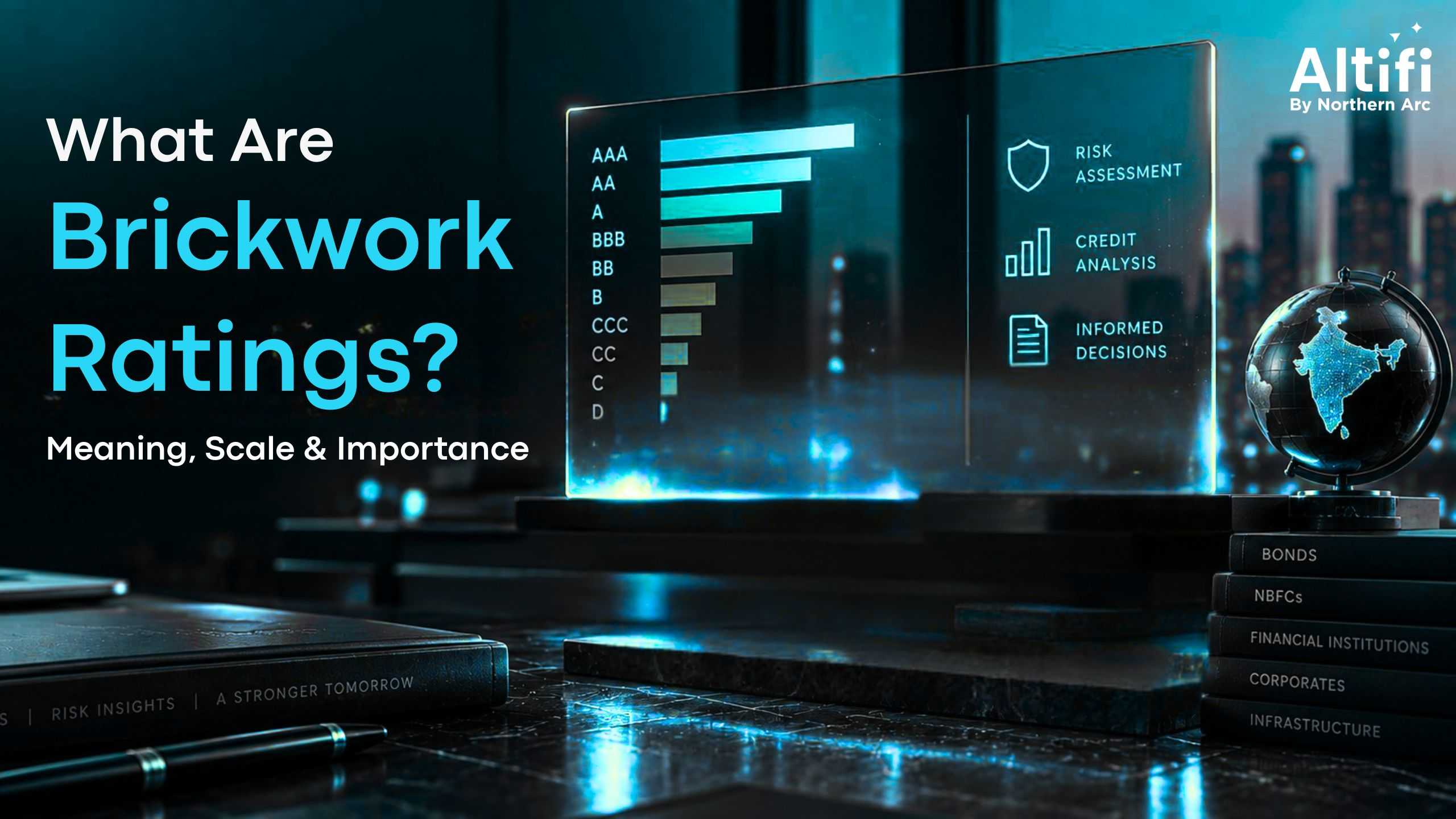
When evaluating a bond or other debt instrument, understanding its credit rating can provide useful context about the issuer's ability to meet its financial obligations. Brickwork Ratings (BWR) is a credit rating agency in India that assigns ratings to debt instruments, issuers and other financial products. The rating scale ranges from BWR AAA at the higher end to BWR D at the lower end for long-term debt instruments. Understanding the brickwork ratings scale, rating process and current regulatory status can help investors interpret credit risk more carefully.
What is Brickwork Ratings (BWR)?
Brickwork Ratings India Private Limited is a SEBI-registered Credit Rating Agency . It is registered with SEBI as a credit rating agency. Its ratings are also recognised by RBI for specified regulatory purposes, including the use of eligible ratings for risk-weighting certain bank exposures under the applicable framework. SEBI's current list of registered credit rating agencies includes Brickwork Ratings India Private Limited under registration number IN/CRA/005/2008.
A brickwork credit rating represents an assessment of the credit quality or repayment risk associated with a particular instrument, issuer or financial obligation. Depending on the type of instrument, BWR uses different rating scales.
For example, long-term debt instruments use ratings ranging from BWR AAA to BWR D, while short-term debt instruments use ratings from BWR A1 to BWR D.
A credit rating is an opinion about credit risk, and it is not a recommendation to buy, sell or invest in a particular security.
How Does the Brickwork Ratings Credit Rating Process Work?
The brickwork credit rating process involves analysing information relevant to the creditworthiness of an issuer or financial instrument. The process can generally include the following stages:
Information Collection and Analysis
BWR reviews relevant financial, operational and business information relating to the issuer or instrument. The information considered can vary depending on the nature of the rating assignment.
Assessment of Credit Factors
The assessment can consider factors such as financial strength, business position, industry conditions, debt obligations, liquidity and the issuer's ability to meet its financial commitments.
Rating Committee Review
The analytical assessment is reviewed through BWR's internal rating process, including consideration by the relevant rating committee, which determines the final rating based on the available information and applicable rating methodology. Brickwork Ratings states that ratings are subject to surveillance during the applicable period, with rating actions possible when material developments affect the assessment.
Rating Publication and Surveillance
The assigned rating and relevant rationale may be published through BWR's disclosures. Subsequent developments can result in rating reaffirmations, upgrades, downgrades or other rating actions.
For investors, the latest rating rationale can therefore be more informative than looking at the rating symbol alone.
Brickwork Ratings Scale Explained: What Do AAA to D Ratings Mean
For long-term debt instruments, brickwork ratings use eight main categories from BWR AAA to BWR D. The categories indicate BWR's assessment of the relative level of credit risk associated with the rated obligation.
| Rating | General Meaning |
|---|---|
| BWR AAA | Highest degree of safety regarding timely servicing of financial obligations; lowest credit risk. |
| BWR AA | High degree of safety regarding timely servicing of financial obligations; very low credit risk. |
| BWR A | Adequate degree of safety regarding timely servicing of financial obligations; low credit risk. |
| BWR BBB | Moderate degree of safety regarding timely servicing of financial obligations; moderate credit risk. |
| BWR BB | Moderate risk of default regarding timely servicing of financial obligations. |
| BWR B | High risk of default regarding timely servicing of financial obligations. |
| BWR C | Very high risk of default regarding timely servicing of financial obligations. |
| BWR D | The instrument is in default or is expected to be in default soon. |
BWR AAA to BWR A
The higher-rated categories indicate comparatively stronger assessed credit quality. BWR AAA represents the highest category, followed by BWR AA and BWR A. However, these ratings still represent credit assessments rather than guarantees of repayment.
BWR BBB
BWR BBB represents a moderate degree of safety regarding timely servicing of financial obligations. It is generally treated as the lowest investment-grade category, while ratings below BBB fall into speculative-grade categories under the rating framework.
BWR BB to BWR C
These categories represent progressively higher levels of assessed default risk. BWR BB indicates moderate default risk, while BWR B and BWR C indicate high and very high default risk, respectively.
BWR D
BWR D is the lowest category on the long-term debt scale. It indicates that the instrument is in default or is expected to be in default soon.
BWR can also use plus and minus modifiers from BWR AA to BWR C to indicate relative standing within the respective rating category. Rating outlooks can also be assigned to ratings from AAA to B.
Why Do Brickwork Ratings Matter for Bond Investors?
A credit rating can provide a structured starting point for assessing the credit risk associated with a debt security. This can be particularly relevant when comparing bonds with different issuers, maturities and yields.
Credit Risk Assessment
The rating can indicate how the rating agency assesses the issuer's or instrument's ability to meet its financial obligations. Higher ratings generally represent lower assessed credit risk within the agency's framework, while lower ratings indicate greater credit concerns.
Bond Comparison
Ratings can provide a common reference point when comparing debt securities. However, two securities with the same rating can still differ in maturity, security, liquidity, structure and other terms.
Yield and Risk Analysis
Yield needs to be considered alongside credit risk. A higher yield may be associated with greater credit, liquidity or other risks. Therefore, investors may find it useful to assess whether the additional yield adequately reflects the risks involved.
Monitoring Credit Changes
A bond's credit rating can change during its life. Investors should therefore review the latest rating and rating rationale rather than relying solely on the rating assigned at issuance. Investors reviewing a bond may therefore consider the latest rating, outlook, rating rationale and any recent rating action rather than relying on an older rating.
How Should Investors Use a BWR Rating When Evaluating a Bond?
A brickwork credit rating agency assessment can form one part of a broader bond evaluation. Investors can consider the following factors:
- Current Rating: Check the latest rating assigned to the specific bond or debt instrument.
- Rating Outlook and Recent Actions: Check the latest outlook and whether the rating has recently been upgraded, downgraded, reaffirmed, placed under review or otherwise changed.
- Rating Rationale: Read the reasoning behind the assigned rating to understand the key credit factors.
- Issuer Financials: Review available information about the issuer's financial position, debt levels and repayment capacity.
- Security Structure: Check whether the bond is secured or unsecured and understand the applicable terms.
- Maturity: Consider the remaining maturity and how it aligns with the investment horizon.
- Yield: Compare the yield with the credit rating, maturity, liquidity and prevailing market conditions.
- Liquidity: Review the availability of secondary-market trading and the potential difficulty of exiting before maturity.
- Recent Rating Actions: Check for recent upgrades, downgrades, reaffirmations or other rating developments.
A rating can support credit-risk analysis, but it does not remove the need to review the offer document, financial information, bond structure and applicable risks.
Is Brickwork Ratings Active in India in 2026?
Yes. Brickwork Ratings continues to operate as a registered credit rating agency in India in 2026. SEBI's current CRA listing records Brickwork Ratings India Private Limited as a registered credit rating agency with registration number IN/CRA/005/2008.
Brickwork Ratings' website also publishes current rating rationales and outstanding ratings, including ratings dated September 2026. This indicates that the agency continues to undertake rating activities and publish rating-related disclosures.
The agency has also had regulatory developments in recent years. SEBI's records indicate that, following compliance with directions issued earlier, Brickwork Ratings was permitted to function without restrictions from March 2024.
Investors reviewing a current rating can therefore refer to the latest BWR disclosures and SEBI's regulatory records rather than relying only on older articles or historical regulatory information.
Conclusion
Brickwork Ratings provides credit assessments across various debt instruments, , issuers and structured or credit-related exposures. For bond investors, the rating can offer useful information about assessed credit risk, but it represents only one part of the overall evaluation. Reviewing the latest rating rationale, issuer financial position, maturity, yield, security, liquidity and recent rating actions can provide a more complete view of a bond's risk profile before an investment decision.
FAQs on Brickwork Ratings
What financial instruments does Brickwork Ratings rate?
Brickwork Ratings provides ratings across debt instruments and other financial products, including long-term and short-term debt, bank loans, structured finance instruments and fixed deposits.
Is there one rating scale for everything?
No. Brickwork Ratings uses different rating scales depending on the financial instrument, including separate scales for long-term and short-term debt.
What does the D rating indicate?
BWR D indicates that a debt instrument is in default or is expected to be in default soon, representing the lowest long-term rating category.
What kind of ratings does Brickwork Ratings offer?
Brickwork Ratings offers credit assessments for debt instruments, issuers, bank loans, structured finance instruments, fixed deposits and other specified financial products.
What are Brickwork unaccepted ratings?
Unaccepted ratings refer to ratings disclosed by BWR where the issuer has not accepted the assigned rating. They are distinct from low-rated or default-rated securities.
Disclaimer:
The information contained in this newsletter (“Newsletter”) is for general informational purposes only. Northern Arc Capital Limited (“Northern Arc”) does not make any warranties about the completeness, reliability, and accuracy of this information. Any action you take upon the information contained in this Newsletter is strictly at your own risk, and Northern Arc will not be liable for any losses and damages in connection with the use of our Newsletter.
The data included in this Newsletter has been obtained from sources that are believed to be reliable and accurate at the time of publication. However, Northern Arc does not guarantee the accuracy or completeness of any information, nor does it assume any responsibility or liability for any errors or omissions therein. Any opinions expressed herein are subject to change without notice and Northern Arc is under no obligation to update or keep current the information contained in this Newsletter.
This Newsletter is not intended to constitute, and should not be construed as, investment advice or a recommendation to purchase, sell, or hold any security or to engage in any investment strategy or transaction. Readers should not rely solely on the information provided in this Newsletter for making investment decisions and should conduct their own due diligence or seek the advice of a qualified professional.
The content of this Newsletter is for informational purposes only and is not a solicitation or an offer to buy or sell any securities or financial instruments. Northern Arc is not responsible for any investment decisions made by the recipients of this Newsletter. Readers should take independent financial advice from a qualified professional in connection with, or independently research and verify, any information that is provided in this Newsletter and wish to rely upon, whether for the purpose of making an investment decision or otherwise.
Northern Arc and its affiliates, directors, employees, and agents expressly disclaim any and all liability for any direct or indirect losses, damages, or expenses of any kind arising out of or relating to the use of this Newsletter, including but not limited to, any losses related to the accuracy, completeness, timeliness, or reliability of such information.
This Newsletter may contain forward-looking statements that are based on current expectations, estimates, forecasts, and projections about the markets in which Northern Arc operates, as well as management’s beliefs and assumptions. Forward-looking statements are not guarantees of future performance and involve certain risks and uncertainties, which are difficult to predict. Past performance is not indicative of future results.
This report is intended solely for the recipient and is not for further circulation. Any distribution, modification, reproduction, or disclosure of the contents of this Newsletter, in whole or in part, without the prior written consent of Northern Arc, is strictly prohibited.