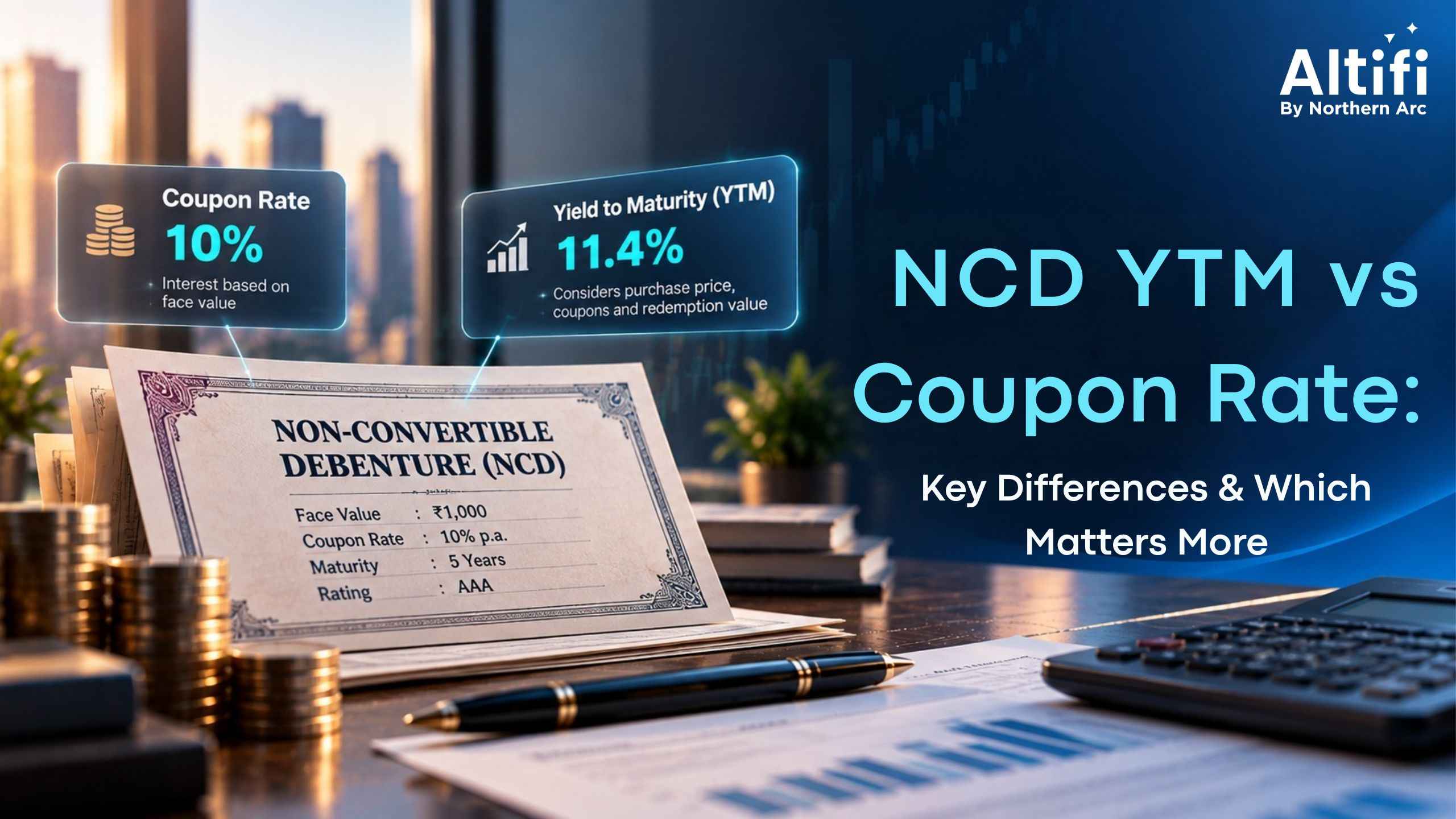
When comparing Non-Convertible Debentures (NCDs), the coupon rate and Yield to Maturity (YTM) provide different information about the investment. The coupon rate shows the interest payment linked to the face value, while YTM considers the purchase price, coupon payments and redemption value.
These two figures may therefore differ for the same NCD. Understanding the difference becomes important when comparing NCDs available at different prices or in the secondary market. Other factors, including maturity, credit rating, payment frequency, liquidity and taxation, also affect how the stated yield may translate into returns depending on the investor's tax treatment.
What Is the Coupon Rate on an NCD?
The coupon rate is the annual interest rate that an NCD issuer pays on the face value of the security.
For example, consider an NCD with a face value of ₹1,000 and a coupon rate of 9% per year. The annual coupon payment would be ₹90, subject to the payment terms of the issue.
The coupon rate is generally stated when the NCD is issued. It helps investors understand the periodic interest payment attached to the security.
However, the coupon rate alone does not show the yield based on the price at which an NCD is purchased. An NCD trading above or below its face value may have a YTM that differs from its coupon rate.
The payment frequency also matters. An NCD may pay interest monthly, quarterly, annually as specified in its terms.
Understanding NCD Yield to Maturity (YTM)
Yield to Maturity (YTM) is the annualised rate of return implied by an NCD's current market price, future coupon payments and redemption value, assuming the security is held until maturity and the stated cash flows occur as scheduled.
In simple terms, YTM looks at the complete stream of expected cash flows rather than only the coupon payment.
For example, suppose an NCD has a face value of ₹1,000, a coupon rate of 9% and a market price of ₹950. The investor pays ₹950 but receives coupon payments based on the ₹1,000 face value. If the NCD is redeemed at ₹1,000 at maturity, the investor earns a ₹50 gain on the initial purchase price. YTM reflects this gain along with the coupon income and considers the timing of these cash flows until maturity.
As a result, the YTM may be higher than the coupon rate when an NCD is purchased below its face value.
The opposite may occur when an NCD is purchased above face value. YTM becomes lower than the coupon because the investor pays a premium above redemption value.
YTM therefore provides a broader measure of the return implied by the NCD's price and cash flows. It is generally expressed as an annual percentage.
Coupon Rate vs YTM: The Core Difference Explained
The following table highlights the main differences between the two metrics.
| Factor | Coupon Rate | Yield to Maturity (YTM) |
|---|---|---|
| Meaning | Interest rate paid on the face value of an NCD | Annualised yield based on purchase price and expected cash flows until maturity |
| Based on | Face value | Current purchase price, coupon payments and redemption value |
| Considers purchase price? | No | Yes |
| Considers redemption value? | No | Yes |
| Changes with market price? | Generally no | Yes |
| Useful for understanding | Periodic coupon income | Overall yield implied by holding the NCD to maturity |
| Example | 9% coupon on ₹1,000 face value gives ₹90 annual coupon | YTM varies depending on the price paid and cash flows |
Consider an NCD with a face value of ₹1,000 and a 9% coupon rate.
If it is purchased for ₹950 and redeemed at ₹1,000, the investor receives ₹90 as annual coupon income and may also receive ₹50 as the difference between purchase price and redemption value at maturity. This difference affects the YTM.
If the same NCD is purchased for ₹1,050, the investor still receives the ₹90 annual coupon based on the face value. However, the ₹50 premium paid above the redemption value affects the YTM.
This is why coupon rate and YTM may not be the same.
YTM, Current Yield, and Coupon Rate: A Three-Metric Framework for NCD Investors
These three measures look at different aspects of an NCD. The following table summarises their roles.
| Metric | What It Measures | Main Calculation Basis | What It Does Not Capture |
|---|---|---|---|
| Coupon Rate | Interest rate attached to the NCD | Annual coupon ÷ face value | Purchase price and redemption difference |
| Current Yield | Annual coupon income relative to current price | Annual coupon payment ÷ current market price | Redemption value and time value of money |
| YTM | Yield based on expected cash flows until maturity | Coupon payments, purchase price, redemption value and time | Changes after purchase if market conditions or cash flows change |
Coupon Rate
Coupon rate is linked to the face value. If an NCD has a ₹1,000 face value and a 9% coupon, its annual coupon is ₹90.
It remains useful for understanding the scheduled coupon payment, but it does not reflect the price paid by the investor.
Current Yield
Current yield compares the annual coupon payment with the current market price.
For example, if an NCD pays ₹90 annually and trades at ₹950, its current yield is approximately 9.47% (₹90 ÷ ₹950 × 100 = 9.47%)
Current Yield = Annual Coupon Payment ÷ Current Market Price × 100
Current yield therefore reflects the price paid for the NCD, but it does not account for the difference between the purchase price and the amount received at maturity.
YTM
YTM goes a step further by considering the coupon payments, purchase price, redemption value and remaining maturity.
For an NCD purchased below face value, the gain arising from redemption at face value may increase YTM. For an NCD purchased above face value, the difference may reduce YTM.
Therefore, when two NCDs have different market prices, comparing only their coupon rates may not provide a complete picture of their respective yields.
How to Read NCD Yield Before You Invest: A Practical Step-by-Step Guide
The following steps provide a simple framework for reading the yield information associated with an NCD.
Step 1: Check the Coupon Rate
Start by checking the coupon rate and payment frequency.
For example, a 10% coupon on a ₹1,000 face value means ₹100 of annual coupon payment, subject to the terms of the NCD.
Step 2: Check the Purchase Price
Next, look at the price at which the NCD is being purchased.
An NCD trading at ₹950 (discount bond), ₹1,000 (par bond) and ₹1,050 (premium bond) may have the same coupon rate but different yields because the purchase prices differ.
Step 3: Check the YTM
YTM brings the purchase price, coupon payments and redemption value into one annualised measure, assuming the NCD is held until maturity and the stated cash flows occur as scheduled.
For comparing NCDs with similar characteristics, YTM combines coupon income and price appreciation/depreciation into one annualised metric.
Step 4: Check the Remaining Maturity
The time remaining until redemption matters because YTM depends on when future coupon payments and the principal amount are received.
Two NCDs with the same coupon and purchase price may have different YTMs if their remaining maturities or cash-flow schedules differ.
Step 5: Check the Credit Rating
Yield is only one part of an NCD's information. The credit rating indicates the rating agency's assessment of the issuer's creditworthiness under its rating framework.
Investors may also review the issuer, security structure, seniority, repayment terms and other details provided in the issue documents.
Step 6: Check Liquidity and Market Price
An NCD available in the secondary market may trade at a price different from its face value.
The quoted YTM may also change as the market price changes. Liquidity is another factor because the ability to sell an NCD before maturity depends on the availability of buyers and prevailing market conditions.
Step 7: Consider the Post-Tax Yield
The stated YTM is generally a pre-tax figure. The amount retained after applicable taxes may therefore differ.
Tax treatment depends on factors such as the nature of the income, holding period, applicable provisions and the investor's tax circumstances.
Post-Tax YTM on NCDs: Why Your Actual Return May Differ From the Stated Yield
The YTM displayed for an NCD is generally calculated before considering the investor's tax liability. Interest income from NCDs may therefore result in a different post-tax outcome.
The applicable tax treatment depends on the investor's circumstances and the prevailing tax provisions. The Income Tax Department provides different tax regimes and slab structures for individual taxpayers, and tax treatment may vary depending on the nature of the income.
A simplified illustration is given below.
| Particular | Illustration |
|---|---|
| NCD purchase price | ₹950 |
| Face value | ₹1,000 |
| Coupon rate | 9% |
| Annual coupon payment | ₹90 |
| Redemption value | ₹1,000 |
| Stated YTM | Depends on cash-flow timing and maturity |
| Post-tax yield | Depends on applicable tax treatment |
For example, an investor receiving ₹90 as annual coupon income does not necessarily retain the entire ₹90 after tax. The applicable tax liability depends on the investor's tax position.
Tax deducted at source (TDS) may also apply to certain interest payments. The applicable provisions depend on the type of security and prevailing tax rules. Therefore, the stated YTM and the post-tax amount received may differ.
A tax calculation should also account for the purchase price, coupon schedule, redemption amount and applicable taxes rather than relying on the coupon rate alone.
Conclusion
Coupon rate and YTM serve different purposes when evaluating an NCD. The coupon rate shows the interest payment linked to the face value, while YTM incorporates the purchase price, coupon payments and redemption value over the remaining maturity.
Current yield provides another reference by comparing the annual coupon with the current market price. Looking at these measures together provides a clearer view of an NCD's stated cash flows and price-related yield. Taxation, credit rating, maturity, liquidity and issue terms also form part of the overall assessment. The relevant metric therefore depends on the specific information being compared and the NCD's terms.
FAQs on NCD YTM and Coupon Rate
Why is YTM higher than coupon rate for some NCDs?
YTM may exceed the coupon rate when an NCD is purchased below its face value and redeemed at a higher amount at maturity.
Can coupon rate and YTM be equal?
Yes. Coupon rate and YTM may be equal when the NCD is purchased at face value and other relevant cash-flow conditions align.
Which metric should NCD investors compare YTM or coupon rate?
YTM provides a broader yield measure, while coupon rate shows scheduled interest on face value. Both provide different information for comparison.
Is the coupon rate fixed throughout the NCD tenure?
For a fixed-rate NCD, the coupon rate generally remains unchanged, subject to the terms stated in the issue documents.
Disclaimer:
The information contained in this newsletter (“Newsletter”) is for general informational purposes only. Northern Arc Capital Limited (“Northern Arc”) does not make any warranties about the completeness, reliability, and accuracy of this information. Any action you take upon the information contained in this Newsletter is strictly at your own risk, and Northern Arc will not be liable for any losses and damages in connection with the use of our Newsletter.
The data included in this Newsletter has been obtained from sources that are believed to be reliable and accurate at the time of publication. However, Northern Arc does not guarantee the accuracy or completeness of any information, nor does it assume any responsibility or liability for any errors or omissions therein. Any opinions expressed herein are subject to change without notice and Northern Arc is under no obligation to update or keep current the information contained in this Newsletter.
This Newsletter is not intended to constitute, and should not be construed as, investment advice or a recommendation to purchase, sell, or hold any security or to engage in any investment strategy or transaction. Readers should not rely solely on the information provided in this Newsletter for making investment decisions and should conduct their own due diligence or seek the advice of a qualified professional.
The content of this Newsletter is for informational purposes only and is not a solicitation or an offer to buy or sell any securities or financial instruments. Northern Arc is not responsible for any investment decisions made by the recipients of this Newsletter. Readers should take independent financial advice from a qualified professional in connection with, or independently research and verify, any information that is provided in this Newsletter and wish to rely upon, whether for the purpose of making an investment decision or otherwise.
Northern Arc and its affiliates, directors, employees, and agents expressly disclaim any and all liability for any direct or indirect losses, damages, or expenses of any kind arising out of or relating to the use of this Newsletter, including but not limited to, any losses related to the accuracy, completeness, timeliness, or reliability of such information.
This Newsletter may contain forward-looking statements that are based on current expectations, estimates, forecasts, and projections about the markets in which Northern Arc operates, as well as management’s beliefs and assumptions. Forward-looking statements are not guarantees of future performance and involve certain risks and uncertainties, which are difficult to predict. Past performance is not indicative of future results.
This report is intended solely for the recipient and is not for further circulation. Any distribution, modification, reproduction, or disclosure of the contents of this Newsletter, in whole or in part, without the prior written consent of Northern Arc, is strictly prohibited.