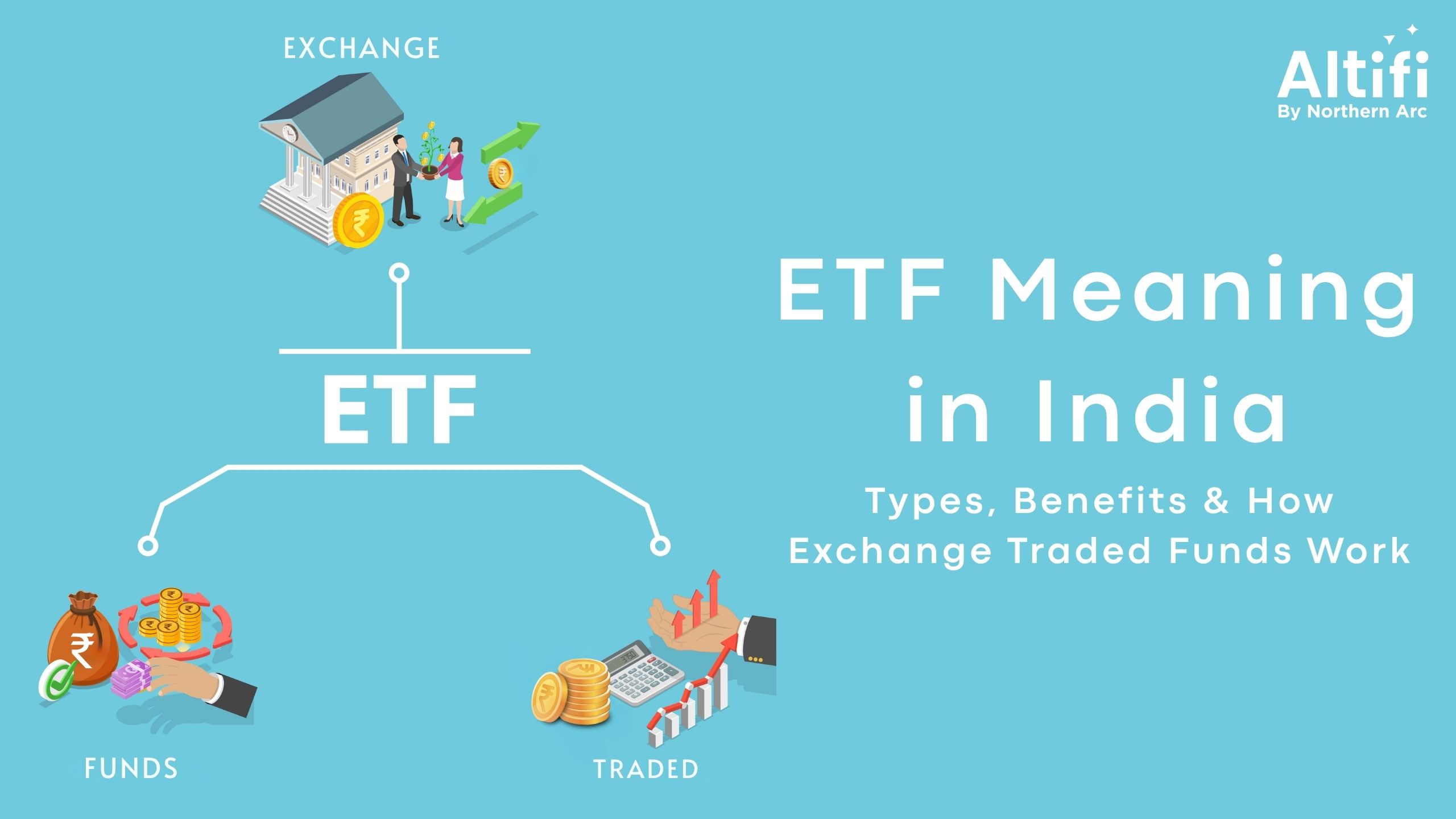
Exchange Traded Funds (ETFs) have become one of the fastest-growing investment categories in India. These investment products combine features of mutual funds and stocks, allowing investors to gain exposure to a basket of securities through a single investment. The growing popularity of ETFs is reflected in industry data. According to reports, the total assets under management (AUM) of ETFs in India crossed ₹10 lakh crore, highlighting increased investor participation and adoption of passive investing strategies.
Understanding how ETFs work, their different types, benefits, risks, and suitability may help investors evaluate their role within an investment portfolio.
What is an ETF?
An Exchange Traded Fund (ETF) is an investment fund that holds a collection of assets such as stocks, bonds, gold, or other securities. ETFs are listed on stock exchanges and are bought and sold during market hours, similar to shares.
Most ETFs aim to track the performance of a specific index, sector, commodity, or asset class. For example, an ETF tracking the Nifty 50 Index invests in securities that represent the index.
Since ETFs trade on exchanges, their market price fluctuates throughout the trading day based on demand and supply.
How Do ETFs Work?
ETFs pool funds from multiple investors and invest those funds in a predefined basket of securities. The portfolio composition depends on the ETF's investment objective and benchmark.
For example, an index ETF tracking the Nifty 50 generally invests in the stocks that form part of the Nifty 50 Index. Similarly, a gold ETF invests in gold-related assets.
Units of ETFs are listed and traded on stock exchanges. Investors purchase and sell ETF units through a Demat and trading account.
The popularity of ETFs has also contributed to higher trading activity. Industry reports indicate that ETF trading volumes increased significantly over recent years, reflecting broader participation across investor segments.
Types of ETFs in India
Here are some of the common types of ETFs available in India.
Equity ETFs
Equity ETFs invest in shares of listed companies and generally track a market index, sector, theme, or investment strategy.
Examples include:
- Nifty 50 ETFs
- Sensex ETFs
- Banking ETFs
- Sector-specific ETFs
These ETFs provide exposure to equity markets through a diversified basket of stocks.
Bond ETFs
Bond ETFs invest in fixed-income securities such as government bonds, treasury bills, or corporate debt instruments.
Examples include:
- Government bond ETFs
- Bharat Bond ETFs
- Debt-focused ETFs
Bond ETFs are commonly used for fixed-income exposure within an investment portfolio.
Gold and Commodity ETFs
Gold and commodity ETFs provide exposure to commodities without requiring physical ownership.
Gold ETFs are among the most widely known commodity-based ETFs in India. These funds generally track the price movements of gold and are traded through stock exchanges.
Commodity ETFs may also provide exposure to other commodity-related assets depending on the fund structure.
International ETFs
International ETFs invest in overseas markets and global securities.
These ETFs provide exposure to international indices, regions, sectors, or companies outside India.
For instance, ETFs may track:
- US stock market indices
- Global technology companies
- International equity markets
International ETFs help investors access global market opportunities through domestic exchanges.
Benefits of Investing in ETFs
- Diversification
ETFs hold multiple securities within a single fund, giving investors exposure to a broad basket of assets through one investment. This helps spread risk across different stocks or bonds.
- Liquidity
ETF units are traded on stock exchanges throughout market hours, allowing investors to buy or sell based on real-time prices. Growing market participation has also improved overall ETF liquidity over time.
- Cost efficiency
Most ETFs follow a passive strategy by tracking an index, which generally keeps management costs lower compared to actively managed funds. Investors typically consider the expense ratio when selecting an ETF.
Risks of ETFs
Here are some risks of ETFs.
Market risk
ETF values move in line with the performance of their underlying assets. If the market or sector declines, the ETF value may also fall.
Tracking error
This is the difference between an ETF’s returns and its benchmark index. Factors like fees, cash holdings, and rebalancing can contribute to this gap.
Liquidity risk
Some ETFs may have lower trading volumes, leading to wider bid-ask spreads and less efficient trades. Reviewing liquidity is important before investing.
How to Choose the Right ETF
Below are some important factors to evaluate before selecting an ETF.
Compare Expense Ratios
The expense ratio represents the annual cost of managing the ETF. A lower expense ratio generally results in lower investment costs over time.
Investors should compare expense ratios among similar ETFs before making a decision.
Track Performance
Tracking error measures how closely an ETF follows its benchmark. Consistent tracking performance is an important consideration when evaluating index-based ETFs.
Reviewing historical tracking data helps investors understand benchmark alignment.
Determine Investment Objective
Every ETF is designed with a specific investment objective. Some ETFs focus on equities, while others provide exposure to bonds, commodities, or international markets.
Understanding the underlying assets and benchmark helps ensure alignment with investment goals.
Who Should Invest in ETFs?
ETFs may suit different types of investors based on goals, risk appetite, and time horizon. Here’s a quick look at who typically benefits from them:
- Beginners looking for simple market exposure
ETFs may offer an easy way to invest in a diversified basket of stocks without picking individual companies. Broad index ETFs (like Nifty 50-linked funds) help new investors start with a single investment.
- Busy professionals who prefer a hands-off approach
Since most ETFs track an index; they don’t need constant monitoring. This makes them a practical option for people with limited time.
- Cost-conscious investors
ETFs usually have lower expense ratios compared to actively managed funds, helping investors keep costs under control while staying invested in the market.
- Long-term investors building wealth
For goals like retirement or long-term savings, ETFs provide steady market exposure with built-in diversification over time.
- Active traders looking for flexibility
ETFs trade on exchanges like stocks, allowing investors to enter and exit during market hours and take short-term positions if needed.
- Fixed deposit investors exploring diversification
Investors used to traditional savings products can use ETFs, especially bond ETFs to add market exposure while still maintaining a balanced portfolio.
ETF vs Mutual Funds
The table below highlights some key differences between ETFs and mutual funds.
| Feature | ETFs | Mutual Funds |
|---|---|---|
| Trading | Traded on stock exchanges | Purchased and redeemed through fund houses |
| Pricing | Market price changes during trading hours | NAV-based pricing |
| Demat Account | Generally required | Not always required |
| Liquidity | Exchange-based transactions | Fund-based redemption process |
| Management Style | Often passive | Active and passive options available |
| Expense Ratio | Often lower for passive ETFs | Varies by fund category |
Conclusion
ETFs have emerged as an important segment of India's investment landscape, offering exposure to various asset classes through a single investment product. Whether focused on equities, bonds, gold, commodities, or international markets, ETFs provide a structured way to participate in different market segments. Their exchange-traded nature, diversified holdings, and passive investment approach have contributed to growing investor interest.
FAQs on ETFs
What is an ETF?
An ETF, or Exchange Traded Fund, is an investment fund that holds a basket of securities and trades on stock exchanges similar to shares.
Are ETFs safe to invest in?
ETFs are market-linked investment products and are subject to risks associated with the underlying assets they hold. The level of risk depends on the ETF's investment objective and asset class.
What is the difference between ETFs and mutual funds?
ETFs trade on stock exchanges throughout the day, while mutual fund transactions are generally executed based on the fund's Net Asset Value (NAV).
Can beginners invest in ETFs?
Beginners may consider ETFs due to their diversified structure and exposure to a broad basket of securities through a single investment.
How can I invest in ETFs in India?
Investors generally purchase ETF units through a demat account and trading account using a registered stock exchange platform.
Disclaimer:
The information contained in this Article (“Article”) is for general informational purposes only. Northern Arc Capital Limited (“Northern Arc”) does not make any warranties about the completeness, reliability, and accuracy of this information. Any action you take upon the information contained in this Article is strictly at your own risk, and Northern Arc will not be liable for any losses and damages in connection with the use of our Article.
The data included in this Article has been obtained from sources that are believed to be reliable and accurate at the time of publication. However, Northern Arc does not guarantee the accuracy or completeness of any information, nor does it assume any responsibility or liability for any errors or omissions therein. Any opinions expressed herein are subject to change without notice and Northern Arc is under no obligation to update or keep current the information contained in this Article.
This Article is not intended to constitute, and should not be construed as, investment advice or a recommendation to purchase, sell, or hold any security or to engage in any investment strategy or transaction. Readers should not rely solely on the information provided in this Article for making investment decisions and should conduct their own due diligence or seek the advice of a qualified professional.
The content of this Article is for informational purposes only and is not a solicitation or an offer to buy or sell any securities or financial instruments. Northern Arc is not responsible for any investment decisions made by the recipients of this Article. Readers should take independent financial advice from a qualified professional in connection with, or independently research and verify, any information that is provided in this Article and wish to rely upon, whether for the purpose of making an investment decision or otherwise.
Northern Arc and its affiliates, directors, employees, and agents expressly disclaim any and all liability for any direct or indirect losses, damages, or expenses of any kind arising out of or relating to the use of this Article, including but not limited to, any losses related to the accuracy, completeness, timeliness, or reliability of such information.
This Article may contain forward-looking statements that are based on current expectations, estimates, forecasts, and projections about the markets in which Northern Arc operates, as well as management’s beliefs and assumptions. Forward-looking statements are not guarantees of future performance and involve certain risks and uncertainties, which are difficult to predict. Past performance is not indicative of future results.
This report is intended solely for the recipient and is not for further circulation. Any distribution, modification, reproduction, or disclosure of the contents of this Article, in whole or in part, without the prior written consent of Northern Arc, is strictly prohibited.