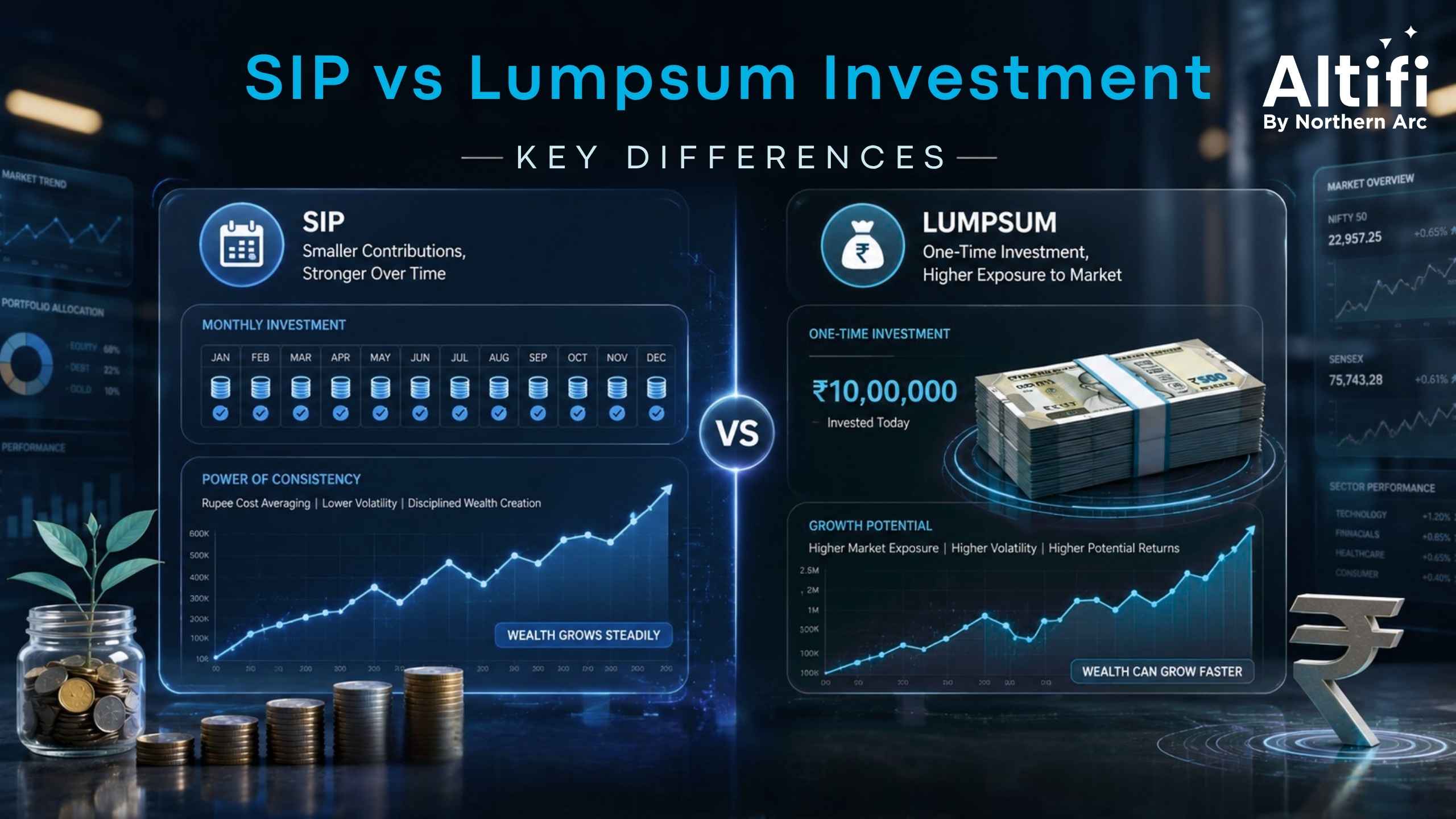
Investors can use different methods to invest in mutual funds based on their available funds and investment plans A SIP involves investing a fixed amount at regular intervals, while a lumpsum involves investing an amount at one time. The difference between these methods relates to investment timing, cash flow, market exposure, and the period over which funds are invested. Understanding these aspects may help investors compare both methods and understand how market conditions can affect their investments.
What are SIP and Lumpsum Investments?
SIP and lumpsum refer to two different ways of investing in a mutual fund schemes.
Systematic Investment Plan (SIP) allows an investor to invest a fixed amount at regular intervals, usually every month. For example, an investor may invest ₹5,000 on a selected date every month. Each instalment buys mutual fund units at the applicable Net Asset Value (NAV) on that date.
A lumpsum investment involves investing a substantial amount in a mutual fund at one time. For example, an investor with ₹1 lakh available for investment may invest the entire amount in a selected scheme in one transaction.
In simple terms, SIP spreads an investment across different dates, while lumpsum puts the investment amount into the market at one time.
How Does SIP Investment Work?
The following steps explain how a SIP investment works:
1. Select a Mutual Fund Scheme:
The investor chooses a scheme after reviewing its investment objective and applicable risks.
2. Decide the SIP Amount:
A fixed amount is selected for regular investment.
3. Choose the Frequency:
The investor selects an available frequency, such as monthly.
4. Select an Investment Date:
An available date is chosen for the regular instalment.
5. Make Regular Instalments:
The selected amount is invested at each scheduled interval.
6. Receive Mutual Fund Units:
Units are allotted based on the applicable NAV for each instalment.
The number of units purchased can differ from one instalment to another because the NAV may change between investment dates.
How Does Lumpsum Investment Work?
The following steps explain how a lumpsum investment works:
1. Select a Mutual Fund Scheme:
The investor identifies a scheme based on its stated objective and risk factors.
2. Decide the Amount:
The investor determines the amount available for a one-time investment.
3. Place the Investment:
The selected amount is invested in the scheme.
4. Receive Units:
Units are allotted according to the applicable NAV.
5. Track the Investment:
The value of the investment changes with the NAV of the scheme.
Unlike SIP, the entire investment amount enters the market at one time. Therefore, the NAV on the investment date becomes relevant for the units purchased.
Key Difference Between SIP and Lumpsum
The following table highlights the key differences between the two investment methods.
Basis | SIP | Lumpsum |
Investment pattern | Regular instalments | One-time investment |
Amount invested | Fixed amount at selected intervals | Larger amount at one time |
Market entry | Spread across different dates | Concentrated on one date |
Cash flow requirement | Regular investable surplus | Amount available upfront |
NAV exposure | Different NAVs across instalments | NAV applicable on investment date |
Investment process | Repeated investments | Single investment transaction |
Market exposure | Builds gradually | Begins with the full amount invested |
SIP vs Lumpsum: Returns and Performance
The performance of SIP and lumpsum investments can differ because the funds enter the market at different times. The outcome also depends on the mutual fund scheme, investment period, market movements, expenses, and applicable taxes.
For SIP investments, each instalment may receive units at a different NAV. For a lumpsum investment, the entire amount is invested at the NAV applicable on the transaction date.
Therefore, the SIP vs lumpsum returns comparison cannot be based only on the investment method.
How Market Conditions Affect SIP vs Lumpsum Returns
Market conditions can affect SIP and lumpsum investments differently because their investment timings are different.
Bull Market (Rising Market)
- SIP: Investments are spread across different dates, so later instalments may be made at higher NAVs as the market rises.
- Lumpsum: The entire amount is invested at one time, so the investment may benefit from a rise that follows the investment date.
Bear Market (Falling Market)
- SIP: Later instalments may purchase more units if NAVs decline, although earlier instalments may experience a fall in value.
- Lumpsum: The entire amount is exposed to the market decline from the investment date, which may reduce its value.
Volatile Market (Fluctuating)
- SIP: Regular investments take place at different NAVs as the market moves up and down.
- Lumpsum: The entire amount is invested at one NAV, making the investment timing more relevant to subsequent market movements.
Pros and Cons of SIP and Lumpsum
The following are some key advantages and limitations of SIP and lumpsum investments.
Pros of SIP and Lumpsum
SIP | Lumpsum |
Regular investments can support a structured investment approach. | A larger available amount can be invested in one transaction. |
Investments are spread across different market levels. | The entire amount gets market exposure from the investment date. |
A smaller amount can be invested at regular intervals. | No need to make regular instalments after the initial investment. |
May suit investors with a regular source of investable funds. | May be used when a substantial amount is already available. |
Cons of SIP and Lumpsum
SIP | Lumpsum |
Requires regular availability of funds for instalments. | The entire amount is exposed to market movements from the investment date. |
Later instalments may be made at higher NAVs during rising markets. | Investment timing may have a greater impact on the initial investment value. |
The investment may take longer to become fully deployed. | Requires a larger amount to be available at the time of investment. |
SIP vs Lumpsum: Example Calculation
Consider an investor with ₹1,20,000 available for investment.
Under a SIP approach, the investor may invest ₹10,000 every month for 12 months. Under a lumpsum approach, the entire ₹1,20,000 may be invested at one time.
Assume the following simplified NAVs for illustration:
Particular | SIP | Lumpsum |
Total investment | ₹1,20,000 | ₹1,20,000 |
Investment period | 12 months | 12 months |
Investment pattern | ₹10,000 monthly | ₹1,20,000 once |
NAV exposure | Different NAVs | One initial NAV |
If the NAV changes during the 12-month period, each SIP instalment may purchase a different number of units. The lumpsum investment purchases units based on the NAV applicable on the investment date.
This example shows why investment timing can affect the number of units accumulated and the resulting investment value.
When Should You Choose SIP or Lumpsum?
The choice between SIP and lumpsum depends on factors such as the availability of funds, cash flow pattern, investment timing, and investment objective.
Situation | SIP May Be Considered | Lumpsum May Be Considered |
Regular cash flow | A fixed amount is available regularly | A substantial amount is already available |
Investment amount | Investment is planned through smaller instalments | Investment is planned through a one-time amount |
Market exposure | Investment is spread across different dates | Entire amount is invested on one date |
Investment approach | Regular investing is preferred | One-time deployment is preferred |
Available funds | Funds become available periodically | Funds are available upfront |
The table provides a general comparison. The appropriate method may vary based on individual financial circumstances, investment objectives, and risk tolerance.
Things to Consider Before Choosing SIP or Lumpsum
The following factors may be considered before selecting an investment method:
- Available Funds: Consider whether the amount is available regularly or at one time.
- Cash Flow: Review the amount that can be allocated towards investments periodically.
- Market Conditions: Market movements can affect the two investment methods differently.
- Investment Period: Consider the period for which the investment may remain invested.
- Risk Tolerance: Mutual funds are subject to market risks.
- Scheme Characteristics: Review the scheme's objective, asset allocation, costs, and risk factors.
- Taxation: Tax treatment depends on the mutual fund category, holding period, and applicable tax provisions.
Conclusion
SIP and lumpsum are two methods of investing in mutual funds, with different investment timings and cash-flow requirements. SIP spreads investments across multiple dates, while lumpsum deploys the available amount at one time. Market conditions can affect both methods differently because the funds enter the market at different points. The investment method alone does not determine the outcome. Scheme features, investment period, available funds, market conditions, costs, taxation, and applicable risks are also relevant when comparing the two approaches.
FAQs on SIP vs Lumpsum
Can you invest through both SIP and Lumpsum?
Yes, an investor can use both methods, subject to the mutual fund scheme's applicable terms and available funds.
Which has higher returns, SIP or Lumpsum?
Neither method has a fixed return advantage. Outcomes may differ based on market movements, investment timing, scheme performance, costs, and taxes.
Can I invest in both SIP and lumpsum simultaneously?
Yes, both methods may be used simultaneously, including within the same mutual fund scheme where the applicable terms permit.
What is the minimum amount to start a SIP?
The minimum SIP amount varies across schemes. Some mutual funds may allow SIP investments starting from ₹100 to ₹500, subject to applicable terms.
What are the tax implications of SIP vs lumpsum?
Tax treatment may depend on the mutual fund category, holding period, capital gains, and applicable income tax provisions.
Is lumpsum investment risky?
Lumpsum investments remain subject to market risk, and the full invested amount is exposed to market movements from the investment date.
Disclaimer:
The information contained in this Article (“Article”) is for general informational purposes only. Northern Arc Capital Limited (“Northern Arc”) does not make any warranties about the completeness, reliability, and accuracy of this information. Any action you take upon the information contained in this Article is strictly at your own risk, and Northern Arc will not be liable for any losses and damages in connection with the use of our Article.
The data included in this Article has been obtained from sources that are believed to be reliable and accurate at the time of publication. However, Northern Arc does not guarantee the accuracy or completeness of any information, nor does it assume any responsibility or liability for any errors or omissions therein. Any opinions expressed herein are subject to change without notice and Northern Arc is under no obligation to update or keep current the information contained in this Article.
This Article is not intended to constitute, and should not be construed as, investment advice or a recommendation to purchase, sell, or hold any security or to engage in any investment strategy or transaction. Readers should not rely solely on the information provided in this Article for making investment decisions and should conduct their own due diligence or seek the advice of a qualified professional.
The content of this Article is for informational purposes only and is not a solicitation or an offer to buy or sell any securities or financial instruments. Northern Arc is not responsible for any investment decisions made by the recipients of this Article. Readers should take independent financial advice from a qualified professional in connection with, or independently research and verify, any information that is provided in this Article and wish to rely upon, whether for the purpose of making an investment decision or otherwise.
Northern Arc and its affiliates, directors, employees, and agents expressly disclaim any and all liability for any direct or indirect losses, damages, or expenses of any kind arising out of or relating to the use of this Article, including but not limited to, any losses related to the accuracy, completeness, timeliness, or reliability of such information.
This Article may contain forward-looking statements that are based on current expectations, estimates, forecasts, and projections about the markets in which Northern Arc operates, as well as management’s beliefs and assumptions. Forward-looking statements are not guarantees of future performance and involve certain risks and uncertainties, which are difficult to predict. Past performance is not indicative of future results.
This report is intended solely for the recipient and is not for further circulation. Any distribution, modification, reproduction, or disclosure of the contents of this Article, in whole or in part, without the prior written consent of Northern Arc, is strictly prohibited.