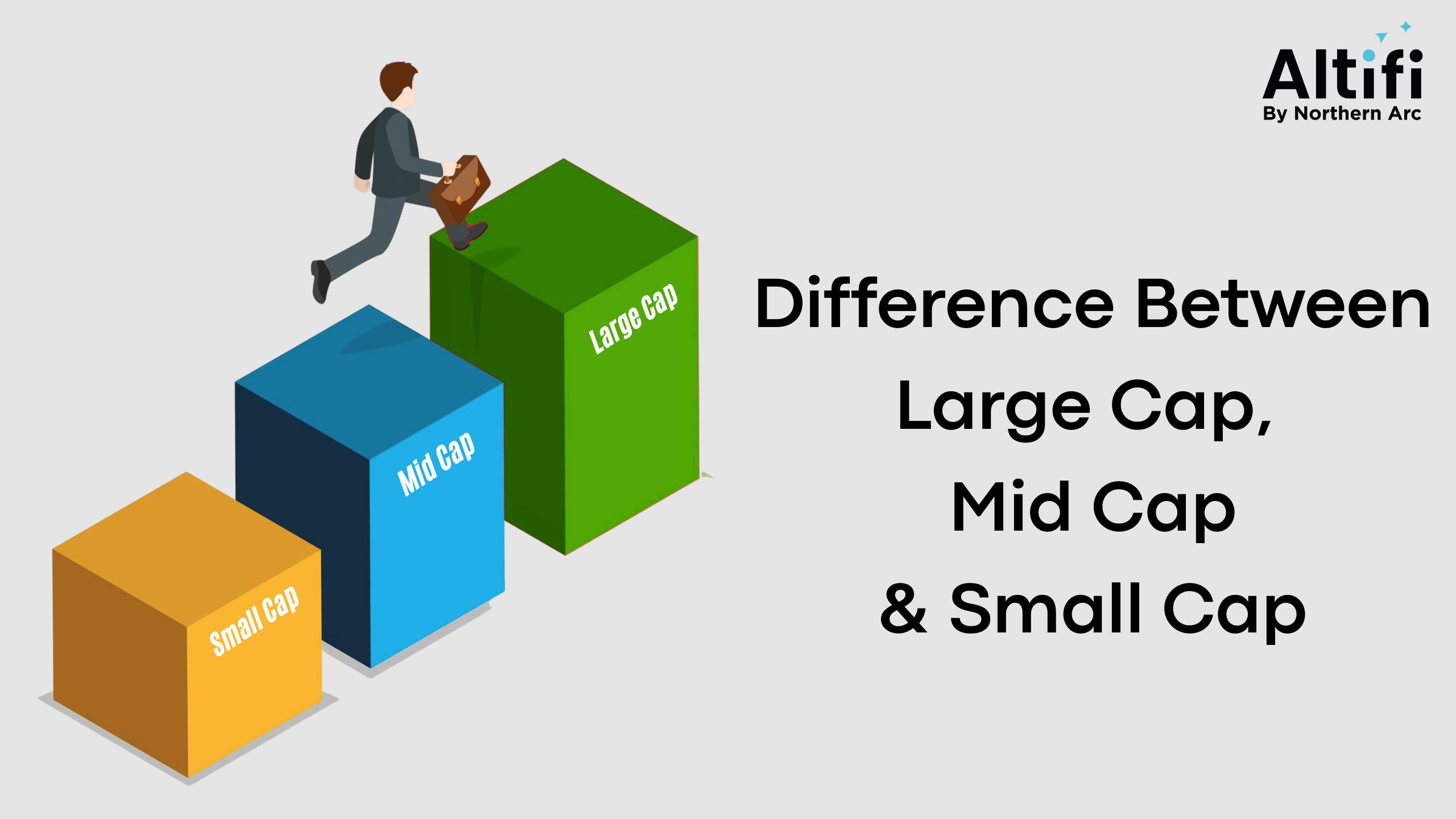
Market capitalisation is the total valuation of a company in terms of its number of shares traded on a stock exchange. Companies can be divided into large, mid and small cap based on their market capitalisation. This distinction is very important because each type of stock performs differently and can impact how the investment behaves, its risks, stability, etc. Most individuals who start investing learn about these financial instruments quite early on in their investing journey, but the difference between small cap mid cap and large cap is not clearly understood.
What is Market Capitalisation?
The market capitalisation, commonly referred to as the ‘market cap,’ is calculated by multiplying a stock’s price by the number of stocks available in the market. To comprehend the significance of the categorisation, one should recognise the fact that the bigger firms are generally considered safer compared to smaller ones, although the smaller ones can also grow significantly.
In India, companies are broadly grouped into three categories:
- Large cap
- Mid cap
- Small cap
This classification is defined by regulatory frameworks and updated twice a year to reflect market changes.
What are Large Cap Companies?
Large cap companies refer to the largest 100 companies listed on Indian stock exchanges in terms of market capitalisation.
These are usually well-established businesses with a long operating history. Many times, they are industry leaders with strong brand presence and relatively stable earnings.
Key Characteristics
- An established business with a successful track record
- Comparatively low levels of volatility
- Provide regular dividends in many cases
- Slow but stable growth
Example
Companies from the banking, IT, and FMCG sectors belong to large cap. In practice, large caps are often considered suitable for investors who prefer stability and relatively predictable returns over long periods.
What are Mid Cap Companies?
Mid cap companies are ranked between 101 and 250 based on market capitalisation. They represent companies in a growth phase. These firms usually offer moderate growth but can lack some stability in comparison to large cap.
Key Characteristics
- Moderate risk and return profile
- Higher growth potential than large caps
- Less stability compared to large caps
- Increasing market presence
Example
Firms that have developed their business models but continue to expand their operations would qualify as mid cap. Worth noting, mid-caps can sometimes transition into large caps over time if they continue to grow steadily.
What are Small Cap Companies?
Small cap companies are ranked 251 and beyond based on their market capitalisation. In essence, they are relatively young or niche businesses. The companies may still be new to the market or operate in a particular niche market.
Key Characteristics
- High growth potential
- Higher volatility and risk
- Limited track record in many cases
- Sensitive to market conditions
Example
Start-ups or smaller regional businesses that are expanding operations often fall into this category. In simple terms, small caps may offer significant upside, but the price movements can be sharp. This is where careful selection becomes important.
Small Cap vs Mid Cap vs Large Cap: Key Differences
Here are some clear comparisons to understand how they differ:
| Basis | Large Cap | Mid Cap | Small Cap |
|---|---|---|---|
| Market Rank | Top 100 | 101–250 | 251 and beyond |
| Risk Level | Lower | Moderate | Higher |
| Growth Potential | Steady | Moderate to high | High |
| Stability | High | Medium | Low |
| Volatility | Lower | Moderate | Higher |
| Investment Horizon | Suitable for long-term stability | Suitable for balanced growth | Suitable for long-term high growth |
How to Choose Between Large, Mid and Small Cap?
There isn’t a single suitable choice. It usually depends on what the investor is aiming for.
Based on Risk Appetite
- Conservative investors often lean towards large caps
- Moderate risk-takers may consider mid caps
- Aggressive investors may explore small caps
Based on Portfolio Balance
In practice, many portfolios include a mix of all three. This helps spread risk while still capturing growth opportunities.
Why this Classification Matters
This classification is not just theoretical. It influences how mutual funds are structured, how portfolios are diversified, and how risk is managed.
For instance:
- Large cap funds focus on stability
- Mid cap funds aim for growth
- Small cap funds look for high potential opportunities
Understanding the difference between small cap, mid cap, and large cap helps investors align their choices with their financial goals more effectively.
Conclusion
The distinction between large cap, mid cap, and small cap companies is based on the company’s size, risk, and growth capacity. Each of these categories has its own place in the investment portfolio. Large cap investments are known for being stable and consistent, while mid cap companies lie somewhere in-between growth and stability. Small cap companies, on the other hand, provide high potential at the cost of added risk. In many cases, balancing between these three categories is key to a sound investment strategy.
FAQs on Large Cap, Mid Cap and Small Cap
What is the main difference between small cap, mid cap, and large cap?
The main difference lies in market capitalisation, which reflects company size. This affects risk levels, growth potential, and price stability.
Are small cap stocks always risky?
They generally carry a higher risk due to volatility and limited track record, but not all small cap companies perform poorly. Some grow significantly over time.
Can a mid cap company become a large cap?
Yes, if a mid cap company grows consistently and its market value increases, it can move into the large cap category.
Which is better: small cap vs mid cap vs large cap?
There is no universal answer. Each category serves a different purpose depending on risk tolerance, goals, and investment horizon.
Is it good to invest in all three categories?
In many cases, a diversified approach that includes large, mid, and small caps helps balance risk and return.
How are these categories defined in India?
Companies are classified based on their market capitalisation rankings, typically updated by regulatory authorities and stock exchanges.
Disclaimer:
The information contained in this Article (“Article”) is for general informational purposes only. Northern Arc Capital Limited (“Northern Arc”) does not make any warranties about the completeness, reliability, and accuracy of this information. Any action you take upon the information contained in this Article is strictly at your own risk, and Northern Arc will not be liable for any losses and damages in connection with the use of our Article.
The data included in this Article has been obtained from sources that are believed to be reliable and accurate at the time of publication. However, Northern Arc does not guarantee the accuracy or completeness of any information, nor does it assume any responsibility or liability for any errors or omissions therein. Any opinions expressed herein are subject to change without notice and Northern Arc is under no obligation to update or keep current the information contained in this Article.
This Article is not intended to constitute, and should not be construed as, investment advice or a recommendation to purchase, sell, or hold any security or to engage in any investment strategy or transaction. Readers should not rely solely on the information provided in this Article for making investment decisions and should conduct their own due diligence or seek the advice of a qualified professional.
The content of this Article is for informational purposes only and is not a solicitation or an offer to buy or sell any securities or financial instruments. Northern Arc is not responsible for any investment decisions made by the recipients of this Article. Readers should take independent financial advice from a qualified professional in connection with, or independently research and verify, any information that is provided in this Article and wish to rely upon, whether for the purpose of making an investment decision or otherwise.
Northern Arc and its affiliates, directors, employees, and agents expressly disclaim any and all liability for any direct or indirect losses, damages, or expenses of any kind arising out of or relating to the use of this Article, including but not limited to, any losses related to the accuracy, completeness, timeliness, or reliability of such information.
This Article may contain forward-looking statements that are based on current expectations, estimates, forecasts, and projections about the markets in which Northern Arc operates, as well as management’s beliefs and assumptions. Forward-looking statements are not guarantees of future performance and involve certain risks and uncertainties, which are difficult to predict. Past performance is not indicative of future results.
This report is intended solely for the recipient and is not for further circulation. Any distribution, modification, reproduction, or disclosure of the contents of this Article, in whole or in part, without the prior written consent of Northern Arc, is strictly prohibited.