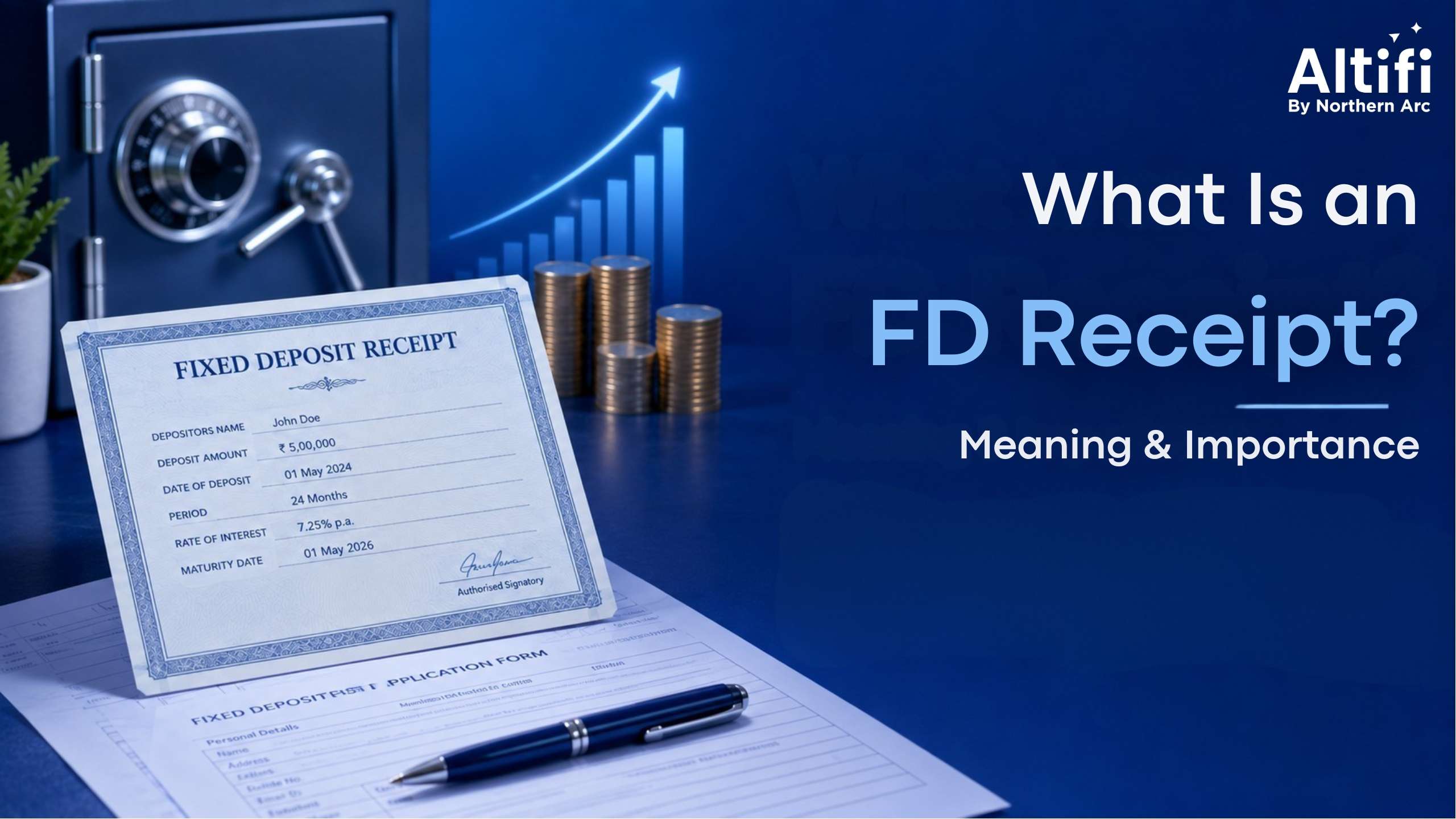
An FD receipt is a document issued by a bank or financial institution after a fixed deposit is opened. It records important details such as the deposit amount, tenure, interest rate, maturity date, and maturity amount. The receipt may be provided in physical or digital form, depending on how the fixed deposit is opened. It can serve as a record of the deposit and may be required for certain banking or financial transactions and processes. Keeping the receipt accessible may also make it easier to verify the deposit details when required.
What is an FD Receipt (FDR)?
A Fixed Deposit Receipt (FDR) is a document that confirms the opening of a fixed deposit. It contains details of the fixed deposit and its applicable terms and conditions.
The receipt is generally issued after the deposit amount is accepted by the bank or financial institution. For an online fixed deposit, the receipt may be available through internet banking, mobile banking, or email.
The FDR should be retained until the fixed deposit matures or is closed.
Why is an FD Receipt Important?
The following are some reasons why an FD receipt may be important:
- Proof of Deposit: It provides a record of the fixed deposit opened with the institution.
- Deposit Details: It contains important information such as the principal amount, interest rate, and maturity date.
- Tax Reference: The receipt may help in checking deposit and interest details for tax-related records.
- Premature Closure: The receipt may be used as a reference while requesting premature closure, subject to the institution's process.
- Loan or Overdraft Facility: Some institutions may accept an FD as security for a loan or overdraft, subject to their terms.
- Record Keeping: It provides a reference for tracking the deposit until maturity or closure.
The receipt does not replace the terms and conditions applicable to the fixed deposit. The institution's records and applicable account terms remain relevant.
What Information Does an FD Receipt Contain?
The following are some details that may appear on an FD receipt:
| Information | Details |
|---|---|
| Deposit Account Number | Unique reference associated with the fixed deposit |
| Principal Amount | Amount initially placed in the fixed deposit |
| Interest Rate | Rate applicable to the deposit |
| Deposit Date | Date on which the fixed deposit was opened |
| Maturity Date | Date on which the selected tenure ends |
| Maturity Amount | Amount payable on maturity according to the applicable terms |
| Tenure | Period for which the deposit is placed |
| Interest Payout | Details of how interest is paid or compounded |
| Nominee Details | Nominee information, where applicable |
| Customer Details | Name and other relevant customer information |
The exact information may vary between banks and financial institutions.
How to Get or Download an FD Receipt Online
The exact steps vary by bank. Some institutions provide an option to download the receipt directly, while others may provide a digital confirmation or deposit advice instead. The following steps may be followed to access an FD receipt online:
- Log in to the bank's internet banking or mobile banking facility.
- Open the section for deposits or fixed deposits.
- Select the relevant fixed deposit from the list.
- Choose the option to view, download, or generate the deposit receipt.
- Save the digital receipt or download it for future reference.
Some institutions may also send the receipt to the registered email address after the deposit is opened.
How to Get an FD Receipt Offline
The following steps may be followed to obtain an FD receipt offline:
- Visit the branch where the fixed deposit was opened or another branch, where permitted.
- Provide the required customer and deposit details.
- Submit an application for the fixed deposit receipt, if required.
- Complete the applicable verification process.
- Collect the physical receipt or other document provided by the institution.
The process may differ between institutions and based on whether the original receipt is available.
Things to Check on Your FD Receipt
The following details may be checked after receiving the FD receipt:
- Customer Name: Check whether the name matches the bank's records.
- Deposit Amount: Verify the principal amount placed in the fixed deposit.
- Interest Rate: Check the applicable interest rate mentioned on the receipt.
- Tenure: Confirm the selected tenure and deposit date.
- Maturity Date: Verify the date on which the fixed deposit matures.
- Maturity Amount: Check the stated maturity amount against the applicable deposit terms.
- Nominee Details: Verify the nominee information, where applicable.
- Deposit Number: Ensure that the fixed deposit reference or account number is correctly recorded.
- Interest Payout Details: Check whether the interest is cumulative or paid at specified intervals.
Any discrepancy should be brought to the attention of the concerned bank or financial institution.
What to do if Your FD Receipt is Lost or Damaged
The following steps can be considered if an FD receipt is lost or damaged:
- Contact the Institution: Inform the bank or financial institution about the missing or damaged receipt.
- Provide Deposit Details: Share the deposit account number, customer details, deposit amount, or other available information.
- Complete Verification: Provide the documents requested for customer and deposit verification.
- Submit an Application: The institution may require a written request or prescribed form for a duplicate receipt.
- Collect the Replacement: The bank may provide a duplicate or replacement receipt, subject to its verification and documentation requirements.
For digital deposits, the receipt can also be available through the institution's online banking facility or registered email.
Conclusion
An FD receipt provides a record of a fixed deposit and contains details that may be useful throughout its tenure. It can show the deposit amount, interest rate, tenure, maturity date, and other applicable information. A receipt may also be useful for record keeping, tax-related documentation, or certain banking processes. If the receipt is lost or damaged, the bank or financial institution usually provide a replacement after completing the required verification. Checking the receipt when it is issued may help identify any incorrect deposit details at an early stage.
FAQs on FD Receipt
Can you use an FD receipt as proof of investment?
Yes, an FD receipt may serve as supporting proof of a fixed deposit, subject to the requirements of the concerned institution or authority.
What is the full form of FDR?
FDR stands for Fixed Deposit Receipt. It is a document containing details and terms of a fixed deposit.
Can I use my FD receipt as collateral for a loan?
Some banks may allow a fixed deposit to be used as security for a loan or overdraft, subject to applicable terms.
What should I do if my FD receipt is lost or damaged?
The depositor may contact the concerned institution, complete verification, and request a duplicate or replacement receipt.
How can I identify a fake FD receipt?
The receipt may be verified against the institution's records, deposit account details, and official banking channels to confirm its authenticity.
Will my nominee's details appear on the FD receipt?
Nominee details may appear on the receipt where applicable, although the information and format may differ between financial institutions.
Disclaimer:
The information contained in this Article (“Article”) is for general informational purposes only. Northern Arc Capital Limited (“Northern Arc”) does not make any warranties about the completeness, reliability, and accuracy of this information. Any action you take upon the information contained in this Article is strictly at your own risk, and Northern Arc will not be liable for any losses and damages in connection with the use of our Article.
The data included in this Article has been obtained from sources that are believed to be reliable and accurate at the time of publication. However, Northern Arc does not guarantee the accuracy or completeness of any information, nor does it assume any responsibility or liability for any errors or omissions therein. Any opinions expressed herein are subject to change without notice and Northern Arc is under no obligation to update or keep current the information contained in this Article.
This Article is not intended to constitute, and should not be construed as, investment advice or a recommendation to purchase, sell, or hold any security or to engage in any investment strategy or transaction. Readers should not rely solely on the information provided in this Article for making investment decisions and should conduct their own due diligence or seek the advice of a qualified professional.
The content of this Article is for informational purposes only and is not a solicitation or an offer to buy or sell any securities or financial instruments. Northern Arc is not responsible for any investment decisions made by the recipients of this Article. Readers should take independent financial advice from a qualified professional in connection with, or independently research and verify, any information that is provided in this Article and wish to rely upon, whether for the purpose of making an investment decision or otherwise.
Northern Arc and its affiliates, directors, employees, and agents expressly disclaim any and all liability for any direct or indirect losses, damages, or expenses of any kind arising out of or relating to the use of this Article, including but not limited to, any losses related to the accuracy, completeness, timeliness, or reliability of such information.
This Article may contain forward-looking statements that are based on current expectations, estimates, forecasts, and projections about the markets in which Northern Arc operates, as well as management’s beliefs and assumptions. Forward-looking statements are not guarantees of future performance and involve certain risks and uncertainties, which are difficult to predict. Past performance is not indicative of future results.
This report is intended solely for the recipient and is not for further circulation. Any distribution, modification, reproduction, or disclosure of the contents of this Article, in whole or in part, without the prior written consent of Northern Arc, is strictly prohibited.