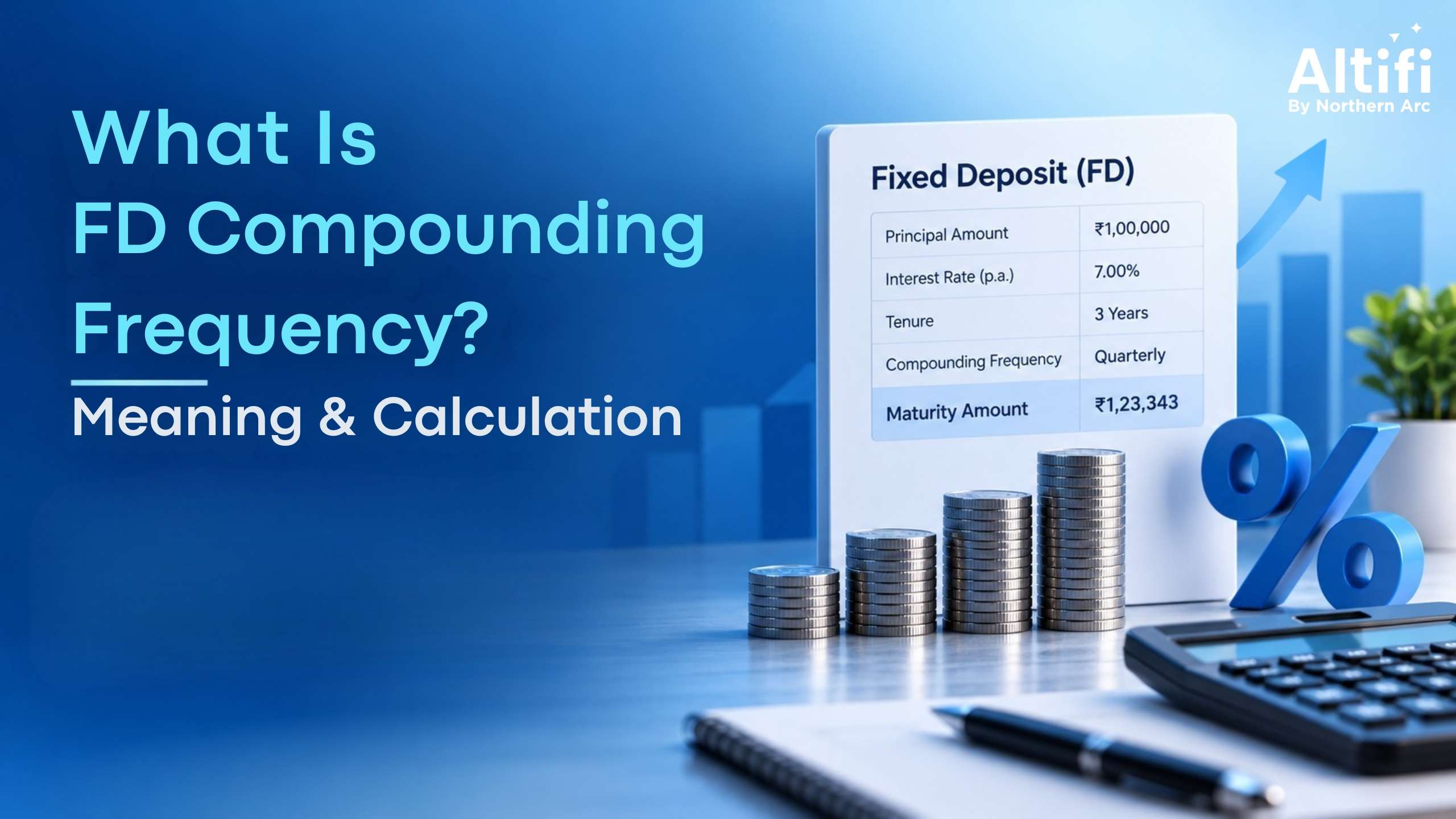
The interest earned on a Fixed Deposit (FD) depends on factors such as the principal, interest rate, tenure, interest calculation method, compounding frequency and interest payout structure applicable to the deposit. Compounding frequency determines how often the accumulated interest is added to the principal for further interest calculation. Understanding this aspect can help investors compare FD options and estimate maturity values.
What is Compounding Frequency in an FD?
Compounding frequency refers to how often the interest earned on an FD is added to the principal during the investment tenure. Once interest is added, the principal amount becomes the base for calculating interest in the next compounding period.
For example, under annual compounding, interest is added once a year. Under quarterly compounding, it is added four times a year. The more frequently interest is compounded, the earlier the accumulated interest becomes part of the amount used for subsequent calculations.
The standard compound interest formula is:
A = P (1 + r/n)^(nt)
Where:
- A = Maturity amount
- P = Principal amount
- r = Annual interest rate
- n = Number of compounding periods per year
- t = Tenure in years
How Does FD Compounding Frequency Work?
Consider an FD of ₹1,00,000 at an annual interest rate of 8% for five years.
With annual compounding, interest is added once every year. In the first year, the interest is ₹8,000, making the amount ₹1,08,000. The next year's interest is then calculated on ₹1,08,000.
With quarterly compounding, interest is calculated and added four times a year. Interest earned each quarter is added to the principal for the next quarter's quarter's calculation.
Therefore, compounding frequency in FD affects the way interest accumulates throughout the tenure. The difference is more visible when the principal amount or investment period is larger.
Types of FD Compounding Frequency
FDs may use different compounding intervals, depending on the product and applicable terms.
| Compounding Frequency | Number of Times Per Year | General Description |
|---|---|---|
| Annual | 1 | Interest is compounded once a year |
| Half-yearly | 2 | Interest is compounded twice a year |
| Quarterly | 4 | Interest is compounded every three months |
| Monthly | 12 | Interest is compounded every month |
The compounding frequency and interest payout frequency are not always the same. An FD may offer monthly or quarterly interest payouts while applying the applicable calculation method separately. Investors should check the specific FD terms before comparing maturity amounts.
How Does Compounding Frequency Affect FD Returns?
The effect of compounding becomes more visible when the principal, interest rate or tenure increases.
For example, consider a ₹10 lakh FD at 7% per annum for five years, with interest compounded annually or quarterly.
| Compounding | Approx. maturity amount | Approx. interest earned |
|---|---|---|
| Annually | ₹14,02,552 | ₹4,02,552 |
| Quarterly | ₹14,14,778 | ₹4,14,778 |
| Difference | ₹12,226 | ₹12,226 |
This is an illustration based on the same nominal interest rate and tenure. The difference comes only from the compounding interval.
The effect tends to become more noticeable over longer periods because the interest accumulated in earlier periods gets included in later calculations.
What is Effective Annual Yield (EAY) on an FD?
Effective Annual Yield (EAY) shows the actual annualised return from an interest rate after taking the compounding frequency into account.
The formula is:
EAY = (1 + r/n)^n − 1
Where:
- r = Nominal annual interest rate
- n = Number of compounding periods per year
For example, if an FD offers a nominal rate of 6% and compounds quarterly:
EAY = (1 + 0.06/4)^4 − 1
This gives an EAY of approximately 6.14%.
A comparison at a 6% nominal rate is shown below:
| Compounding frequency | Periods per year | Approx. EAY |
|---|---|---|
| Annual | 1 | 6.00% |
| Half-yearly | 2 | 6.09% |
| Quarterly | 4 | 6.14% |
| Monthly | 12 | 6.17% |
EAY helps compare products where the stated annual interest rate and compounding frequency differ. The nominal rate alone does not show the full effect of compounding.
How to Choose an FD Based on Compounding Frequency
Compounding frequency is one factor among several when assessing an FD. Consider the following points:
1. Check whether the FD is cumulative or non-cumulative
A cumulative FD generally accumulates interest until maturity, while a non-cumulative FD provides interest payouts at selected intervals. The interest payout structure differs between cumulative and non-cumulative FDs.
2. Compare the nominal rate and EAY
A stated interest rate should be considered along with the applicable compounding frequency. EAY can help provide a common basis for comparison.
3. Consider the investment tenure
The effect of compounding can become more noticeable over longer tenures. A small difference in periodic accumulation can add up over several years.
4. Check the maturity amount
Look at the actual maturity value rather than considering the interest rate alone. The maturity amount reflects the principal, rate, tenure and applicable compounding method.
5. Check the interest payout terms
If regular income is required, a non-cumulative FD with periodic interest payouts may have a different structure from a cumulative FD.
Tax Implications of FD Interest and Compounding
Interest earned from an FD is generally taxable as income and forms part of the taxpayer's taxable income according to the applicable tax rules. The fact that interest remains accumulated in the FD rather than being withdrawn does not by itself make the interest tax-free.
TDS is a separate concept from the final tax liability. The Income Tax Department states that Section 80TTB provides eligible resident senior citizens with a deduction of up to ₹50,000 on interest from deposits with banks, post offices and co-operative banks. Banks are generally not required to deduct TDS under Section 194A up to the applicable threshold, subject to applicable conditions.
| Tax consideration | What to check |
|---|---|
| FD interest | Include taxable interest as required under applicable tax rules |
| TDS | Check whether the bank is required to deduct TDS |
| Senior citizens | Check eligibility for Section 80TTB |
| Tax regime | Consider the applicable tax regime and slab |
| Form 15H | Eligible senior citizens can consider the applicable declaration requirements |
Tax treatment can depend on the taxpayer's circumstances and the applicable financial year. A tax professional can help determine the exact liability.
Key Factors to Check Before Choosing an FD
Before opening an FD, review:
- Interest rate and applicable tenure
- Compounding frequency
- Interest payout option
- Maturity amount
- Premature withdrawal conditions
- Tax treatment
- TDS provisions
- Applicable deposit insurance coverage
- Terms for renewal or maturity instructions
Conclusion
FD compounding frequency determines how often accumulated interest is added to the amount used for subsequent interest calculations. Annual, half-yearly, quarterly and monthly methods can produce different maturity values when other terms remain the same. Investors can compare the interest rate, tenure, compounding method, payout option and tax implications together before selecting an FD. The applicable bank terms should always be checked before investing.
Frequently Asked Questions About FD Compounding Frequency
Does higher compounding frequency always give better FD returns?
When the principal, stated interest rate and tenure are identical, more frequent compounding generally produces a higher maturity amount because interest is added to the calculation base more often. The actual FD terms should still be compared.
Can I choose the compounding frequency for my FD?
It depends on the FD product and the terms offered by the bank. Investors should check whether the available options include annual, half-yearly, quarterly or monthly compounding.
Why is quarterly compounding the standard in India?
Quarterly compounding is commonly used for cumulative bank FDs, although the exact method depends on the bank and product terms. The applicable calculation method should be checked in the FD documentation.
How much difference does compounding frequency make on a ₹10 lakh FD?
The difference depends on the interest rate and tenure. For example, at 8% for five years, the illustrative maturity amount is about ₹14.69 lakh with annual compounding and ₹14.86 lakh with quarterly compounding, creating a difference of around ₹16,600.
Is FD interest taxable even if it is compounded and not withdrawn?
Yes. FD interest can be taxable even when it is accumulated rather than received as a periodic payout. The applicable tax treatment depends on current income-tax rules and the investor's circumstances.
Disclaimer:
The information contained in this Article (“Article”) is for general informational purposes only. Northern Arc Capital Limited (“Northern Arc”) does not make any warranties about the completeness, reliability, and accuracy of this information. Any action you take upon the information contained in this Article is strictly at your own risk, and Northern Arc will not be liable for any losses and damages in connection with the use of our Article.
The data included in this Article has been obtained from sources that are believed to be reliable and accurate at the time of publication. However, Northern Arc does not guarantee the accuracy or completeness of any information, nor does it assume any responsibility or liability for any errors or omissions therein. Any opinions expressed herein are subject to change without notice and Northern Arc is under no obligation to update or keep current the information contained in this Article.
This Article is not intended to constitute, and should not be construed as, investment advice or a recommendation to purchase, sell, or hold any security or to engage in any investment strategy or transaction. Readers should not rely solely on the information provided in this Article for making investment decisions and should conduct their own due diligence or seek the advice of a qualified professional.
The content of this Article is for informational purposes only and is not a solicitation or an offer to buy or sell any securities or financial instruments. Northern Arc is not responsible for any investment decisions made by the recipients of this Article. Readers should take independent financial advice from a qualified professional in connection with, or independently research and verify, any information that is provided in this Article and wish to rely upon, whether for the purpose of making an investment decision or otherwise.
Northern Arc and its affiliates, directors, employees, and agents expressly disclaim any and all liability for any direct or indirect losses, damages, or expenses of any kind arising out of or relating to the use of this Article, including but not limited to, any losses related to the accuracy, completeness, timeliness, or reliability of such information.
This Article may contain forward-looking statements that are based on current expectations, estimates, forecasts, and projections about the markets in which Northern Arc operates, as well as management’s beliefs and assumptions. Forward-looking statements are not guarantees of future performance and involve certain risks and uncertainties, which are difficult to predict. Past performance is not indicative of future results.
This report is intended solely for the recipient and is not for further circulation. Any distribution, modification, reproduction, or disclosure of the contents of this Article, in whole or in part, without the prior written consent of Northern Arc, is strictly prohibited.