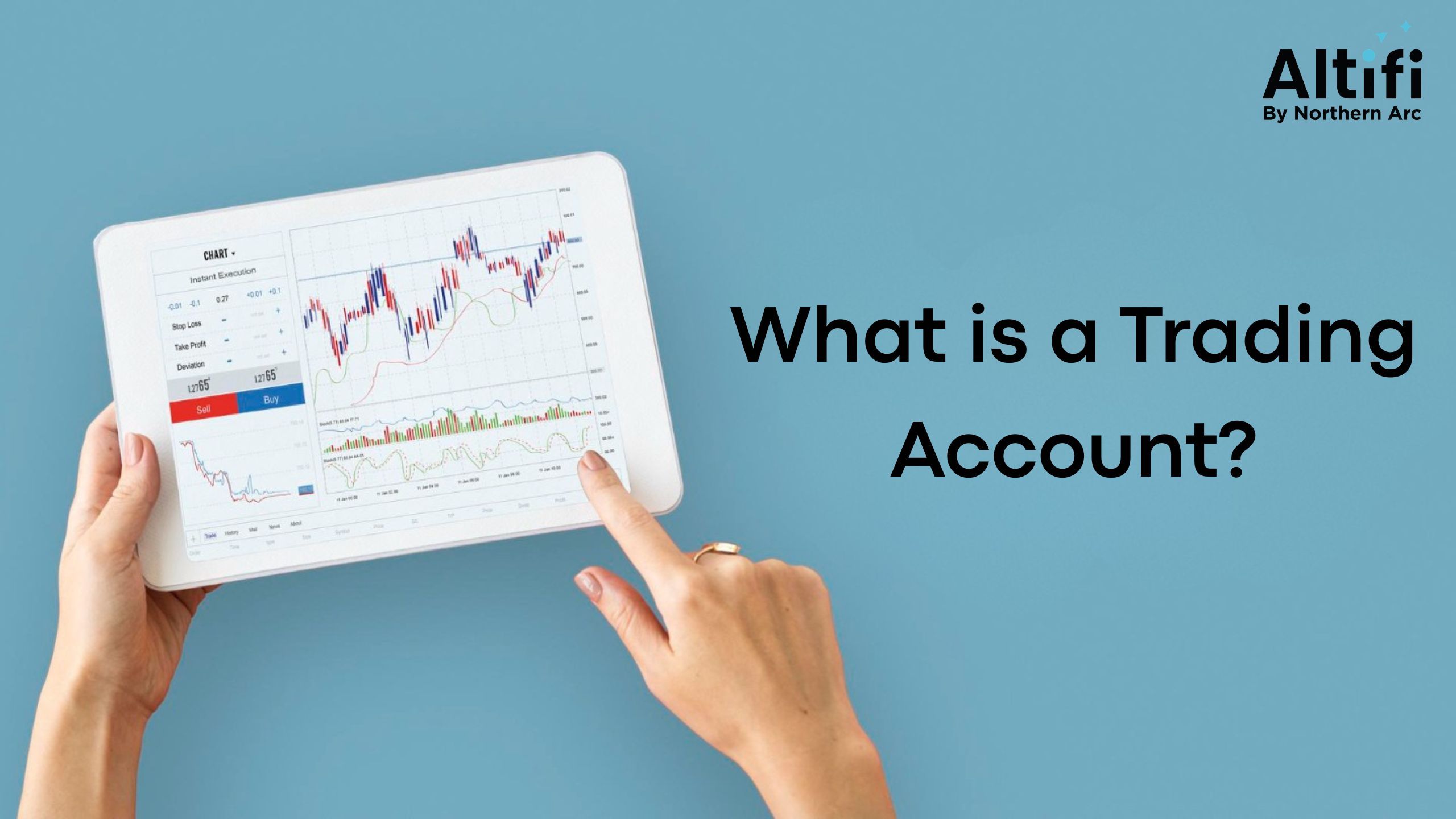
India now has over 17 crore Demat accounts registered with CDSL and NSDL combined, according to depository data as of early 2026. That figure has more than doubled since 2020. Yet many first-time investors still find one basic step confusing about what exactly a trading account is. A trading account is the account through which an investor places buy and sell orders for securities on stock exchanges like NSE and BSE. Without it, there's simply no way to participate in India's stock market.
While trading accounts are commonly used for equities, they may also be used to access listed debt instruments such as corporate bonds and debentures through exchanges. As more investors explore fixed-income options alongside equities, understanding how a trading account works becomes relevant in a broader investment context.
Understanding Trading Account
One of the common questions individuals new to investing ask is, what is trading account meaning and how it works.
A trading account is used to place orders in the stock market. It works together with:
- A bank account for fund transfers
- A Demat account for holding securities
When an investor places an order:
- The request is sent to the exchange
- Funds are debited or credited via the bank
- Securities are stored in the Demat account
This structure enables a smooth and reliable process. In practice, it is used across the industry and supports different types of investments, including listed fixed-income instruments available on exchanges.
Trading Account vs Demat Account: Key Differences Explained
Although often used together, these accounts serve different roles:
| Parameter | Trading Account | Demat Account |
|---|---|---|
| Primary function | Execute buy/sell orders | Store securities electronically |
| Managed by | Stockbroker (SEBI-registered) | Depository Participant (DP) linked to NSDL or CDSL |
| Unique identifier | Trading ID / Client Code | Demat Account Number (16-digit BO ID) |
| Mandatory for | Buying or selling securities on exchanges | Holding shares, bonds, ETFs, mutual fund units |
| Can exist independently | Yes (for F&O cash-settled trades) | Yes (to hold securities without active trading) |
| Annual charges | May include AMC or platform fees | DP annual maintenance charges |
Why Do You Need a Trading Account? Key Reasons for Indian Investors
A trading account is important for investors who wish to access financial markets:
- It enables access to exchanges like NSE and BSE
- It allows participation in both equity and certain listed debt instruments
- It supports transparent and trackable transactions
- It provides access to market data and order tracking
As people rely more on online platforms, trading accounts have made investing more structured. In many cases, they also provide tools that help investors compare different instruments, including fixed-income securities.
Types of Trading Accounts in India: Which One is Right for You?
Trading accounts may be categorised based on usage:
Equity Trading Account
Used to buy and sell shares and ETFs on the National Stock Exchange of India (NSE) and Bombay Stock Exchange (BSE). This is the most common account for beginners.
Commodity Trading Account
Used to trade commodities like gold, silver, and crude oil on exchanges such as the Multi Commodity Exchange of India.
Derivatives (F&O) Trading Account
Used for futures and options trading in indices and stocks. It usually requires extra margin and is more complex.
Currency Trading Account
Used to trade currency pairs like USD/INR on exchange platforms. Often used by businesses or experienced traders.
2-in-1 Trading Account
Combines a trading account and Demat account with one broker. It is simple and widely used.
3-in-1 Trading Account
Combines a trading account, Demat account, and bank account in one place. It offers improved integration and convenience.
Key Features and Benefits of Trading Account
Trading accounts are designed to support different investment needs:
- Real-time order placement and execution
- Access to market data and price movements
- Integration with bank and Demat accounts
- Digital interface for tracking investments
- Access to multiple asset classes, including equities and listed debt instruments
These features make trading accounts widely used across the industry. They continue to evolve with new tools and technology, improving accessibility for investors.
How to Open a Trading Account Online in India: Step-by-Step Guide
Opening a trading account is typically a digital process:
- Select a reliable SEBI-registered broker
- Visit the broker's website or download their app and click on the account opening link
- Fill in personal details like name, date of birth, address, PAN number, and Aadhaar number.
- Complete e-KYC either through Aadhaar-based OTP verification or DigiLocker integration for document verification
- Upload required documents like photo, Aadhaar, PAN card, bank account and income proof.
- Sign digitally using Aadhaar-based e-sign or a scanned wet signature, depending on the broker.
- Receive the trading account credentials via email/SMS once the broker verifies the application.
Eligibility Criteria for Opening a Trading Account in India
The basic eligibility requirements are:
- Must be an Indian citizen (NRIs have separate account categories)
- Minimum age of 18 years (minors can open accounts through a guardian)
- Valid PAN card (mandatory under Income Tax rules for securities transactions)
- Active bank account in the applicant's name
Documents Required to Open a Trading Account
Commonly required documents include:
- PAN card (mandatory)
- Aadhaar card (for e-KYC and address proof)
- Recent passport-size photograph
- Bank account proof
- Income proof
How to Choose the Right Broker for Your Trading Account
Selecting a broker is an important step. Investors may consider:
- Brokerage charges and fee structure
- Platform usability and features
- Customer support
- Regulatory compliance
- Range of available instruments, including access to listed debt securities
A reliable broker can improve the overall experience. In many cases, investors look for platforms that support both equity and fixed-income investments.
Conclusion
A trading account is used to buy and sell investments in the market. It works together with a Demat account and a bank account to complete each transaction. It is mostly used for shares, but in some cases, it can also be used to access listed debt instruments. As more investment options become available, knowing how a trading account works can help investors manage different types of investments. Overall, it is a simple tool that helps in carrying out market transactions.
FAQs on Trading Account
What is a trading account?
A trading account is a SEBI-regulated account held with a registered stockbroker that allows individuals to buy and sell securities such as stocks, bonds, ETFs, and derivatives on stock exchanges like NSE and BSE.
How does a trading account work?
When an individual place a buy or sell order through your broker's platform, the trading account transmits that order to the stock exchange. The exchange aligns it with a counterparty, and settlement happens on a T+1 basis for equity trades.
What is the difference between a trading account and a Demat account?
A trading account is used to execute transactions (buying and selling). A Demat account is used to hold the securities in electronic form after purchase. Both are typically opened together but serve different functions.
Is a trading account free to open?
Many discount brokers offer free account opening. However, ongoing costs such as brokerage per trade, annual maintenance charges, and regulatory fees still apply. It's important to review the full fee schedule before signing up.
What documents are required to open a trading account?
Individuals need a PAN card, Aadhaar card, a recent photograph, and bank account proof. For F&O access, income documentation such as an ITR or salary slip may also be required.
What is a 3-in-1 trading account?
A 3-in-1 account combines a trading account, Demat account, and savings bank account into a single integrated offering. It's typically available from bank-backed brokerages and allows seamless fund transfers between the three accounts.
Who regulates trading accounts in India?
The Securities and Exchange Board of India (SEBI) regulates all stockbrokers and trading accounts in India.
Disclaimer:
The information contained in this Article (“Article”) is for general informational purposes only. Northern Arc Capital Limited (“Northern Arc”) does not make any warranties about the completeness, reliability, and accuracy of this information. Any action you take upon the information contained in this Article is strictly at your own risk, and Northern Arc will not be liable for any losses and damages in connection with the use of our Article.
The data included in this Article has been obtained from sources that are believed to be reliable and accurate at the time of publication. However, Northern Arc does not guarantee the accuracy or completeness of any information, nor does it assume any responsibility or liability for any errors or omissions therein. Any opinions expressed herein are subject to change without notice and Northern Arc is under no obligation to update or keep current the information contained in this Article.
This Article is not intended to constitute, and should not be construed as, investment advice or a recommendation to purchase, sell, or hold any security or to engage in any investment strategy or transaction. Readers should not rely solely on the information provided in this Article for making investment decisions and should conduct their own due diligence or seek the advice of a qualified professional.
The content of this Article is for informational purposes only and is not a solicitation or an offer to buy or sell any securities or financial instruments. Northern Arc is not responsible for any investment decisions made by the recipients of this Article. Readers should take independent financial advice from a qualified professional in connection with, or independently research and verify, any information that is provided in this Article and wish to rely upon, whether for the purpose of making an investment decision or otherwise.
Northern Arc and its affiliates, directors, employees, and agents expressly disclaim any and all liability for any direct or indirect losses, damages, or expenses of any kind arising out of or relating to the use of this Article, including but not limited to, any losses related to the accuracy, completeness, timeliness, or reliability of such information.
This Article may contain forward-looking statements that are based on current expectations, estimates, forecasts, and projections about the markets in which Northern Arc operates, as well as management’s beliefs and assumptions. Forward-looking statements are not guarantees of future performance and involve certain risks and uncertainties, which are difficult to predict. Past performance is not indicative of future results.
This report is intended solely for the recipient and is not for further circulation. Any distribution, modification, reproduction, or disclosure of the contents of this Article, in whole or in part, without the prior written consent of Northern Arc, is strictly prohibited.