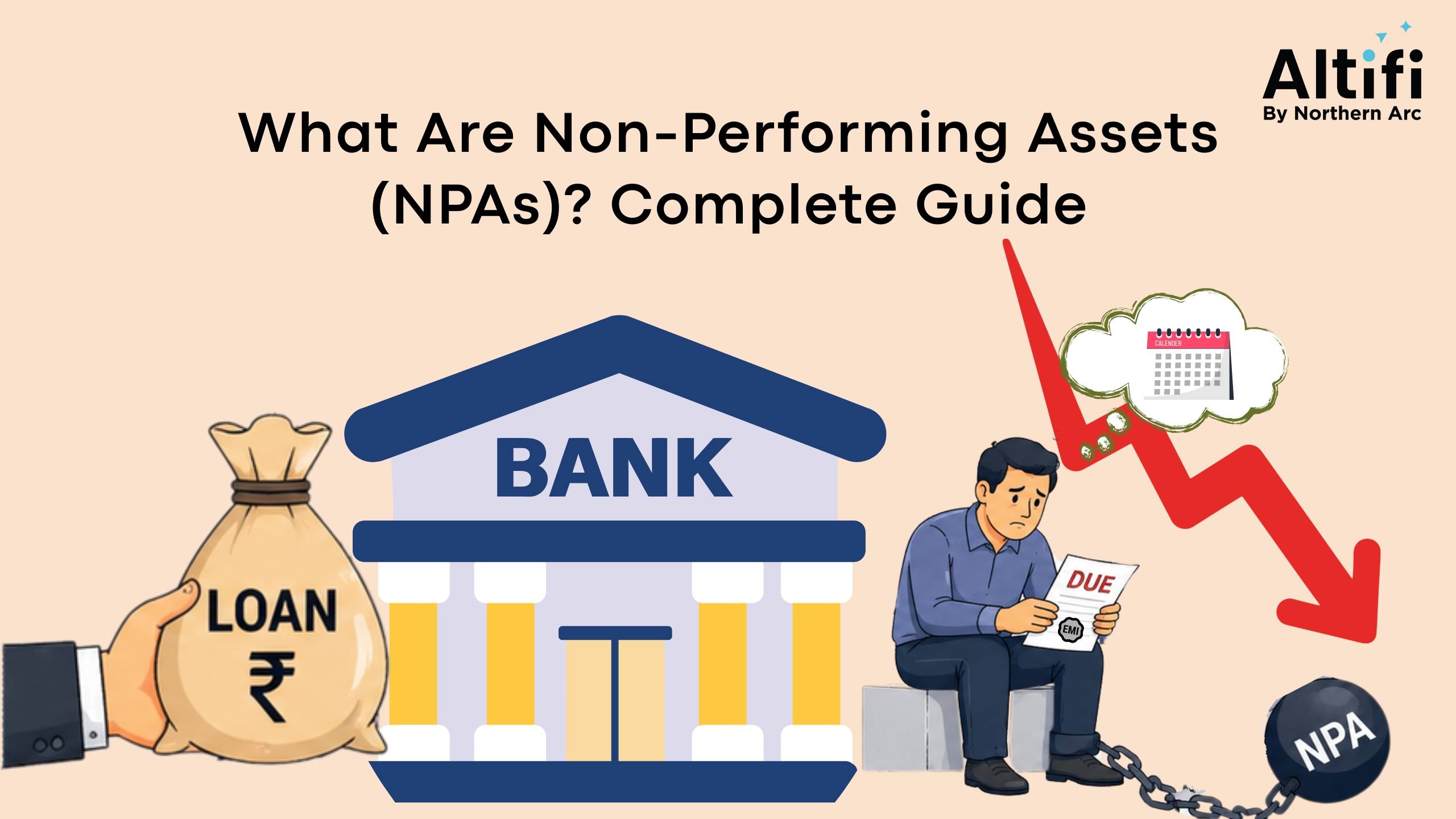
When you take a loan from a bank, you need to repay two things: interest and the principal, both on time. However, sometimes borrowers become defaulters and stop repaying their loans for a while. If the process continues for too long, the loan becomes a liability for the bank and not an asset. Such loans are classified Non-Performing Assets (NPAs). This term is crucial for understanding the actual condition of any bank. In this article, let’s learn about NPA in detail.
Understanding Non-Performing Assets
Non-performing asset can be defined as the loans where the interest or principal amount remains overdue for more than 90 days. An NPA in India is a loan that is not paid beyond 90 days. The banks provide loans and expect repayment which helps to earn money. Non-performance means that the banks suffer losses as well as other costs due to default. Non-performing assets are an indication of the condition of the economy because if there are many NPAs, it indicates financial problems in the economy and vice versa.
How Does a Non-Performing Asset Work?
Here's a simple way to understand the process:
- A bank lends money to an individual or a business.
- The borrower is expected to repay through EMIs or scheduled interest and principal payments.
- If payments stop coming in, the account is first marked as a "Special Mention Account" (SMA), which is an early warning stage.
- If the default continues beyond 90 days, the loan is officially classified as an NPA.
- Once marked NPA, the bank stops recognising interest income from that account (since it may never be recovered) and starts setting aside provisions.
- The bank then works on recovery through restructuring, legal action, or selling the debt to asset reconstruction companies.
This entire cycle can take months or years, depending on how serious the default is and what recovery tools are used.
Example of a Non-Performing Asset
Suppose a small business takes a loan of ₹50 lakh from a bank for expansion. Due to a market slowdown, the business is unable to generate enough revenue and stops paying its EMI.
Month | Status | Action by Bank |
Month 1-2 | Payment missed | Reminder sent, marked SMA-0/SMA-1 |
Month 3 | 90+ days overdue | Loan classified as NPA |
Month 3-12 | Sub-standard NPA | Provisioning begins |
After 1 year | Doubtful NPA | Higher provisioning, recovery steps intensify |
After 3+ years | Loss asset | Bank may write off or sell the loan |
This example shows how a single missed payment, if it continues, can move a loan through different stages of stress until it becomes a serious liability for the bank.
Key Features of Non-Performing Assets
- The overdue period must exceed 90 days for classification as NPA in India
- NPAs stop generating interest income for the bank
- NPAs are categorised based on how long they remain unpaid
- They reduce a bank's profitability and lending capacity
- NPAs are tracked and reported to the RBI as part of regulatory compliance
Types of Non-Performing Assets
Based on how long an account remains overdue, NPAs are divided into three main categories:
Sub-Standard Assets
These are accounts that have remained NPA for less than or equal to 12 months. The risk of loss is moderate at this stage, and there's still a reasonable chance of recovery.
Doubtful Assets
If a sub-standard asset remains unpaid for more than 12 months, it becomes a doubtful asset. At this stage, recovery is uncertain, and banks must set aside significantly higher provisions.
Loss Assets
These are loans identified as unrecoverable, either by the bank itself, auditors, or RBI inspectors. The bank usually writes off such loans since there's little to no chance of recovery.
What Causes Non-Performing Assets?
Several factors can lead to a loan turning into an NPA:
Poor credit assessment
Sometimes banks provide loans without assessing their borrowers' capacity to repay.
Economic downturn
An underperforming economy will have less revenue for the business, thus making repayment difficult.
Intentional default
Sometimes there is intentional default by some borrowers even though they have the capacity to repay.
Industry specific
There are certain industries such as steel, power, or infrastructure that experience cycles.
Misuse of funds
Sometimes borrowers misuse the loaned funds for non-sanctioned purposes.
Project delays
Sometimes big projects are delayed due to cost overruns, making repayment difficult.
Natural disasters
Natural disasters such as floods, drought, or pandemic affect the borrowers’ capacity to repay.
International factors
Changes in currency rates or international recession adversely affect export-oriented businesses.
How are NPA Ratios Calculated?
Banks use two main ratios to measure NPA levels:
Gross NPA Ratio = (Gross NPAs / Gross Advances) × 100
Net NPA Ratio = (Net NPAs / Net Advances) × 100, where Net NPA = Gross NPA – Provisions made
Example: If a bank has total advances of ₹10,000 crore and Gross NPAs of ₹210 crore, the Gross NPA ratio would be:
(210 / 10,000) × 100 = 2.1%
This is actually close to real numbers, the ratio of gross non-performing assets to gross advances for Indian banks declined to 2.1% as of September 2025, according to RBI data.
Gross NPA (GNPA) vs Net NPA (NNPA)
Aspect | Gross NPA (GNPA) | Net NPA (NNPA) |
Meaning | Total bad loans before provisions | Bad loans after deducting provisions |
Formula | Gross NPA / Gross Advances | (Gross NPA – Provisions) / Net Advances |
What it shows | Overall loan quality | Actual risk exposure after cushioning |
Usually higher or lower | Higher | Lower |
Recent India figure | Around 2.1% (Sept 2025) | Around 0.5% (Sept 2025) |
Impact of Non-Performing Assets on Banks and the Economy
NPAs can affect the economy in the following ways.
Reduced profitability
Banks earn less since NPAs don't generate interest income
Lower lending capacity
Funds get locked in provisioning instead of fresh loans
Higher interest rates
Banks may raise rates on new loans to cover losses from bad ones
Weakened investor confidence
High NPAs can impact a bank's stock price and credit rating
Slower economic growth
Reduced lending affects business expansion and job creation
Government burden
Public sector banks may need capital infusion from the government to stay stable
Stress on financial system stability
A widespread NPA crisis can reduce confidence in the entire banking sector
How Banks Manage and Recover NPAs
Here's how a bank manages and recovers NPAs.
Restructuring loans
Extending repayment periods or adjusting interest rates for genuine cases
One-Time Settlement (OTS)
Negotiating a lump-sum settlement with the borrower.
Insolvency and Bankruptcy Code (IBC)
Taking defaulters to the National Company Law Tribunal for resolution.
SARFAESI Act
Allowing banks to seize and sell collateral without court intervention.
Selling to Asset Reconstruction Companies (ARCs)
Transferring bad loans to specialised recovery firms.
Setting up stressed asset verticals
Dedicated teams within banks to monitor and recover NPAs.
Write-offs
Removing unrecoverable loans from the books after making full provisions.
Conclusion
Non-Performing Assets is an important metric that gives us insights into a bank’s financial condition as well as the economy as a whole. While it is difficult to completely avoid NPA in any lending operation to some extent, it is important to ensure that this does not go out of control to ensure profitability for banks and steady growth of the economy. The Indian banking industry has done well in this regard – the overall gross NPA ratio stood at 1.8% as of March 2026, which is a low figure even by the standards set by RBI for decades.
FAQs on Non-Performing Assets
How do banks manage non-performing assets?
NPAs are managed by the process of restructuring, one time settlement, recovery through SARFAESI and IBC, sale of loans to Asset Reconstruction Companies, and by making recovery teams.
What is the difference between GNPA and NNPA?
GNPA is the sum of bad loans without making any provisions, whereas NNPA is the balance left after provisions. NNPA provides the realistic risk position of a bank.
How do banks reduce their Non-Performing Assets?
Banks decrease their NPAs by taking timely measures for recovery, strict credit appraisal, restructuring of truly stressed accounts, recovery measures, and write-off of unrecoverable debts after proper provision.
After how many days does a loan become an NPA in India?
A bank keeps a loan for a period of 90 days before classifying it as an NPA in India.
Can a borrower remove an NPA status from their loan account?
Yes, if the borrower clears all overdue payments and brings the account fully up to date, the bank can reclassify it as a standard (performing) asset, though this depends on the bank's specific policy and RBI guidelines.
Disclaimer:
The information contained in this newsletter (“Newsletter”) is for general informational purposes only. Northern Arc Capital Limited (“Northern Arc”) does not make any warranties about the completeness, reliability, and accuracy of this information. Any action you take upon the information contained in this Newsletter is strictly at your own risk, and Northern Arc will not be liable for any losses and damages in connection with the use of our Newsletter.
The data included in this Newsletter has been obtained from sources that are believed to be reliable and accurate at the time of publication. However, Northern Arc does not guarantee the accuracy or completeness of any information, nor does it assume any responsibility or liability for any errors or omissions therein. Any opinions expressed herein are subject to change without notice and Northern Arc is under no obligation to update or keep current the information contained in this Newsletter.
This Newsletter is not intended to constitute, and should not be construed as, investment advice or a recommendation to purchase, sell, or hold any security or to engage in any investment strategy or transaction. Readers should not rely solely on the information provided in this Newsletter for making investment decisions and should conduct their own due diligence or seek the advice of a qualified professional.
The content of this Newsletter is for informational purposes only and is not a solicitation or an offer to buy or sell any securities or financial instruments. Northern Arc is not responsible for any investment decisions made by the recipients of this Newsletter. Readers should take independent financial advice from a qualified professional in connection with, or independently research and verify, any information that is provided in this Newsletter and wish to rely upon, whether for the purpose of making an investment decision or otherwise.
Northern Arc and its affiliates, directors, employees, and agents expressly disclaim any and all liability for any direct or indirect losses, damages, or expenses of any kind arising out of or relating to the use of this Newsletter, including but not limited to, any losses related to the accuracy, completeness, timeliness, or reliability of such information.
This Newsletter may contain forward-looking statements that are based on current expectations, estimates, forecasts, and projections about the markets in which Northern Arc operates, as well as management’s beliefs and assumptions. Forward-looking statements are not guarantees of future performance and involve certain risks and uncertainties, which are difficult to predict. Past performance is not indicative of future results.
This report is intended solely for the recipient and is not for further circulation. Any distribution, modification, reproduction, or disclosure of the contents of this Newsletter, in whole or in part, without the prior written consent of Northern Arc, is strictly prohibited.