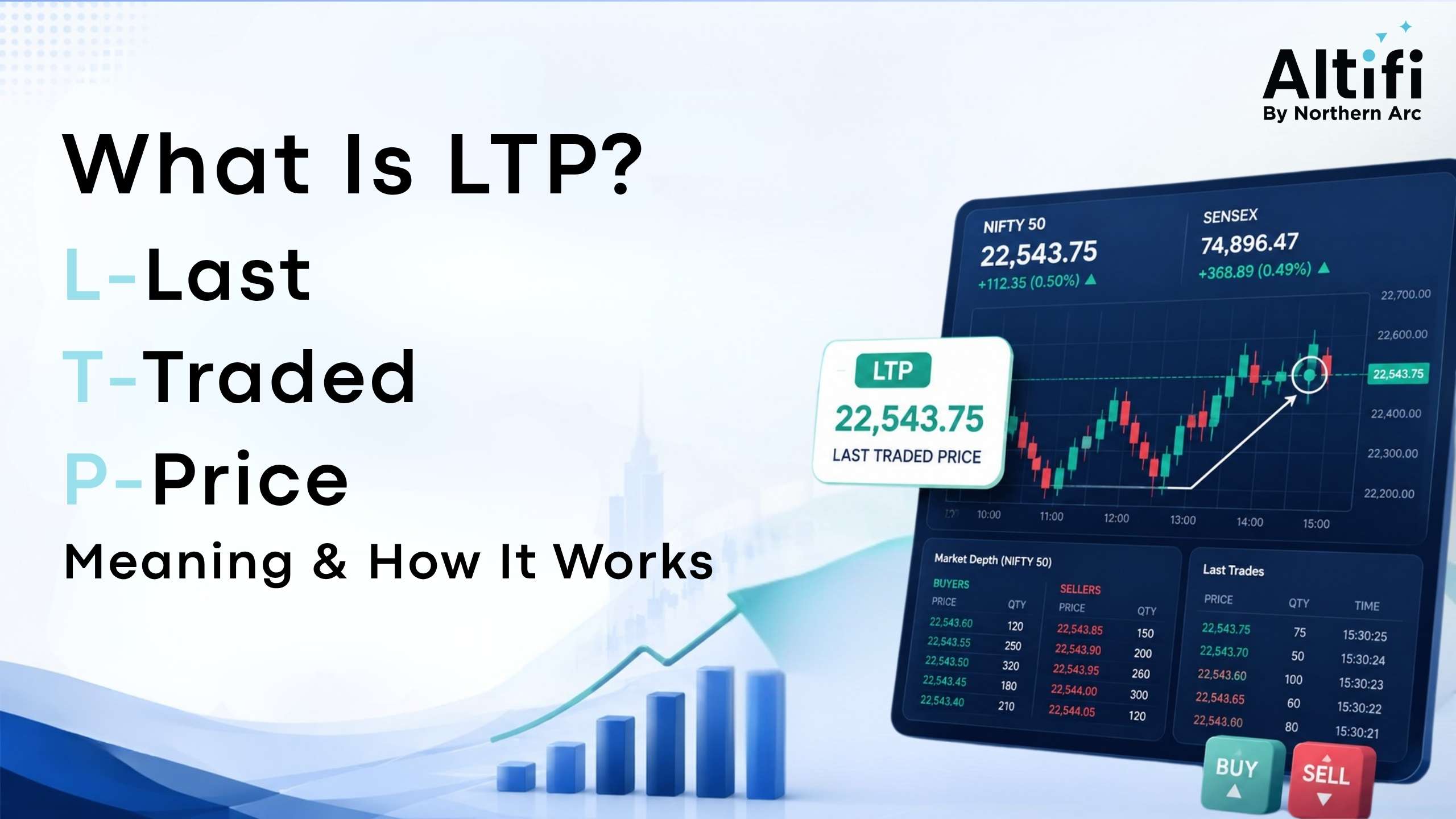
In case you are ever wondering why the prices of stocks seem to fluctuate every few seconds when you are watching a stock ticker, all you need to know is that it all has to do with one simple term - LTP. It Stands for "Last Traded Price". It is the price at which the most recent trade in a security was executed on the exchange. When learning how stock prices are displayed on NSE and BSE in India, LTP is often mistaken by investors for "the current price" or even for "closing price". In this article we explain what LTP means, how it is calculated and why it is important to understand its difference from other price benchmarks.
What is LTP?
LTP is short for Last Traded Price, the price at which the most recent trade involving a particular stock occurred at an exchange such as NSE or BSE. In other words, when a transaction between a buyer and a seller occurs at the price of ₹1,500 for one share of Reliance Industries, ₹1,500 will be the LTP until a new trade takes place, even if that takes place just seconds later.
The difference between LTP and market price must be understood in this context, since the former only refers to the price of the last executed transaction, and not what the next one will take place at. While the difference hardly exists on a liquid large-cap stock where transactions keep occurring one after another, this can be very different on a small-cap stock.
How is LTP Determined?
The LTP depends upon the automatic order matching process carried out by the stock exchange. If there is a match between the bid and ask of the buyer and seller, the deal will be done, and the price where the deal takes place will be the LTP. Process in detail:
- Buyers and sellers put orders of buying and selling stocks on the trading terminal of the stock exchange.
- The matching mechanism of the stock exchange finds out the compatible bid and ask prices.
- If there is any match at all, the deal will take place.
LTP is very volatile and keeps changing all through the market hours due to continuous trading. Say, if a stock is trading at ₹1,000, and its next trade is at ₹1,100, then the LTP is updated immediately to ₹1,100.
Why Does LTP Matter to Investors and Traders?
LTP is important due to the following reasons:
- Reflects recent trading activity: Changes in LTP show the prices at which recent transactions have occurred and can be considered alongside volume, bid-ask data and other market information.
- Guides entry and exit decisions: Traders track LTP movement to time their buy or sell trades.
- Benchmarking orders price: This is useful for investors in deciding either to trade via a market order or limit order.
- F&O trading: LTP of the underlying security is one of the market inputs traders monitor when assessing derivatives positions, although derivative prices are also affected by factors such as volatility, time to expiry, interest rates and demand and supply.
- Indicator of liquidity: More liquidity implies greater reliability of the LTP as a market signal.
How Is LTP Used in Trading?
Suppose you want to buy shares of Tata Motors. Your broker's screen shows an LTP of ₹780. If the LTP is ₹780 and you place a market order, your order will execute against the available sell orders in the order book. The execution price may be ₹780, higher than ₹780, or across multiple prices depending on available liquidity. If you instead place a buy limit order at ₹770, the order can execute when an eligible sell order is available at ₹770 or below, subject to the exchange's order-matching rules. Intraday traders also use LTP to set stop-losses. For instance, exiting a position automatically if the LTP falls 2% below their purchase price.
What Factors Affect LTP?
Several forces push LTP up or down within the same trading session:
Demand and Supply
More buyers than sellers pushes LTP higher, and vice versa.
Market Sentiment
News, earnings results, or broader index movements can trigger rapid LTP shifts.
Liquidity
Highly traded stocks like Nifty 50 constituents see LTP update almost every second, while illiquid stocks may go minutes without a new trade.
Circuit Limits
Exchange-imposed price bands can temporarily halt trading, freezing the LTP at the circuit level.
How Does Trading Volume Affect LTP?
Volume and LTP reliability go hand in hand. When trading volume is high, each new trade impacts the LTP only slightly, producing a smooth, trustworthy price trend. For example, a heavily traded stock like HDFC Bank may see thousands of trades an hour, so its LTP closely mirrors genuine market value. In contrast, a low-volume small-cap stock might trade only a handful of times a day — a single large order can swing its LTP sharply, making it a less dependable gauge of the stock's real worth.
How Does LTP Affect Order Execution?
When you place a market order, your trade is generally executed at or near the current LTP, depending on available orders in the order book at the time the exchange processes the order. However, in fast-moving or illiquid stocks, the price can shift between the moment you click "buy" and the moment your order actually executes — a phenomenon known as slippage. For example, if the LTP is ₹500 when you place a market order but jumps to ₹505 before execution due to a sudden rush of buyers, your order may fill at the higher price. This is why many traders in volatile stocks prefer limit orders over market orders.
LTP vs Closing Price vs Opening Price
Let’s understand how LTP, closing price and opening price differ from each other.
Parameter | LTP | Opening Price | Closing Price |
Meaning | Price of the most recent trade | First trade price of the day | Official reference price for the day |
Frequency | Changes continuously during market hours | Set once at market open | Set once at market close |
Calculation | Simply the last executed trade | Determined via the pre-open call auction | Weighted average of trades in the last 30 minutes of the session (on NSE/BSE) |
Used for | Live tracking, order placement | Gauging opening sentiment | NAV calculation, index computation, settlement |
Common Misconceptions About LTP
Here are some misconceptions people often have regarding LTP.
- "LTP is the current market price."
It only reflects the last completed trade, not necessarily what the next trade will be.
- "LTP always equals the closing price."
The official closing price is a weighted average of the last 30 minutes of trading and may differ slightly from the final LTP recorded at 3:30 PM.
- "A stable LTP means a stable stock."
In illiquid stocks, an unchanged LTP may simply mean no trades occurred, not that demand and supply are balanced.
- "LTP guarantees your execution price."
Especially with market orders in volatile stocks, actual execution can differ from the displayed LTP.
Conclusion
LTP, or Last Traded Price, is a live, ever-changing number that reflects the most recent agreement between a buyer and a seller. While it is not the same as the closing price or a guaranteed execution price, understanding how LTP works helps Indian investors and traders read market sentiment, place smarter orders, and manage risk more effectively, whether they are trading equities or F&O contracts on NSE and BSE.
FAQs on LTP
What is the LTP full form?
LTP stands for Last Traded Price.
How is LTP determined in the stock market?
It is set automatically whenever the exchange's order-matching system pairs a buyer's bid with a seller's ask, and the resulting trade price becomes the new LTP.
Why does LTP keep changing during market hours?
Because new trades occur continuously as buy and sell orders are matched at different prices, reflecting shifting demand and supply.
Is LTP the same as the closing price or market price?
No. The closing price is a weighted average of the last 30 minutes of trading, while LTP is simply the single most recent trade.
What is the difference between LTP and ATP (Average Traded Price)?
LTP is the latest price at which a stock was bought or sold, while ATP shows how much buyers have paid on average over a specific period.
Does LTP affect the price at which my order gets executed?
Yes, particularly for market orders, which execute at or near the current LTP, though prices can shift before execution in volatile stocks.
Where can I see the LTP of a stock?
It is available on stock exchange websites, broker trading platforms, and financial apps.
What is the LTP full form in share market?
It stands for Last Traded Price, the same meaning applies across the equity, derivatives, and commodities segments.
Disclaimer:
The information contained in this newsletter (“Newsletter”) is for general informational purposes only. Northern Arc Capital Limited (“Northern Arc”) does not make any warranties about the completeness, reliability, and accuracy of this information. Any action you take upon the information contained in this Newsletter is strictly at your own risk, and Northern Arc will not be liable for any losses and damages in connection with the use of our Newsletter.
The data included in this Newsletter has been obtained from sources that are believed to be reliable and accurate at the time of publication. However, Northern Arc does not guarantee the accuracy or completeness of any information, nor does it assume any responsibility or liability for any errors or omissions therein. Any opinions expressed herein are subject to change without notice and Northern Arc is under no obligation to update or keep current the information contained in this Newsletter.
This Newsletter is not intended to constitute, and should not be construed as, investment advice or a recommendation to purchase, sell, or hold any security or to engage in any investment strategy or transaction. Readers should not rely solely on the information provided in this Newsletter for making investment decisions and should conduct their own due diligence or seek the advice of a qualified professional.
The content of this Newsletter is for informational purposes only and is not a solicitation or an offer to buy or sell any securities or financial instruments. Northern Arc is not responsible for any investment decisions made by the recipients of this Newsletter. Readers should take independent financial advice from a qualified professional in connection with, or independently research and verify, any information that is provided in this Newsletter and wish to rely upon, whether for the purpose of making an investment decision or otherwise.
Northern Arc and its affiliates, directors, employees, and agents expressly disclaim any and all liability for any direct or indirect losses, damages, or expenses of any kind arising out of or relating to the use of this Newsletter, including but not limited to, any losses related to the accuracy, completeness, timeliness, or reliability of such information.
This Newsletter may contain forward-looking statements that are based on current expectations, estimates, forecasts, and projections about the markets in which Northern Arc operates, as well as management’s beliefs and assumptions. Forward-looking statements are not guarantees of future performance and involve certain risks and uncertainties, which are difficult to predict. Past performance is not indicative of future results.
This report is intended solely for the recipient and is not for further circulation. Any distribution, modification, reproduction, or disclosure of the contents of this Newsletter, in whole or in part, without the prior written consent of Northern Arc, is strictly prohibited.