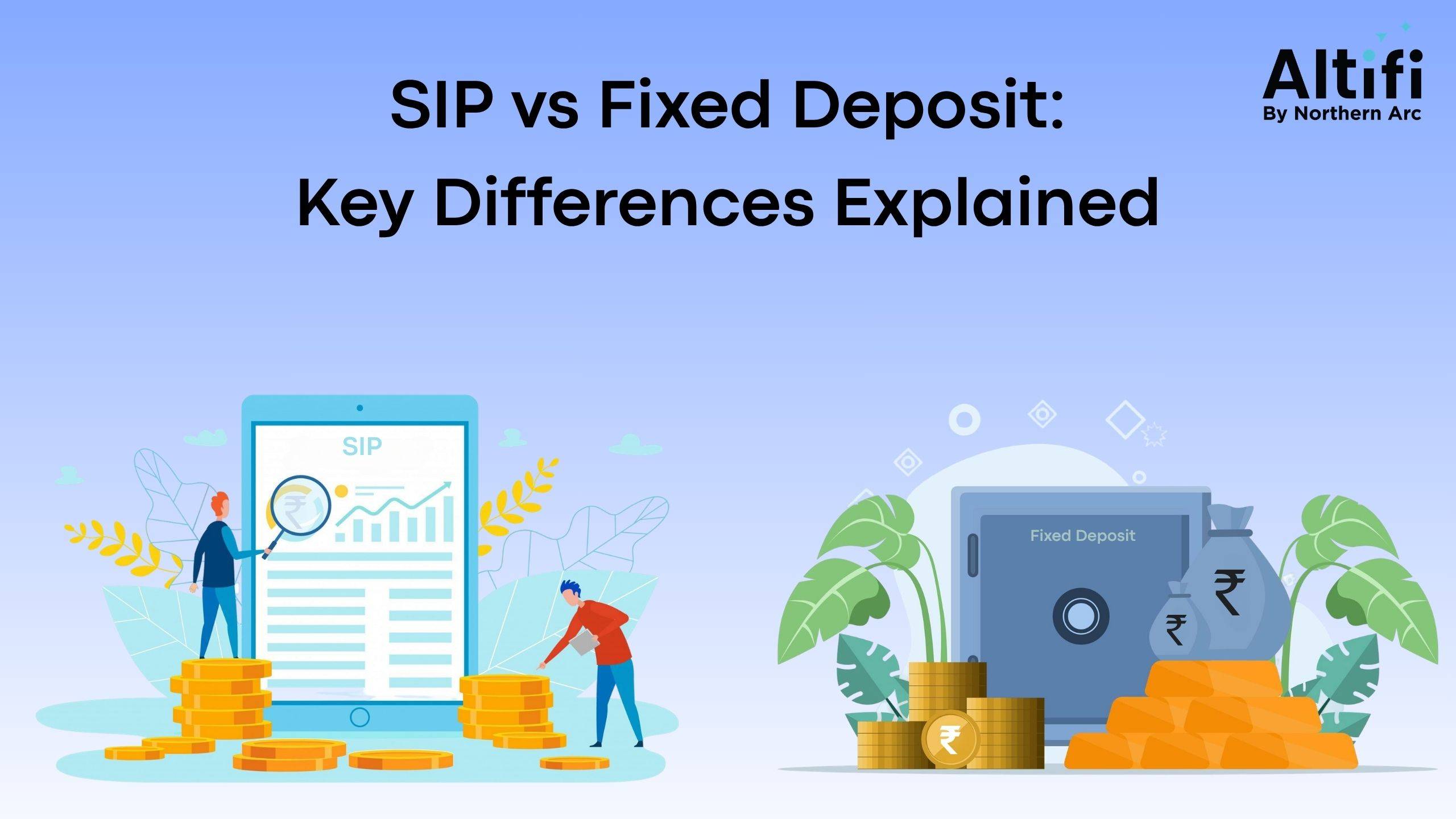
SIP vs FD compares market-linked investing through mutual funds with fixed-interest bank deposits. SIPs carry market risk, while FDs offer predefined interest rates for a fixed tenure.
Recent data gives some perspective. According to the Reserve Bank of India, bank deposits crossed nearly ₹200 lakh crore in 2024. At the same time, assets managed by mutual funds, as reported by the Association of Mutual Funds in India, have moved past ₹60 lakh crore.
This gradual shift is worth noting. Even so, SIP vs FD is not always about choosing one over the other. Many times, the decision depends on purpose. Each serves a different role. Understanding it may make the comparison clearer.
What is a Fixed Deposit (FD)?
A Fixed Deposit is generally seen as a straightforward financial instrument. An investor places a lump sum with a bank or NBFC for a fixed duration, at an interest rate agreed at the time of booking.
Once the deposit is created, that rate does not change during the tenure. This is one of the defining aspects. It provides visibility on the applicable interest rate and maturity amount at the time of booking. The investor can estimate the interest income and maturity value based on the applicable deposit terms.
The tenures can vary from a few days to as much as 10 years. The interest can be paid periodically or accumulated and paid at the time of maturity, depending on the chosen option.
Another point often observed is that the principal amount is not linked to market movements. Because of this, FDs are commonly used where lower volatility is preferred over market-linked risk-return potential.
Types of Fixed Deposits in India
Fixed Deposits are available in different forms, depending on how the investor prefers to receive interest income.
Cumulative FD
Interest is compounded over time and paid at maturity. This is often chosen when a regular income is not required.
Non-Cumulative FD
Interest is paid at fixed intervals, such as monthly or quarterly. This structure is often used when periodic interest payouts are preferred.
Tax-Saver FD
Eligible for deduction under Section 80C up to ₹1.5 lakh. These deposits come with a mandatory five-year lock-in period.
Senior Citizen FD
The banks normally provide a relatively higher rate of interest to senior citizens who are 60 years or older.
What is a Systematic Investment Plan (SIP)?
The systematic investment plan, or SIP, enables the investor to put a fixed sum of capital at periodic intervals in a mutual fund scheme. These schemes are regulated by the Securities and Exchange Board of India (SEBI).
Unlike fixed deposits, returns here are not predetermined. They depend on how the underlying investments perform over time.
In simple terms, SIPs spread investment across different market levels. Instead of committing a large amount at once, the investor contributes periodically, often monthly. Over time, this approach helps average out the cost of investment.
Investors usually use SIPs as a measure to gradually build exposure to equity or debt markets without needing to time entry points.
SIP vs Fixed Deposit: Where They Differ
The differences between SIPs and Fixed Deposits become clearer when viewed side by side.
| Parameter | Fixed Deposit (FD) | Systematic Investment Plan (SIP) |
|---|---|---|
| Nature of Returns | Fixed at the time of investment | Market-linked and variable |
| Risk Level | Generally low | Varies based on fund type |
| Investment Style | Lump sum | Periodic (monthly, weekly, etc.) |
| Minimum Investment | Usually starts from ₹1,000 | Can start from around ₹500 |
| Capital Protection | Principal remains unaffected (within terms) | No assurance; value may fluctuate |
| Tax Treatment | Interest taxed as per the income slab; TDS applicable | Taxed as capital gains |
| Insurance Cover | Up to ₹5 lakh under DICGC | No insurance cover |
| Lock-in Period | Flexible; tax-saver FD has 5-year lock-in | No lock-in except ELSS (3 years) |
| Return Visibility | Known in advance | Not known in advance |
Which One to Choose: What Actually Matters
One common question that usually arises is - SIP or FD; which is better. In practice, the choice between SIP and FD often depends on a few practical factors, such as:
Investment Horizon
FDs are commonly used for shorter durations. SIPs, especially those linked to equity funds, tend to work over longer periods.
Risk Comfort
FDs are generally associated with lower volatility compared to market-linked instruments. SIPs, on the other hand, may move up or down in the short term. This difference can matter, particularly when predictability is important.
Financial Goals
Short-term financial requirements and lower exposure to market fluctuations are often associated with FDs. Long-term goals, where growth plays a role, are more commonly associated with SIPs.
Tax Impact
Interest from FDs is taxed as per the applicable slab. SIPs, depending on the type of fund and holding period, may have different tax treatment.
Premature Withdrawal: What Happens If Needed
Financial situations can change, and early withdrawal is not uncommon.
- In the case of FDs, breaking the deposit before maturity usually results in a lower interest rate being applied. Some banks may also charge a penalty ranging between 0.5-01%. Tax-saver FDs do not allow premature withdrawal.
- With SIPs, investors can redeem units at any time. However, certain funds may apply an exit load if withdrawn early. Also, since returns depend on market conditions, the redemption value may differ from the invested amount.
Conclusion
Fixed deposits and SIPs are often used for different purposes within a financial plan. Fixed deposits are typically associated with predefined interest rates and lower exposure to market-linked fluctuations, making them relevant where consistency is preferred. SIPs, in contrast, provide exposure to market-linked instruments and may support long-term capital appreciation, subject to market conditions. In many cases, investors do not view them as alternatives but as complementary tools. The overall choice usually depends on time horizon, risk appetite, and how each instrument fits into broader financial priorities.
FAQs on SIP vs FD
Is SIP better than FD?
There is no single option that will suit all financial situations. SIPs are generally used for market-linked growth over time, while FDs are used where lower variability is preferred.
What is the main difference between SIP and FD?
An FD involves a lump-sum deposit with a predetermined interest rate. A SIP involves periodic investments where returns depend on market performance.
Are there tax benefits on fixed deposits?
Tax-saver FDs qualify under Section 80C up to ₹1.5 lakh. However, the interest earned is taxable.
Which is suitable for senior citizens?
FDs may be considered due to predefined interest payout structures. Some may also include limited SIP exposure depending on their needs.
Can both SIP and FD be used together?
Yes, many investors use both. FDs may be considered for stability, while SIPs for gradual market participation.
Disclaimer:
The information contained in this Article (“Article”) is for general informational purposes only. Northern Arc Capital Limited (“Northern Arc”) does not make any warranties about the completeness, reliability, and accuracy of this information. Any action you take upon the information contained in this Article is strictly at your own risk, and Northern Arc will not be liable for any losses and damages in connection with the use of our Article.
The data included in this Article has been obtained from sources that are believed to be reliable and accurate at the time of publication. However, Northern Arc does not guarantee the accuracy or completeness of any information, nor does it assume any responsibility or liability for any errors or omissions therein. Any opinions expressed herein are subject to change without notice and Northern Arc is under no obligation to update or keep current the information contained in this Article.
This Article is not intended to constitute, and should not be construed as, investment advice or a recommendation to purchase, sell, or hold any security or to engage in any investment strategy or transaction. Readers should not rely solely on the information provided in this Article for making investment decisions and should conduct their own due diligence or seek the advice of a qualified professional.
The content of this Article is for informational purposes only and is not a solicitation or an offer to buy or sell any securities or financial instruments. Northern Arc is not responsible for any investment decisions made by the recipients of this Article. Readers should take independent financial advice from a qualified professional in connection with, or independently research and verify, any information that is provided in this Article and wish to rely upon, whether for the purpose of making an investment decision or otherwise.
Northern Arc and its affiliates, directors, employees, and agents expressly disclaim any and all liability for any direct or indirect losses, damages, or expenses of any kind arising out of or relating to the use of this Article, including but not limited to, any losses related to the accuracy, completeness, timeliness, or reliability of such information.
This Article may contain forward-looking statements that are based on current expectations, estimates, forecasts, and projections about the markets in which Northern Arc operates, as well as management’s beliefs and assumptions. Forward-looking statements are not guarantees of future performance and involve certain risks and uncertainties, which are difficult to predict. Past performance is not indicative of future results.
This report is intended solely for the recipient and is not for further circulation. Any distribution, modification, reproduction, or disclosure of the contents of this Article, in whole or in part, without the prior written consent of Northern Arc, is strictly prohibited.