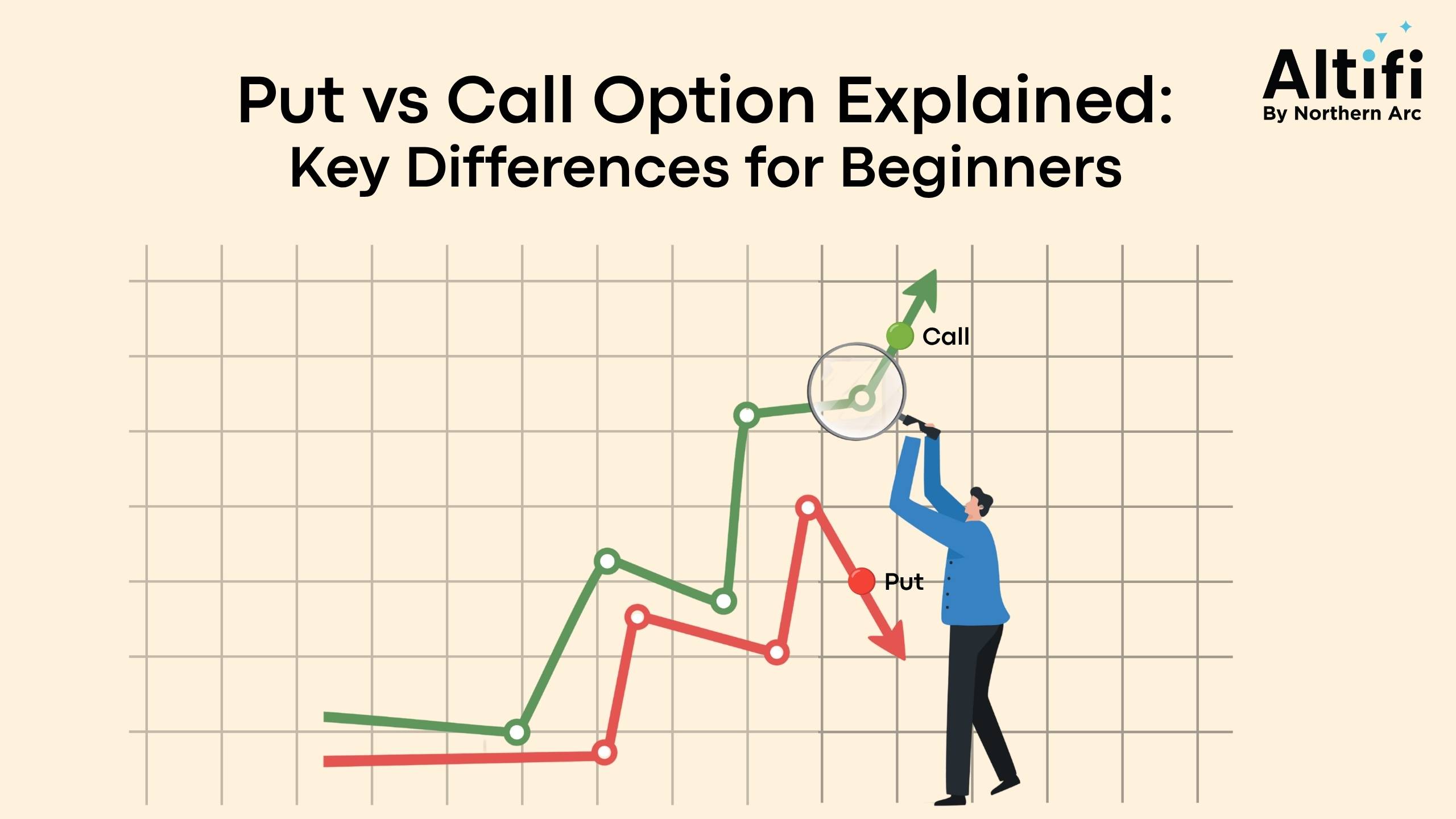
Options are commonly traded derivative financial instruments in India, and the majority of the deals made using these products fall into two categories: Call Option and Put Option. In the case of the call option, the investor has the right to purchase the asset at a pre-decided price, while in the case of the put option, investors can sell the asset at a pre-decided price. By 2025, NSE became the largest derivatives exchange in the world in terms of volume of transactions, as per Future Industry Association, and the Index Options contributed significantly to this volume.
What is a Call Option?
A call option refers to a contractual agreement which allows the holder the right and not the obligation to buy a particular stock or index at a predetermined cost referred to as strike price till the expiry date. The cost paid by the holder in order to exercise such a right is referred to as the premium. When the underlying security price is above the strike price, then the option may bring profits. When it falls below, the holder has the right to let the contract expire after losing the premium.
The buyers believe that the underlying price will move up. The writers of the call options have an opposing outlook.
Call Option Example
Suppose Reliance Industries is trading at ₹2,800. A trader buys a call option with a strike price of ₹2,850, paying a premium of ₹40 per share, with a lot size of 500 shares. The total premium paid is ₹20,000 (₹40 × 500).
If Reliance rises to ₹2,950 before expiry, the option is worth at least ₹100 (₹2,950 − ₹2,850). The trader's profit is ₹100 − ₹40 = ₹60 per share, or ₹30,000 in total.
If Reliance stays at ₹2,750, the option expires worthless, and the trader's loss is limited to the ₹20,000 premium paid.
How does Call Option Work?
Here’s how call options work.
- The buyer pays a premium upfront to hold the right to buy at the strike price.
- Profit rises as the underlying price moves further above the strike price.
- Loss for the buyer is capped at the premium paid, irrespective of how much the price falls.
- The seller receives the premium but faces theoretically unlimited losses if the price keeps rising.
- Most contracts are settled in cash on index options, while some stock options may require physical delivery if held till expiry.
- Time decay works against the buyer, meaning the option loses value each day, all else being equal, as expiry approaches.
What is a Put Option?
A put option gives the buyer the right, but not the obligation, to sell a stock or index at a fixed strike price before expiry. Traders buy put options when they expect prices to fall. As with calls, the buyer pays a premium and the maximum loss is limited to that amount.
Put options are also commonly used as a hedge. An investor holding shares can buy a put option to protect against a fall in price, without having to sell the shares outright.
Put Option Example
Assume Nifty is trading at 24,500. A trader buys a put option with a strike price of 24,400, paying a premium of ₹80, with a lot size of 65.
If Nifty falls to 24,150 before expiry, the option is worth at least 250 points (24,400 − 24,150). The trader's profit is 250 − 80 = 170 points, or ₹11,050 (170 × 65).
If Nifty instead rises to 24,700, the put option expires worthless, and the loss is limited to the premium of ₹5,200 (80 × 65).
How do Put Options Work?
A put option works in the following way.
- The buyer pays a premium for the right to sell at the strike price.
- Profit increases as the underlying price falls further below the strike price.
- Maximum loss for the buyer is the premium paid, regardless of how high the price rises.
- Sellers of put options earn the premium but bear losses if the price drops sharply.
- Puts are often used to hedge existing stock holdings against a market decline.
- Like calls, put option premiums fall over time due to time decay as expiry nears.
Call Option vs Put Option: Key Differences
Basis | Call Option | Put Option |
Right given | Right to buy the asset | Right to sell the asset |
Market view | Bullish (price expected to rise) | Bearish (price expected to fall) |
Buyer's profit | Rises as price goes above strike | Rises as price falls below strike |
Buyer's maximum loss | Limited to premium paid | Limited to premium paid |
Seller's risk | Unlimited, in theory, as price rises | Substantial, as price can fall toward zero |
Common use | Speculation on price rise, or protecting a short position | Speculation on price fall, or hedging a long position |
Key Terms Used in Options Trading
Term | Meaning In the Indian stock market, CE stands for Call European and PE refers to Put European. These are the two types of option contracts you can trade in the Futures and Options (F&O) segment. |
Strike Price | The fixed price at which the option can be exercised |
Premium | The price paid by the buyer to hold the option |
Expiry Date | The date on which the contract lapses |
In the Money (ITM) | An option with intrinsic value if exercised now |
Out of the Money (OTM) | An option with no intrinsic value at present |
Open Interest | Number of outstanding contracts not yet settled |
CE / PE | Call European / Put European, used in Indian option chains |
Lot Size | The fixed number of units per contract |
When Should You Buy a Call Option or a Put Option?
Buy a call option when you expect a stock or index to move up before expiry, and want exposure without committing the full capital needed to buy shares outright. This may suit traders with a short-term bullish view or those wanting leveraged upside.
Buy a put option when you expect a decline, or when you already hold shares and want protection against a fall without selling them. This is common practice around earnings season or before major events, when uncertainty is high.
Many traders in the Indian market now favour very short-dated options, with the average holding period for a contract lasting under 30 minutes, reflecting how actively these instruments are traded rather than held. Newer traders are often better served with longer expiries and smaller position sizes, given the speed at which premiums can move.
Conclusion
Call and put options serve different purposes but share the same basic structure: a premium paid for a right, not an obligation. A call suits a bullish view, while a put suits a bearish one or serves as a hedge for existing holdings. NSE data shows the annual premium turnover of index options stood at ₹136 trillion in FY25, a slight dip from ₹138 trillion the year before, following regulatory steps aimed at curbing excessive speculation. Whichever side of the trade you choose, understanding strike price, premium, and expiry is the starting point before placing an order.
FAQs on Call Option vs Put Option
When should I buy a call option instead of a put option?
Choose a call option when your outlook on the stock or index is bullish and you expect the price to rise before expiry. Choose a put option when your view is bearish or you want to protect an existing holding.
What is CE and PE in Indian options market?
CE stands for Call European option, and PE stands for Put European option. These labels appear in the NSE option chain to distinguish between the two contract types at each strike price.
Can I lose more than my premium when buying options?
No. As a buyer of a call or put option, your maximum loss is limited to the premium you paid, even if the market moves sharply against your position. This risk profile is different for option sellers, whose losses can be much larger.
What happens when an options contract expires worthless?
If the option is out of the money at expiry, it simply lapses with no further action needed, and the buyer loses the premium paid. No shares change hands, and there is no additional payment due.
Disclaimer:
The information contained in this newsletter (“Newsletter”) is for general informational purposes only. Northern Arc Capital Limited (“Northern Arc”) does not make any warranties about the completeness, reliability, and accuracy of this information. Any action you take upon the information contained in this Newsletter is strictly at your own risk, and Northern Arc will not be liable for any losses and damages in connection with the use of our Newsletter.
The data included in this Newsletter has been obtained from sources that are believed to be reliable and accurate at the time of publication. However, Northern Arc does not guarantee the accuracy or completeness of any information, nor does it assume any responsibility or liability for any errors or omissions therein. Any opinions expressed herein are subject to change without notice and Northern Arc is under no obligation to update or keep current the information contained in this Newsletter.
This Newsletter is not intended to constitute, and should not be construed as, investment advice or a recommendation to purchase, sell, or hold any security or to engage in any investment strategy or transaction. Readers should not rely solely on the information provided in this Newsletter for making investment decisions and should conduct their own due diligence or seek the advice of a qualified professional.
The content of this Newsletter is for informational purposes only and is not a solicitation or an offer to buy or sell any securities or financial instruments. Northern Arc is not responsible for any investment decisions made by the recipients of this Newsletter. Readers should take independent financial advice from a qualified professional in connection with, or independently research and verify, any information that is provided in this Newsletter and wish to rely upon, whether for the purpose of making an investment decision or otherwise.
Northern Arc and its affiliates, directors, employees, and agents expressly disclaim any and all liability for any direct or indirect losses, damages, or expenses of any kind arising out of or relating to the use of this Newsletter, including but not limited to, any losses related to the accuracy, completeness, timeliness, or reliability of such information.
This Newsletter may contain forward-looking statements that are based on current expectations, estimates, forecasts, and projections about the markets in which Northern Arc operates, as well as management’s beliefs and assumptions. Forward-looking statements are not guarantees of future performance and involve certain risks and uncertainties, which are difficult to predict. Past performance is not indicative of future results.
This report is intended solely for the recipient and is not for further circulation. Any distribution, modification, reproduction, or disclosure of the contents of this Newsletter, in whole or in part, without the prior written consent of Northern Arc, is strictly prohibited.