Introduction
For many investors, bonds appear straightforward at first glance. They promise regular interest payments and return of principal at maturity, which can make them feel more predictable than equities. However, beneath this apparent simplicity lies a dynamic pricing mechanism that often causes confusion especially the fact that bond prices and yields move in opposite directions.
This inverse relationship is not arbitrary. It is a fundamental characteristic of how fixed-income markets function and reflects changes in interest rates, investor expectations, credit perception, and overall market conditions. Understanding this relationship is essential for anyone looking to invest in bonds, assess portfolio risk, or interpret movements in the broader debt market.
This article explains the concept step by step, using simple logic and practical examples, to help investors understand why bond prices rise when yields fall, and why prices fall when yields rise.
Understanding Key Bond Concepts
Before exploring the relationship itself, it is useful to clarify a few basic terms that form the foundation of bond pricing.
Bond Price
The bond price is the amount an investor pays to purchase a bond in the market. While bonds are issued at a face value, their market price can fluctuate over time based on interest rates, issuer credit quality, and market demand.
Face Value
Face value (also called par value) is the amount the issuer agrees to repay the bondholder at maturity. In India, most bonds typically have a face value of ₹1,000 or ₹100.
Coupon Rate
The coupon rate is the fixed interest rate the bond issuer pays annually on the face value of the bond. For example, a bond with a face value of ₹1,000 and a coupon rate of 8% pays ₹80 per year, regardless of its market price.
Bond Yield
Bond yield represents the return an investor earns on a bond based on its current market price, not the face value. As the bond price changes in the secondary market, the yield adjusts accordingly.
Yield to Maturity (YTM)
Yield to maturity is the total return an investor can expect if the bond is held until maturity, assuming all coupon payments are reinvested at the same yield. YTM considers:
- The current market price
- Coupon payments
- Time remaining until maturity
- Redemption at face value
The Core Principle: Fixed Cash Flows
The key reason bond prices and yields move oppositely lies
in one defining feature of bonds:
their cash flows are fixed.
Once a bond is issued:
- The coupon amount does not change.
- The face value repayment at maturity does not change.
What does change is the price investors are willing to pay for those fixed cash flows. Yield simply reflects the return generated from those cash flows at the prevailing market price.
Why Prices and Yields Move in Opposite Directions
A Simple Intuition
Imagine buying the same stream of cash flows at two different prices:
- If you pay less, your return is higher.
- If you pay more, your return is lower.
This logic applies directly to bonds.
When the price of a bond increases, the fixed coupon
payments represent a smaller percentage of the price paid, resulting in a lower
yield.
When the price falls, the same coupon payments represent a higher percentage of
the investment, resulting in a higher yield.
A Practical Example
Consider a bond with:
- Face value: ₹100
- Coupon rate: 10%
- Annual coupon payment: ₹10
- Maturity: 5 years
Case 1: Bond Trades at Face Value
If an investor buys the bond at ₹100:
- Annual return = ₹10
- Yield = 10%
Case 2: Bond Price Rises
Suppose market interest rates decline and investors are willing to pay ₹110 for the same bond.
The bond still pays:
- ₹10 per year
- ₹100 at maturity
However, because the investor paid more:
- The effective return falls
- Yield declines (for example, to around 7–8%)
Case 3: Bond Price Falls
If interest rates rise or the issuer’s credit quality weakens, the bond may trade at ₹90.
Now:
- The investor still receives ₹10 annually
- The lower purchase price increases the return
- Yield rises (for example, to around 12–13%)
This illustrates the inverse relationship clearly:
Higher price → lower yield
Lower price → higher yield
Why Bond Prices Change
Bond prices do not move randomly. Several key factors influence their movement, and through price changes, yields adjust in the opposite direction.
1. Interest Rates in the Economy
Interest rates are the most important driver of bond prices.
When interest rates rise:
- New bonds are issued with higher coupon rates.
- Existing bonds with lower coupons become less attractive.
- Investors demand a lower price to compensate.
- Bond prices fall and yields rise.
When interest rates fall:
- New bonds offer lower coupons.
- Existing bonds with higher coupons become more attractive.
- Investors are willing to pay a premium.
- Bond prices rise and yields fall.
This is why bond markets closely track central bank policy decisions.
2. Credit Quality of the Issuer
A bond’s price also reflects the market’s perception of the issuer’s ability to repay.
If an issuer’s financial position improves:
- Default risk is perceived to be lower.
- Demand for the bond increases.
- Bond price rises and yield falls.
If credit quality deteriorates:
- Investors demand higher compensation for risk.
- Bond price declines.
- Yield increases to reflect higher risk.
3. Market Demand and Liquidity
Like any traded asset, bonds are influenced by supply and demand.
- High demand and limited supply push prices up.
- Excess supply or weak demand push prices down.
Liquidity also matters:
- Bonds that trade frequently tend to have more stable pricing.
- Illiquid bonds may experience sharper price swings, leading to volatile yields.
4. Inflation Expectations
Inflation affects the real value of future cash flows.
When inflation expectations rise:
- Fixed coupon payments lose purchasing power.
- Investors demand higher yields.
- Bond prices fall.
When inflation expectations ease:
- Fixed cash flows become more valuable.
- Bond prices rise and yields fall.
5. Time to Maturity
The remaining maturity of a bond affects how sensitive its price is to yield changes.
- Longer-maturity bonds experience larger price swings for a given change in yield.
- Shorter-maturity bonds are relatively more stable.
This sensitivity is commonly referred to as interest rate risk.
Price vs Yield: Two Ways of Quoting the Same Bond
In bond markets, transactions may be quoted using either:
- Price, or
- Yield
Both represent the same information from different perspectives.
A bond quoted at:
- A higher price implies a lower yield.
- A higher yield implies a lower price.
Understanding this avoids confusion when comparing bonds or reading market data.
How Investors Use This Relationship
Understanding the inverse relationship helps investors:
- Interpret interest rate movements
- Assess bond portfolio risk
- Understand mark-to-market fluctuations
- Compare bonds with different coupons and maturities
It also explains why bond portfolios may show short-term price volatility even though the underlying income remains stable.
Common Misunderstandings
“If prices fall, am I losing money?”
A decline in bond price reflects market valuation, not necessarily a loss—especially if the bond is held until maturity and the issuer remains solvent.
“Higher yield always means better return”
Higher yield often reflects higher risk. Yield should always be evaluated alongside credit quality, maturity, and liquidity.
Conclusion
The inverse relationship between bond prices and yields is one of the most fundamental concepts in fixed-income investing. It arises naturally from the fact that bonds deliver fixed cash flows while their market prices fluctuate in response to changing economic conditions.
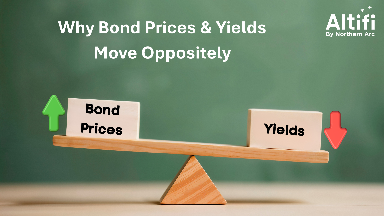
When prices rise, yields fall. When prices fall, yields rise. This see-saw effect reflects changes in interest rates, credit perception, inflation expectations, and market demand.
By understanding this relationship, investors can better interpret bond market movements, evaluate investment choices, and approach fixed-income investing with greater clarity and confidence.
FAQs
1. Why do bond prices and yields move in opposite directions?
Bonds pay a fixed amount of interest. If you buy a bond at a higher price, the return you earn is lower. If you buy it at a lower price, the return is higher. This is why when bond prices go up, yields go down and vice versa.
2. What happens to bonds when interest rates change?
When interest rates rise, new bonds offer higher interest, so older bonds become less attractive and their prices fall. When interest rates fall, existing bonds with higher interest become more valuable and their prices rise.
3. Does a falling bond price mean I am losing money?
Not necessarily. Bond prices change in the market every day. If you hold a bond until maturity and the issuer repays it, you still receive the face value and interest, regardless of price changes in between.
4. Why do some bonds offer higher yields than others?
Higher yields usually reflect higher risk, longer maturity, or lower demand. Bonds with lower risk or shorter maturity generally offer lower yields.
5. Should I look at bond price or yield?
Both matter. Price tells you how much you pay today, while
yield tells you what return you earn. Yield is often used to compare different
bonds, while price helps understand market movements.
Disclaimer:
The information contained in this Article (“Article”) is for general informational purposes only. Northern Arc Capital Limited (“Northern Arc”) does not make any warranties about the completeness, reliability, and accuracy of this information. Any action you take upon the information contained in this Article is strictly at your own risk, and Northern Arc will not be liable for any losses and damages in connection with the use of our Article.
The data included in this Article has been obtained from sources that are believed to be reliable and accurate at the time of publication. However, Northern Arc does not guarantee the accuracy or completeness of any information, nor does it assume any responsibility or liability for any errors or omissions therein. Any opinions expressed herein are subject to change without notice and Northern Arc is under no obligation to update or keep current the information contained in this Article.
This Article is not intended to constitute, and should not be construed as, investment advice or a recommendation to purchase, sell, or hold any security or to engage in any investment strategy or transaction. Readers should not rely solely on the information provided in this Article for making investment decisions and should conduct their own due diligence or seek the advice of a qualified professional.
The content of this Article is for informational purposes only and is not a solicitation or an offer to buy or sell any securities or financial instruments. Northern Arc is not responsible for any investment decisions made by the recipients of this Article. Readers should take independent financial advice from a qualified professional in connection with, or independently research and verify, any information that is provided in this Article and wish to rely upon, whether for the purpose of making an investment decision or otherwise.
Northern Arc and its affiliates, directors, employees, and agents expressly disclaim any and all liability for any direct or indirect losses, damages, or expenses of any kind arising out of or relating to the use of this Article, including but not limited to, any losses related to the accuracy, completeness, timeliness, or reliability of such information.
This Article may contain forward-looking statements that are based on current expectations, estimates, forecasts, and projections about the markets in which Northern Arc operates, as well as management’s beliefs and assumptions. Forward-looking statements are not guarantees of future performance and involve certain risks and uncertainties, which are difficult to predict. Past performance is not indicative of future results.
This report is intended solely for the recipient and is not for further circulation. Any distribution, modification, reproduction, or disclosure of the contents of this Article, in whole or in part, without the prior written consent of Northern Arc, is strictly prohibited.