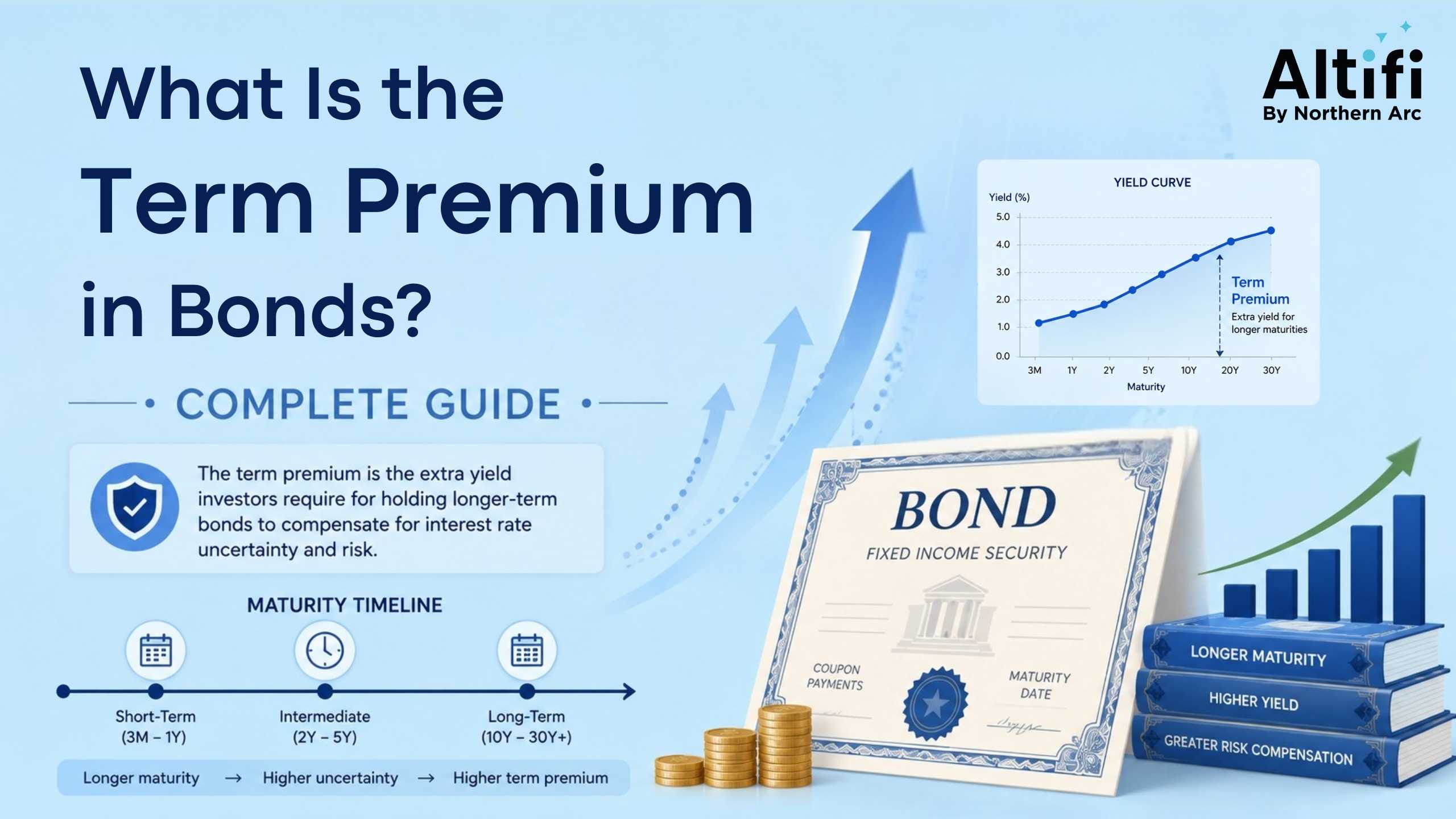
When investing in bonds, longer-term securities often offer higher yields than shorter-term ones. One reason for this difference is the term premium. It is the additional return investors may expect for holding a bond with a longer maturity and greater exposure to risks such as interest rate changes. Understanding the term premium can help investors interpret bond yields, compare different maturities, and make more informed fixed-income investment decisions.
What is the Term Premium?
The term premium is the extra yield a long-term bond offers over what an investor would earn by rolling over short-term instruments repeatedly across the same period. It is not the coupon rate. The coupon is the fixed interest an issuer pays on the face value (par value) of a bond. The term premium sits inside the YTM of a long-term bonds, it is the portion investors demand purely for holding duration risk, separate from where they expect short-term rates to average out.
Why Does the Term Premium Exist?
Investors expect additional compensation for taking on the extra risks associated with longer-term bonds.
Interest rate risk
Longer-duration bonds witness sharper price swings for every basis point move in rates. Duration measures this sensitivity.
Inflation risk
A fixed coupon set today may lose real value if inflation runs above expectations over a 10-year horizon.
Liquidity risk
Longer-dated papers can see wider bid-ask spreads in the secondary market, particularly during stress periods.
Credit risk
Longer-term bonds carry greater credit uncertainty, as an issuer's financial position may change over time. Investors may therefore expect additional compensation for accepting this risk.
Each of these risks pushes investors to demand more yield. Together, they build the term premium.
How is the Term Premium Calculated?
The term premium is estimated by comparing long-term bond yields with expected future short-term interest rates.
Term Premium = Long-term bond yield − Average expected future short-term rate
Example: the 10-year G-Sec yield is around 6.7% (Capera live yield curve data, 6 July 2026). If the market expects the repo rate to average roughly 5.7% over the decade, the indicative term premium works out to approximately 100 basis points. (Figures are approximate and subject to change based on market conditions.)
Yield Curve and the Term Premium
Long-dated G-Secs are yielding well above the 1-year rate right now, per Capera's July 6 data , a gap of about 101 basis points. Part of that gap is just the market betting rates stay higher down the road. The rest is investors charging extra to lock money up for a decade instead of a year. When that gap widens, it's usually one of those two things moving, not risk going up or down.
Example of Term Premium in India
The rise in interest rates during FY 2022–23 was characterised by an increase in the repo rate from 4.00% to 6.50% as the Reserve Bank of India (RBI) sought to curb high inflation. During this period, short-term interest rates rose sharply, while long-term government bond yields increased by a smaller margin, resulting in a lower term premium. More recently, the RBI maintained the repo rate at 5.25% in its June 2026 monetary policy, while the yield on the 10-year Government Security (G-Sec) remained around 6.69%–6.76% in early July 2026 amid easing crude oil prices and continued foreign portfolio inflows into government securities. Such changes in policy rates, inflation expectations, and long-term bond yields influence the level of the term premium over time.
Why Does the Term Premium Matter to Investors?
Understanding the term premium helps investors evaluate whether the extra return justifies the additional risk.
- A wider term premium may mean long bonds offer more compensation, subject to credit and market risk.
- A narrowing premium suggests limited extra reward for taking on longer duration.
- It helps investors read whether a high yield reflects genuine uncertainty or simply expectations that rates stay elevated.
How Investors Can Use the Term Premium
The term premium can support investment decisions related to bond selection and portfolio construction.
Match duration to time horizon
A longer horizon may make a wider term premium more relevant.
Track the yield curve shape
Steepening or flattening curves signal shifts in the premium.
Compare across instruments
When the term premium is wide, long bonds may offer a different risk-adjusted profile than fixed deposits of similar tenure, though tax treatment depends on individual circumstances, consult a qualified tax professional.
Consider laddering
Spreading holdings across 2, 5, and 10-year maturities can diversify exposure to term premium changes.
Term Premium in the Current Market Environment
Current market indicators provide useful context for understanding today's term premium.
- Repo rate: 5.50% (reduced by 50 basis points in June 2026).
- 10-year G-Sec yield: approximately 6.69–6.76% as of early July 2026.
- 10Y–1Y spread: approximately +101 basis points.
- Foreign portfolio investors bought over ₹351 billion of Indian government bonds in the month to early July 2026, supporting demand at the long end.
Figures are approximate and subject to change based on prevailing market conditions.
Conclusion
The term premium is the compensation embedded in a long-term bond's yield for the extra uncertainty of holding it. It moves with RBI policy, inflation expectations, government borrowing, and foreign investor demand. Reading the yield curve and comparing current spreads against historical averages can help first-time investors understand whether long-duration bonds are offering meaningful compensation, or whether the additional yield mainly reflects expectations already priced in.
FAQs on Term Premium in Bonds
Why is the term premium important in bond investing?
It shows how much extra yield the market is offering purely for holding duration risk, helping investors determine whether long bonds are adequately compensating for that risk at current prices.
Is the term premium the same as a bond's coupon rate?
No. The coupon is the fixed interest paid on face value. The term premium is a component of the bond's overall yield, reflecting compensation for holding a longer maturity.
What factors influence the term premium?
Interest rate expectations, inflation uncertainty, liquidity conditions, and the volume of government borrowing all influence how the term premium moves over time.
How is the term premium different from the credit spread?
Credit spread reflects compensation for an issuer's credit risk relative to a benchmark, historically associated with lower default risk for higher-rated issuers. The term premium reflects compensation purely for maturity and duration, independent of issuer quality.
What should investors consider when evaluating the term premium?
Investors may consider their time horizon, the current shape of the yield curve, and how the indicative yield on offer compares with historical term premium levels, alongside credit and liquidity risk.
Disclaimer:
The information contained in this newsletter (“Newsletter”) is for general informational purposes only. Northern Arc Capital Limited (“Northern Arc”) does not make any warranties about the completeness, reliability, and accuracy of this information. Any action you take upon the information contained in this Newsletter is strictly at your own risk, and Northern Arc will not be liable for any losses and damages in connection with the use of our Newsletter.
The data included in this Newsletter has been obtained from sources that are believed to be reliable and accurate at the time of publication. However, Northern Arc does not guarantee the accuracy or completeness of any information, nor does it assume any responsibility or liability for any errors or omissions therein. Any opinions expressed herein are subject to change without notice and Northern Arc is under no obligation to update or keep current the information contained in this Newsletter.
This Newsletter is not intended to constitute, and should not be construed as, investment advice or a recommendation to purchase, sell, or hold any security or to engage in any investment strategy or transaction. Readers should not rely solely on the information provided in this Newsletter for making investment decisions and should conduct their own due diligence or seek the advice of a qualified professional.
The content of this Newsletter is for informational purposes only and is not a solicitation or an offer to buy or sell any securities or financial instruments. Northern Arc is not responsible for any investment decisions made by the recipients of this Newsletter. Readers should take independent financial advice from a qualified professional in connection with, or independently research and verify, any information that is provided in this Newsletter and wish to rely upon, whether for the purpose of making an investment decision or otherwise.
Northern Arc and its affiliates, directors, employees, and agents expressly disclaim any and all liability for any direct or indirect losses, damages, or expenses of any kind arising out of or relating to the use of this Newsletter, including but not limited to, any losses related to the accuracy, completeness, timeliness, or reliability of such information.
This Newsletter may contain forward-looking statements that are based on current expectations, estimates, forecasts, and projections about the markets in which Northern Arc operates, as well as management’s beliefs and assumptions. Forward-looking statements are not guarantees of future performance and involve certain risks and uncertainties, which are difficult to predict. Past performance is not indicative of future results.
This report is intended solely for the recipient and is not for further circulation. Any distribution, modification, reproduction, or disclosure of the contents of this Newsletter, in whole or in part, without the prior written consent of Northern Arc, is strictly prohibited.