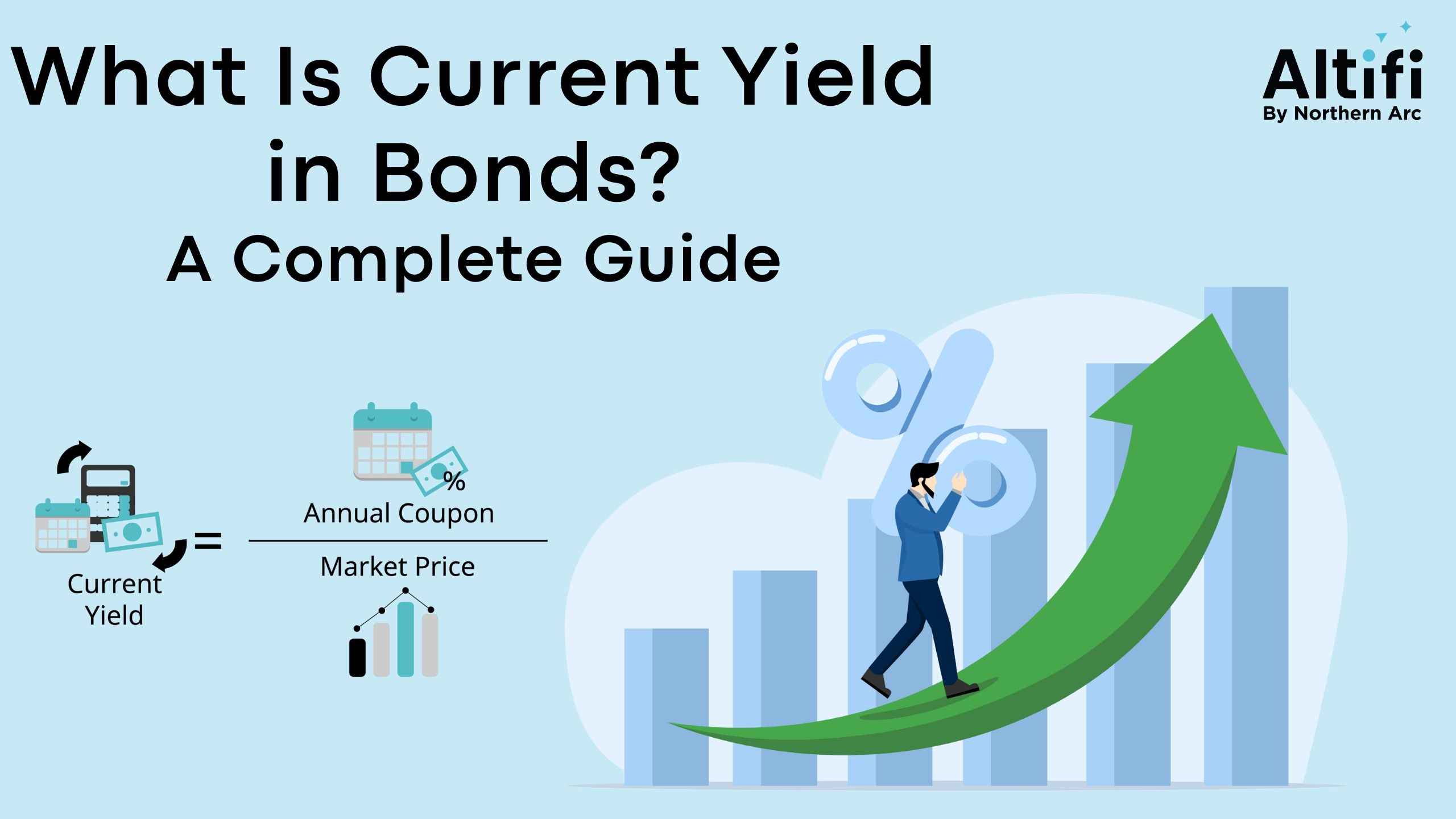
Investors looking to buy bonds need to evaluate the income generated by the bond compared to its market price and not the face value of the bond. In such situations, the current yield is an effective metric. The current yield is a straightforward calculation that helps estimate the income return of the bond using its market price. However, current yield cannot be used to estimate the total return of the bond. Let's explore it in detail in this guide.
What is Current Yield?
Current yield is the annual interest income generated by a bond expressed as a percentage of its current market price.
Unlike the coupon rate, which is calculated using the bond's face value, current yield changes whenever the bond's market price changes.
The formula is:
Current Yield (%) = (Annual Coupon Payment ÷ Current Market Price) × 100
For example, suppose a bond pays an annual coupon of ₹900 and is currently trading at ₹10,500.
Current Yield = (₹900 ÷ ₹10,500) × 100 = 8.57%
This means an investor buying the bond at ₹10,500 would earn annual coupon income equal to 8.57% of the purchase price, before taxes and transaction costs.
Current yield reflects only the bond's annual coupon income. It does not include any gain or loss that may arise if the bond is sold or redeemed.
How To Calculate Current Yield
Calculating current yield requires only two figures.
Step 1: Identify the annual coupon payment.
This is the total interest the bond pays in one year.
Step 2: Find the bond's current market price.
This is the price at which the bond is currently trading, which may differ from its face value.
Step 3: Apply the formula.
Current Yield = (Annual Coupon Payment ÷ Current Market Price) × 100
Example 1
- Face value: ₹10,000
- Coupon rate: 8%
- Annual coupon: ₹800
- Current market price: ₹10,000
Current Yield = (₹800 ÷ ₹10,000) × 100 = 8%
Example 2
- Face value: ₹10,000
- Coupon rate: 8%
- Annual coupon: ₹800
- Current market price: ₹9,500
Current Yield = (₹800 ÷ ₹9,500) × 100 = 8.42%
Although both bonds pay the same coupon, the bond trading at a lower price has a higher current yield.
Factors That Affect Current Yield
Current yield changes whenever either the annual coupon or the market price changes.
The main factors include:
- Bond price: When the market price falls, current yield rises. When the price rises, current yield falls.
- Coupon payment: Higher annual coupon payments generally increase current yield if the market price remains unchanged.
- Interest rates: Rising market interest rates often reduce existing bond prices, which may increase current yield.
- Issuer credit risk: Changes in an issuer's perceived creditworthiness may affect the bond's market price.
- Market demand and liquidity: Strong demand may increase prices, while lower demand may reduce them.
Current yield is therefore a dynamic measure that changes as market prices fluctuate.
Current Yield Vs Yield To Maturity (YTM)
Factor | Current Yield | Yield to Maturity (YTM) |
Measures | Annual income relative to current price | Estimated total annualised return if held until maturity |
Uses market price | Yes | Yes |
Includes coupon payments | Yes | Yes |
Includes capital gain or loss at maturity | No | Yes |
Considers time remaining to maturity | No | Yes |
Assumes reinvestment of coupons | No | Yes, under standard YTM assumptions |
Current yield provides a quick income measure, while YTM offers a more comprehensive estimate of potential returns if the bond is held until maturity.
For investors comparing long-term bond investments, YTM generally provides a more complete picture than current yield alone.
Limitations Of Current Yield
Current yield is easy to calculate, but it has important limitations.
It does not:
- Include capital gains or losses if the bond is redeemed at face value.
- Consider the time remaining until maturity.
- Reflect reinvestment of coupon payments.
- Measure the bond's total return.
- Capture reinvestment risk or interest-rate risk.
For investors planning to hold a bond until maturity, Yield to Maturity generally provides a more complete assessment.
Investors should therefore avoid making decisions based solely on current yield.
How Investors Use Current Yield When Evaluating Bonds
Current yield is commonly used as an initial comparison tool.
It can help investors:
- Compare the income generated by similar bonds.
- Assess whether a bond's income aligns with their objectives.
- Understand how market price movements affect income returns.
- Screen bonds before conducting more detailed analysis.
However, investors should also review:
- Yield to maturity.
- Credit rating.
- Issuer financial strength.
- Remaining maturity.
- Coupon structure.
- Liquidity.
- Credit risk.
- Tax implications.
For example, two bonds may have similar current yields, but one may have a significantly higher credit risk or much longer maturity.
Looking beyond current yield can provide a more balanced assessment.
Conclusion
Current yield is a simple measure that shows the annual coupon income generated relative to a bond's current market price. It helps investors compare the income potential of different bonds, particularly when prices differ from face value. However, the disadvantage is that it fails to take into consideration the capital gains, the capital losses, and the maturity period of the bond. The investor needs to compare the current yield with other indicators like the Yield to Maturity, as well as analyse other aspects.
Frequently Asked Questions (FAQs)
How Does Bond Price Affect Current Yield?
Current yield moves inversely to the bond's market price. When the price falls, current yield increases. When the price rises, current yield decreases, assuming the coupon payment remains unchanged.
Can Current Yield Be Higher Than The Coupon Rate?
Yes. If a bond trades below its face value (at a discount), its current yield can exceed its coupon rate because the same annual coupon is divided by a lower market price.
Why Does A Discount Bond Have A Higher Current Yield?
A discount bond has a lower market price while continuing to pay the same coupon amount. Dividing the coupon by a lower price results in a higher current yield.
Why Does A Premium Bond Have A Lower Current Yield?
A premium bond trades above its face value. Since the annual coupon is divided by a higher market price, the current yield becomes lower than the coupon rate.
How Do Investors Use Current Yield To Compare Bonds?
Investors use current yield to compare the income generated by bonds trading at different market prices. It is often used as a starting point before evaluating other measures such as YTM, credit quality, maturity, and liquidity.
Does Current Yield Account For Capital Gains Or Losses?
No. Current yield considers only annual coupon income relative to the current market price. It does not include any capital gain or capital loss that may arise if the bond is sold or held until maturity.
Disclaimer:
The information contained in this newsletter (“Newsletter”) is for general informational purposes only. Northern Arc Capital Limited (“Northern Arc”) does not make any warranties about the completeness, reliability, and accuracy of this information. Any action you take upon the information contained in this Newsletter is strictly at your own risk, and Northern Arc will not be liable for any losses and damages in connection with the use of our Newsletter.
The data included in this Newsletter has been obtained from sources that are believed to be reliable and accurate at the time of publication. However, Northern Arc does not guarantee the accuracy or completeness of any information, nor does it assume any responsibility or liability for any errors or omissions therein. Any opinions expressed herein are subject to change without notice and Northern Arc is under no obligation to update or keep current the information contained in this Newsletter.
This Newsletter is not intended to constitute, and should not be construed as, investment advice or a recommendation to purchase, sell, or hold any security or to engage in any investment strategy or transaction. Readers should not rely solely on the information provided in this Newsletter for making investment decisions and should conduct their own due diligence or seek the advice of a qualified professional.
The content of this Newsletter is for informational purposes only and is not a solicitation or an offer to buy or sell any securities or financial instruments. Northern Arc is not responsible for any investment decisions made by the recipients of this Newsletter. Readers should take independent financial advice from a qualified professional in connection with, or independently research and verify, any information that is provided in this Newsletter and wish to rely upon, whether for the purpose of making an investment decision or otherwise.
Northern Arc and its affiliates, directors, employees, and agents expressly disclaim any and all liability for any direct or indirect losses, damages, or expenses of any kind arising out of or relating to the use of this Newsletter, including but not limited to, any losses related to the accuracy, completeness, timeliness, or reliability of such information.
This Newsletter may contain forward-looking statements that are based on current expectations, estimates, forecasts, and projections about the markets in which Northern Arc operates, as well as management’s beliefs and assumptions. Forward-looking statements are not guarantees of future performance and involve certain risks and uncertainties, which are difficult to predict. Past performance is not indicative of future results.
This report is intended solely for the recipient and is not for further circulation. Any distribution, modification, reproduction, or disclosure of the contents of this Newsletter, in whole or in part, without the prior written consent of Northern Arc, is strictly prohibited.