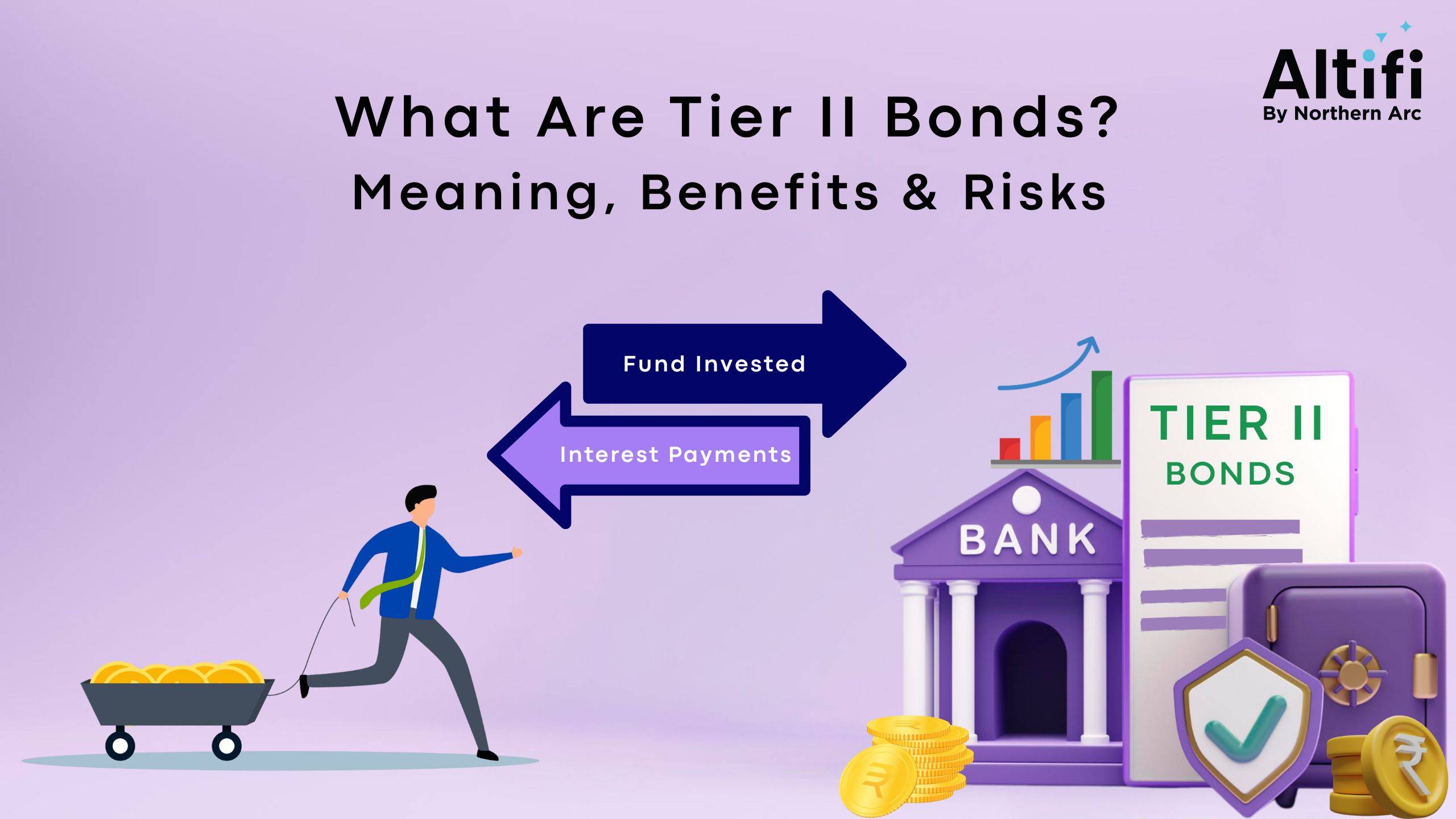
Tier II bonds play an important role in a bank's capital structure while also serving as an investment option for fixed-income investors. Since these instruments differ from conventional bonds in terms of their regulatory purpose, risk profile, and repayment structure, it is important to understand their key features before investing. They may offer relatively higher coupon rates than some traditional debt instruments, but this potential return is accompanied by a distinct risk profile. Understanding how Tier II bonds work can help investors assess whether they align with their investment objectives and risk appetite.
What are Tier II Bonds?
Tier II bonds are debt instruments issued by banks to raise supplementary capital under the Reserve Bank of India’s (RBI) Basel III framework. Banks in India are required to maintain a minimum capital adequacy ratio (CAR) to absorb potential losses, and Tier II capital forms the second layer of this regulatory capital, sitting alongside Tier 1 capital.
Tier II bonds are subordinated instruments, which means they rank below senior debt in the repayment hierarchy. In the event of financial stress, repayments are made to senior creditors first, while Tier II bondholders are paid after them.
How Tier II Bonds Work
Tier II bonds form part of a bank's supplementary capital and help meet the capital adequacy requirements prescribed by the RBI. Unlike Tier I capital, which absorbs losses while a bank continues operating, Tier II capital is designed to absorb losses if the bank enters liquidation or resolution.
Banks issue Tier II bonds to strengthen their capital base without diluting existing shareholders and to diversify their funding sources. However, only subordinated bonds that meet the RBI's eligibility criteria qualify as Tier II capital for regulatory purposes.
Key Features of Tier II Bonds
The following are a few key features of Tier II bonds that investors may want to be aware of.
Maturity and Redemption
Tier II bonds carry a fixed maturity period, generally a minimum of five years and in many cases extending to ten or fifteen years. Maturity refers to the date on which the principal amount is repaid to the bondholder, and this is a separate concept from duration, which relates to the bond's sensitivity to interest rate changes. At maturity, the principal is repaid provided the issuing bank has not reduced or written off the bond’s value due to financial stress.
Credit Rating
Tier II bonds are assigned a credit rating by agencies such as the CRISIL, ICRA and CARE Ratings. These ratings reflect the assessed credit quality of the specific instrument, which may differ from the issuing bank's overall rating. A bond rated in the higher categories is generally considered relatively less risky than one in the lower categories, though no rating offers an assurance against default.
Call Option
Some Tier II bonds may include a call option, which allows the issuing bank to redeem the bond before its scheduled maturity date, subject to RBI approval and a minimum lock-in period. A call option, where present, is detailed in the bond's offer document along with the applicable conditions.
Benefits of Tier II Bonds
The following are a few benefits associated with Tier II bonds.
Higher Yields
Tier II bonds have historically offered relatively higher than coupon rates than other traditional fixed-income options. This relatively higher yield reflects the additional subordination and credit risk associated with these instruments, and indicative yields are subject to change based on market conditions.
Diversification
For investors whose fixed income holdings are concentrated in government securities or bank-offered instruments, Tier II bonds may introduce exposure to a different risk-return segment. This diversification within the fixed income category may help spread issuer-specific risk across a broader base.
Risks of Tier II Bonds
The following are a few risks associated with Tier II bonds that investors should consider.
Credit Risk
The issuing bank's ability to make coupon payments and repay principal depends on its ongoing financial health. A downgrade in the issuer's rating may reduce the market value of the bond and may indicate a higher probability of default.
Liquidity Risk
Tier II bonds may not trade as frequently as government securities or highly rated corporate bonds in the secondary market. Investors looking to exit before maturity may find it difficult to locate buyers, or may need to accept a price below face value.
Interest Rate Risk
Like other fixed-coupon instruments, the market price of Tier II bonds tends to move in the opposite direction to prevailing interest rates. If market yields rise after a bond is purchased, its market price may decline. Longer-tenure Tier II bonds may be more sensitive to this movement compared to shorter-tenure instruments.
Who Should Invest in Tier II Bonds?
Tier II bonds are debt instruments that carry subordination, credit, and liquidity risk, which differs from the risk profile of bank-offered financial instruments such as fixed deposits. Assessing one's own risk appetite, investment horizon, and overall portfolio composition may be relevant before considering an allocation to Tier II bonds. Investors who are not in a position to absorb a partial or full loss of principal in a worst-case scenario may want to weigh this factor carefully against the relatively higher coupon on offer. Investors may also wish to consult a Securities and Exchange Board of India (SEBI) registered investment adviser to understand how these instruments may fit within an existing portfolio.
How to Evaluate Tier II Bonds
The following is a checklist that may help investors evaluate Tier II bonds before making an allocation decision.
- Review the credit rating assigned to the specific bond instrument, rather than relying solely on the issuing bank's overall rating, as credit ratings may differ at the instrument level.
- Check the bank's non-performing asset (NPA) ratio and capital adequacy ratio (CAR), which are available in quarterly financial disclosures and may indicate the bank's financial stability.
- Read the offer document for details on maturity date, coupon rate, coupon frequency, call option provisions, and write-down triggers, as each of these terms may affect the bond's risk-return profile.
- Consider the absence of Deposit Insurance and Credit Guarantee Corporation (DICGC) protection on Tier II bonds, which is a feature available on certain bank deposits up to a specified limit.
- Spread exposure across multiple issuers where possible, which may help reduce concentration in a single bank's credit profile.
- Transact only through platforms registered with SEBI or regulated by the RBI, which may provide a layer of regulatory oversight.
Conclusion
Tier II bonds are subordinated debt instruments that Indian banks issue to meet RBI’s capital requirement guidelines. These instruments may offer relatively higher coupon rates compared to certain conventional fixed income options, though this is accompanied by subordination, credit, and liquidity risk. Reviewing the issuer's credit rating, understanding the loss-absorption structure, and assessing one's own risk appetite are factors that may be relevant before considering an allocation to Tier II bonds.
FAQs on Tier II Bonds
What are Tier II bonds?
Tier II bonds are subordinated debt instruments issued by banks to raise supplementary regulatory capital. They carry a fixed maturity and contractual coupon payments, with losses absorbed only during liquidation or resolution.
Are Tier II bonds safe?
Tier II bonds carry subordination, credit, and liquidity risk, and do not carry DICGC protection. Their relative safety depends on the issuing bank's financial health and the instrument's credit rating at the time of investment.
How are Tier II bonds different from AT1 bonds?
Tier II bonds have a fixed maturity and contractual coupons, with losses absorbed during liquidation. AT1 bonds are perpetual with discretionary coupons, and losses may be absorbed while the bank continues to operate.
Why do Tier II bonds offer higher yields?
The relatively higher yield on Tier II bonds may reflect the additional subordination and credit risk associated with these instruments compared to senior debt or bank-offered financial instruments.
Disclaimer
The information contained in this newsletter (“Newsletter”) is for general informational purposes only. Northern Arc Capital Limited (“Northern Arc”) does not make any warranties about the completeness, reliability, and accuracy of this information. Any action you take upon the information contained in this Newsletter is strictly at your own risk, and Northern Arc will not be liable for any losses and damages in connection with the use of our Newsletter.
The data included in this Newsletter has been obtained from sources that are believed to be reliable and accurate at the time of publication. However, Northern Arc does not guarantee the accuracy or completeness of any information, nor does it assume any responsibility or liability for any errors or omissions therein. Any opinions expressed herein are subject to change without notice and Northern Arc is under no obligation to update or keep current the information contained in this Newsletter.
This Newsletter is not intended to constitute, and should not be construed as, investment advice or a recommendation to purchase, sell, or hold any security or to engage in any investment strategy or transaction. Readers should not rely solely on the information provided in this Newsletter for making investment decisions and should conduct their own due diligence or seek the advice of a qualified professional.
The content of this Newsletter is for informational purposes only and is not a solicitation or an offer to buy or sell any securities or financial instruments. Northern Arc is not responsible for any investment decisions made by the recipients of this Newsletter. Readers should take independent financial advice from a qualified professional in connection with, or independently research and verify, any information that is provided in this Newsletter and wish to rely upon, whether for the purpose of making an investment decision or otherwise.
Northern Arc and its affiliates, directors, employees, and agents expressly disclaim any and all liability for any direct or indirect losses, damages, or expenses of any kind arising out of or relating to the use of this Newsletter, including but not limited to, any losses related to the accuracy, completeness, timeliness, or reliability of such information.
This Newsletter may contain forward-looking statements that are based on current expectations, estimates, forecasts, and projections about the markets in which Northern Arc operates, as well as management’s beliefs and assumptions. Forward-looking statements are not guarantees of future performance and involve certain risks and uncertainties, which are difficult to predict. Past performance is not indicative of future results.
This report is intended solely for the recipient and is not for further circulation. Any distribution, modification, reproduction, or disclosure of the contents of this Newsletter, in whole or in part, without the prior written consent of Northern Arc, is strictly prohibited.