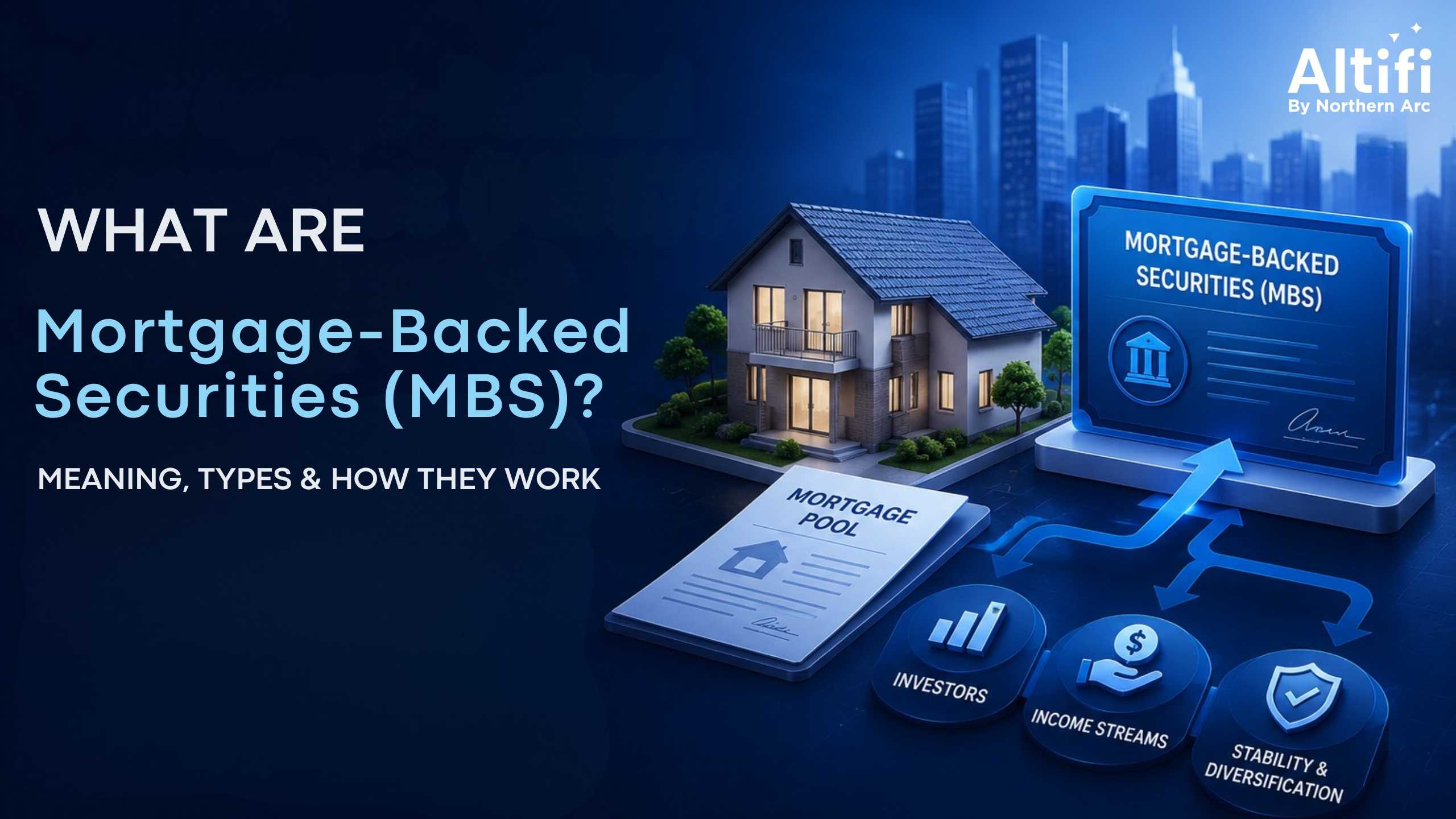
When a bank lends money for a home, it does not always keep that loan on its books until the last EMI is paid. Instead, the bank or housing finance company may sell the loan to a loan pool, which serves as the underlying asset for bonds or other securities purchased by investors. These bonds are called mortgage-backed securities. They let lenders free up capital for fresh loans and give investors a way to earn returns backed by real estate debt. This concept powers a large part of global fixed-income markets and, more recently, has started gaining ground in India too. This article breaks down what MBS are, how they are structured, and what investors ought to know before considering them.
What are Mortgage-Backed Securities (MBS)?
MBS are bonds created by pooling certain number of home loans with the objective of selling their aggregate income flows to investors. When the owners of the home loan pay back on a monthly basis, the money received is paid to the owners of MBS with a certain percentage being taken as the servicing charge. In this manner, MBS acts as a medium for making illiquid home loans into liquid assets. Through this process, the bank transfer some or all of the economic exposure associated with the underlying receivables, depending on the structure and applicable regulatory requirements.
How Do Mortgage-Backed Securities Work?
This process depends on a basic sequence: a lender lends to homeowners, pools the mortgage loans and then sells the pool to a special purpose vehicle (SPV). Bonds are then issued by the SPV using the pool as collateral, which are sold off to the investors. The SPV pays the proceeds from the repayment of the mortgages to the investors, minus the administrative fees incurred in the process. Since thousands of loans are pooled in one pool, the impact of any single borrower’s default on the overall portfolio can reduce. However, it doesn’t eliminate credit risk.
Example of How an MBS Works
Consider the example where a housing finance company creates 1,000 home loans, each of ₹20 lakh, amounting to ₹200 crore worth of total mortgages. Instead of waiting 15 to 20 years to get the money back, the company transfers the mortgage portfolio to the SPV. SPV/trust then structures the receivables into securities, such as Pass-Through Certificates (PTCs), which are issued to investors and sells the securities to institutional investors like insurance companies and pension funds. Every month, when the borrowers make their EMI payments, these payments are transferred to the SPV, which then distributes them to the security holders based on the size of their investment.
How are Mortgage-Backed Securities Created?
Here is how mortgage-backed securities are created.
1. Origination
A bank or housing finance company disburses home loans to individual borrowers.
2) Pooling
A batch of similar loans, matched by tenure, interest rate or credit quality, gets grouped into one pool.
3. Transfer to SPV
The selected pool of mortgage receivables is transferred or assigned to the SPV/trust according to the transaction structure.
4) Tranche formation
Where the transaction is structured into different risk classes, the securities may be divided into tranches with different priority, risk and return characteristics.
5. Rating
Credit rating agencies rate the pool and tranches in the pool.
6) Issue of securities
SPV issues securities called pass-through certificates (PTCs) and sells them to investors.
7. Pass-through repayment
EMIs of borrowers are passed on to the investors by the SPV at certain intervals until maturity of the pool.
Types of Mortgage-Backed Securities
The different types of mortgage-backed securities are as follows.
- Residential Mortgage-Backed Securities (RMBS): These securities are based on residential mortgages for individual houses. This is the most popular form worldwide market of asset-backed securities by asset type.
- Commercial Mortgage-Backed Securities (CMBS): These securities are based on mortgages on commercial properties such as office buildings, shopping malls, and hotels. There are special features about them because there are different risks involved with commercial mortgages than those of household mortgages.
- Pass-Through Securities: This is the simplest form, wherein the investor gets the proportional share of the interest and principal payments received from the borrowers.
- Collateralised Mortgage Obligations (CMOs): More complex than pass-through securities, wherein the pools of mortgages are divided into tranches with differing maturity periods and risks.
Mortgage-Backed Securities in India
MBS are not new in India, although the market is still relatively small as compared to that in the West. The National Housing Bank launched India's pilot MBS issues in August 2000, after which the total volume was estimated at about ₹862 crore. The very first issue, of ₹59.7 crore, was originated by HDFC Ltd, while up until October 2004, the NHB made ten MBS issues, with the total value being around ₹512 crore from more than 35,000 housing lo ans.
Regulatory Framework
The NHB encourages housing finance and facilitates the securitisation process, while SEBI is responsible for regulating the issuance and trading of MBS in capital markets. The SARFAESI Act facilitates securitisation and recovery of secured assets, and securities like Pass Through Certificates reflect the investors’s interest in the cash flows generated from a pool of loans. As per the 2025 Securitisation Directions of RBI, Mortgage Backed Securities are notes issued by a SPV against exposures secured by commercial and residential real estate.
Current Standing
India offers MBS products, but the market remains small and dominated by institutional players, with relatively less retail presence in the market. Contrastingly, the global MBS market is estimated to grow to USD 15.55 trillion in 2025, and is projected to reach USD 22.43 trillion by 2030, representing a CAGR of 7.6%.
Benefits of Mortgage-Backed Securities
The advantages of mortgage-backed securities include:
- Gives investors exposure to real estate-backed debt without directly purchasing property
- Offers portfolio diversification, since mortgage cash flows behave differently from equities or corporate bonds
- Frees up capital for banks and housing finance companies to disburse fresh loans
- Provides a fixed-income stream through regular EMI-linked payouts
- Typically comes with credit ratings and disclosures that assist investors in assessing the underlying risk
- Supports the broader housing finance ecosystem by widening the funding pool available to lenders
Risks of Investing in Mortgage-Backed Securities
The following risks are involved in mortgage-backed securities.
- Prepayment risk: The repayment of loans by borrowers ahead of schedule could limit their profitability.
- Credit risk: In case there is a considerable proportion of defaulted borrowers, cash flows to investors will be less.
- Interest rate risk: Higher interest rates may affect the market value of MBS currently held.
- Liquidity risk: MBS lack liquidity compared to government securities and equity securities in India.
- Complexity: To understand MBS requires some knowledge in finance, thus making it unappealing for a first-time investor.
Who May Consider Investing in Mortgage-Backed Securities?
MBS cater to institutional investors like insurance companies, pension funds, and mutual funds that require long-duration debt instruments to meet their liabilities. The instruments could also be of interest to seasoned investors who know the implications of credit and prepayment risks and seek exposure to more than bonds. Investors having low-risk tolerance, or those seeking liquidity easily, could find themselves not very interested in MBS owing to a thin secondary market in India currently.
Conclusion
Mortgage-backed securities create a linkage between two entirely distinct markets – the mortgage which a family may take for purchasing a house and the fixed-income market of the institutional investor who is thousands of kilometres away from it. They help to ensure that credit remains on tap, while providing the investors access to real estate debt without holding any physical assets. As regards the market in India, it is in its early stages and regulated by RBI, NHB and SEBI. However, the regulatory environment is becoming increasingly mature. The key thing for investors is balancing their income from MBS and the risks involved.
FAQs on Mortgage-Backed Securities
What is mortgage-backed security in simple terms?
It refers to bonds, which are formed by packaging home loans. Here, investors earn from the EMI payments made by the borrowers every month.
How do mortgage-backed securities work?
In this process, a lender sells the collection of home loans to the special purpose vehicle, which creates securities over this collection. The payment received by the borrowers goes to the investors of this security.
What are the types of mortgage-backed securities?
Some common types include Residential Mortgage Backed Securities (RMBS), Commercial Mortgage Backed Securities (CMBS), pass-through securities, and collateralised mortgage obligations (CMOs).
Are mortgage-backed securities available in India?
There are some mortgage-backed securities in India, but the market for the same is relatively small and dominated by institutions.
What are the main risks of investing in MBS?
The major risks involved are prepayment risk, credit risk, interest rate risk, and liquidity risk.
How did mortgage-backed securities cause the 2008 financial crisis?
Home loans that were classified as subprime were provided in large numbers in America and were converted to MBS, which were overrated. As many homeowners defaulted on their loan obligations, losses were incurred by the whole financial sector and hence led to a global financial crisis.
What is the difference between MBS and asset-backed securities (ABS)?
Mortgage-backed securities are backed specifically by mortgages, while asset-backed securities may have different loans as backing, including auto loans and personal loans, among others. This means that all MBS are ABS but not all ABS are MBS.
Who typically invests in mortgage-backed securities?
Most of the investors in MBS include insurance firms, pension funds and mutual funds, among others.
Disclaimer:
The information contained in this newsletter (“Newsletter”) is for general informational purposes only. Northern Arc Capital Limited (“Northern Arc”) does not make any warranties about the completeness, reliability, and accuracy of this information. Any action you take upon the information contained in this Newsletter is strictly at your own risk, and Northern Arc will not be liable for any losses and damages in connection with the use of our Newsletter.
The data included in this Newsletter has been obtained from sources that are believed to be reliable and accurate at the time of publication. However, Northern Arc does not guarantee the accuracy or completeness of any information, nor does it assume any responsibility or liability for any errors or omissions therein. Any opinions expressed herein are subject to change without notice and Northern Arc is under no obligation to update or keep current the information contained in this Newsletter.
This Newsletter is not intended to constitute, and should not be construed as, investment advice or a recommendation to purchase, sell, or hold any security or to engage in any investment strategy or transaction. Readers should not rely solely on the information provided in this Newsletter for making investment decisions and should conduct their own due diligence or seek the advice of a qualified professional.
The content of this Newsletter is for informational purposes only and is not a solicitation or an offer to buy or sell any securities or financial instruments. Northern Arc is not responsible for any investment decisions made by the recipients of this Newsletter. Readers should take independent financial advice from a qualified professional in connection with, or independently research and verify, any information that is provided in this Newsletter and wish to rely upon, whether for the purpose of making an investment decision or otherwise.
Northern Arc and its affiliates, directors, employees, and agents expressly disclaim any and all liability for any direct or indirect losses, damages, or expenses of any kind arising out of or relating to the use of this Newsletter, including but not limited to, any losses related to the accuracy, completeness, timeliness, or reliability of such information.
This Newsletter may contain forward-looking statements that are based on current expectations, estimates, forecasts, and projections about the markets in which Northern Arc operates, as well as management’s beliefs and assumptions. Forward-looking statements are not guarantees of future performance and involve certain risks and uncertainties, which are difficult to predict. Past performance is not indicative of future results.
This report is intended solely for the recipient and is not for further circulation. Any distribution, modification, reproduction, or disclosure of the contents of this Newsletter, in whole or in part, without the prior written consent of Northern Arc, is strictly prohibited.