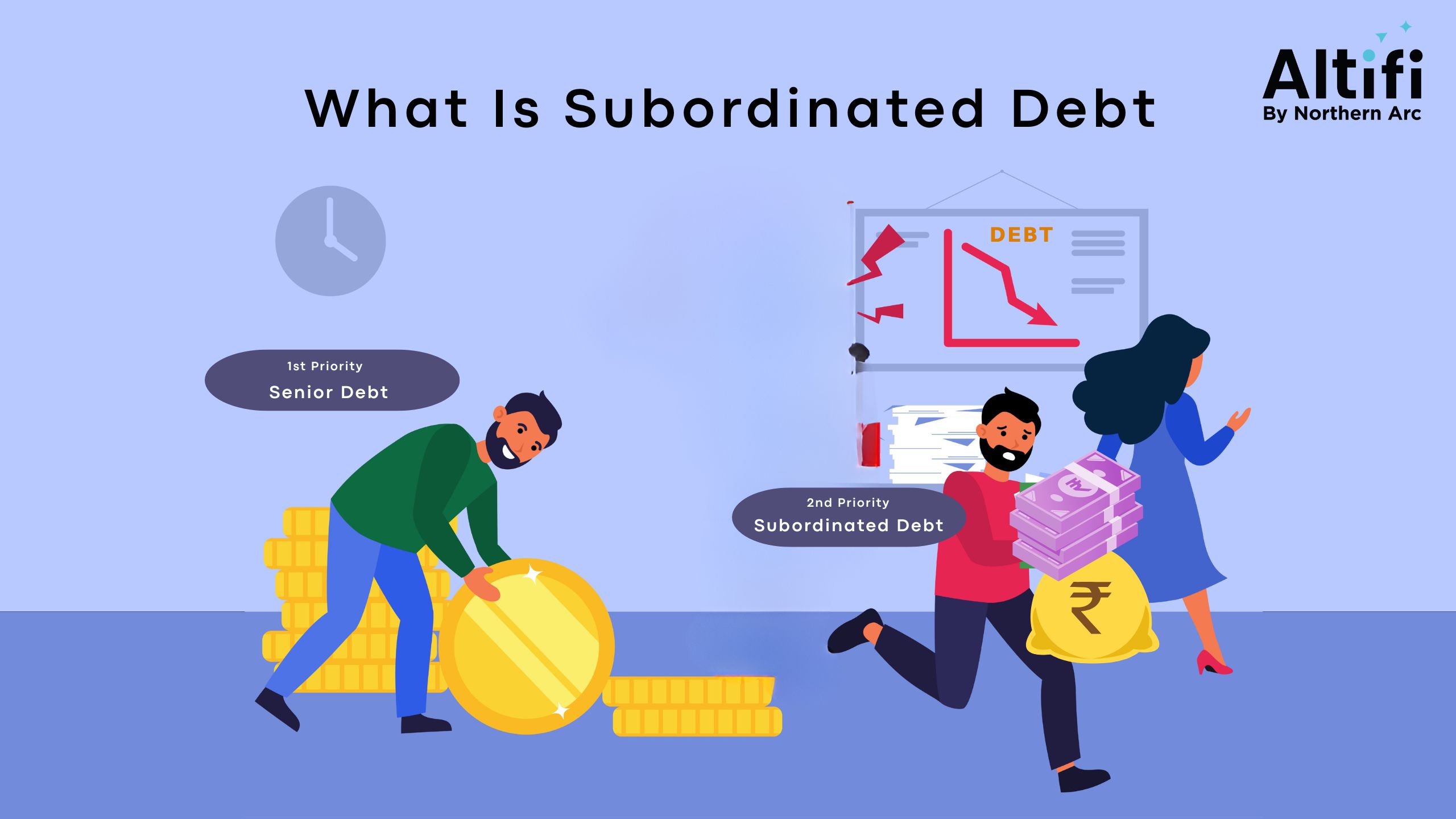
Subordinated debt refers to a category of borrowing that ranks below senior debt in the order of repayment in the event of a borrower's liquidation or default. Subordinated debt ranks below senior debt in the repayment hierarchy and therefore has a lower claim on the issuer's assets during liquidation or insolvency. This lower ranking highlights how debt structures can differ in terms of repayment priority and investor protection. Such variations reflect the broader design of fixed-income markets, where instruments are tailored to balance risk and reward. In this way, subordinated debt illustrates how capital flows are organised within the lending system.
Understanding Subordinated Debt
The term "subordinated" reflects the lower priority these types of bonds have during insolvency. So, if a company or financial institution faces insolvency, holders of subordinated debt may receive repayments only after senior creditors have been paid in full.
Subordinated debt may be issued by banks, non-banking financial companies (NBFCs), and corporates. In the banking context, certain subordinated instruments such as Tier-2 bonds issued by banks qualify as regulatory capital under the Reserve Bank of India (RBI) guidelines, which is one of the primary reasons banks issue these instruments.
How it Works
To understand how this works, let’s consider the capital structure of a typical company. A company's capital is broadly divided into equity and debt. Within debt, there are layers. Senior secured debt occupies the top position, backed by specific collaterals. Senior unsecured debt follows. Subordinated debt ranks below both.
Subordinated debt instruments pay periodic coupon payments to investors. The coupon rates on these instruments may be higher than those on senior debt issued by the same entity, reflecting the relatively higher risk that subordinated bondholders bear. This is because, in a default scenario, subordinated creditors have lower priority than senior creditors and may recover less, or in some cases, nothing at all.
Types of Subordinated Debt
The following are the primary types of subordinate debt instruments:
Subordinated Bonds
These are debt instruments issued by companies, banks, or financial institutions that rank below senior debt obligations in the repayment hierarchy.
Tier-2 Capital Bonds
Issued by banks and regulated by the RBI under Basel III norms, Tier-2 bonds qualify as supplementary regulatory capital. They are subordinated to depositors and senior creditors but rank above equity in the repayment order.
Mezzanine Debt
A hybrid form of financing that may combine features of subordinated debt and equity. Mezzanine instruments may include conversion options and are typically used in project finance or corporate acquisitions.
Convertible Subordinated Debt
Convertible subordinated debt allows the debt instrument to be converted into equity shares of the issuing company under predefined terms and conditions.
Payment-in-Kind (PIK) Notes
Payment-in-Kind (PIK) notes are subordinated instruments where interest may be added to the principal amount instead of being paid in cash during specified periods, subject to the terms of the issue.
Benefits of Subordinated Debt and Why They are Issued
The following are some key reasons why subordinated debt may be issued by companies and financial institutions:
1. Regulatory Capital Compliance for Banks
Banks may issue Tier-2 subordinated bonds to meet capital adequacy requirements under the Basel III framework adopted by the Reserve Bank of India (RBI). These instruments may support a bank's capital management without issuing additional equity.
2. Cost of Capital Considerations
In certain situations, subordinated debt may provide an alternative source of funding compared to issuing fresh equity. Coupon payments may also be treated as an interest expense for the issuer, subject to applicable tax regulations.
3. Access to a Broader Investor Base
Issuing subordinated debt may allow companies to access different categories of investors, including institutional investors and high-net-worth individuals seeking fixed-income opportunities.
4. Relatively Higher Coupon Rates
Subordinated bonds may offer relatively higher coupon rates than senior debt issued by the same entity. This difference may reflect the additional risk associated with their lower repayment priority.
5. Defined Repayment Structure
Unlike equity, subordinated debt generally has predefined coupon payment terms and a specified maturity date, subject to the issue conditions.
6. Portfolio Diversification
Subordinated debt may provide exposure to a different risk profile within the fixed-income segment and may form one component of a broader debt portfolio.
Risks and Limitations of Subordinated Debt
The following are some risks and limitations associated with subordinated debt.
1. Subordination Risk
In the event of liquidation or insolvency, subordinated debt holders are generally repaid only after senior creditors. This may affect the recovery amount available to investors.
2. Relatively Higher Credit Risk
Due to their lower repayment priority, subordinated instruments may carry relatively higher credit risk than senior debt issued by the same entity.
3. Coupon Deferral or Suspension
Certain subordinated instruments, particularly those issued by banks, may include provisions allowing coupon payments to be deferred or suspended under specified conditions.
4. Liquidity Risk
Subordinated bonds may trade less frequently in the secondary market. As a result, investors may face challenges when seeking to sell these instruments before maturity.
5. Complex Instrument Structure
Some subordinated debt instruments may contain features such as call options, conversion provisions, or loss-absorption mechanisms that require careful review.
6. Regulatory Changes
Changes in regulatory requirements or capital norms may affect the treatment, eligibility, or terms of certain subordinated debt instruments.
Senior Debt vs Subordinated Debt: Key Differences
The following table outlines the key differences between senior debt and subordinated debt:
Parameter | Senior Debt | Subordinated Debt |
Repayment Priority | Generally, ranks higher in the repayment hierarchy and may be repaid before subordinated obligations in the event of liquidation or insolvency. | Generally, ranks below senior debt and may be repaid only after senior obligations have been settled. |
Credit Risk | May carry relatively lower credit risk due to its higher repayment priority. | May carry relatively higher credit risk because of its lower repayment priority. |
Coupon Rates | May offer relatively lower coupon rates compared to subordinated debt issued by the same entity. | May offer relatively higher coupon rates to reflect the additional risk associated with subordination. |
Covenants | May include more restrictive covenants aimed at protecting lenders. | May contain fewer covenants compared to senior debt, depending on the issue structure. |
Collateral | May be secured by specific assets of the issuer, depending on the issue structure. | May be unsecured or have limited security, depending on the issue terms. |
Purpose | Generally used for business expansion, asset purchases, refinancing, or other funding requirements. | Generally used to supplement existing financing arrangements, support growth initiatives, or meet regulatory capital requirements in certain cases. |
How to Invest in Subordinated Bonds
The following steps outline a typical process for investing in subordinated bonds.
Access an Investment Platform or Intermediary
Use a registered bond investment platform, broker, or other eligible intermediary that offers access to subordinated bond issuances or listed bonds.
Complete the Required Formalities
Ensure the necessary Know Your Customer (KYC) requirements and Demat account formalities have been completed.
Review Available Subordinated Bonds
Examine details such as the issuer, credit rating, tenure, coupon structure, repayment terms, and subordination provisions.
Evaluate the Issue Terms
Review the offer document or bond information memorandum to understand the rights, obligations, and risks associated with the instrument.
Place an Investment Order
Select the bond and complete the investment transaction through the chosen platform or intermediary.
Monitor the Investment
Track coupon payments, issuer updates, credit rating changes, and maturity-related information through the relevant platform or account statement.
Conclusion
Subordinated debt is a distinct layer within the fixed-income capital structure, carrying a specific risk profile that sets it apart from senior debt instruments. The relatively lower repayment priority and the possibility of higher credit risk are key considerations to determine how these instruments are rated and priced. For investors exploring the fixed-income market, understanding the structure, terms, and credit assessment framework of subordinated bonds may be a relevant step in evaluating whether such instruments align with their overall approach to debt investing.
FAQs on Subordinated Debt
What is subordinated debt in simple terms?
Subordinated debt is a type of borrowing that ranks below senior debt in repayment priority, typically carrying relatively higher coupon rates to reflect the additional risk.
How is subordinated debt different from senior debt?
Subordinated debt is repaid after senior debt in a default scenario, may carry a relatively lower credit rating, and may offer higher coupon rates for the same issuer.
What happens to subordinated bondholders if the issuer defaults?
In a default, subordinated bondholders may receive repayment only after senior creditors are settled. Recovery may be partial or, in certain situations, may not occur at all.
Are subordinated bonds rated differently from senior bonds?
Yes. Rating agencies may assign a relatively lower credit rating to a subordinated bond compared to the senior debt of the same issuer, reflecting the repayment hierarchy.
How can investors access subordinated bonds in India?
Subordinated bonds can be accessed through SEBI-registered bond platforms, brokerages with a debt segment, or through primary issuances on recognised exchanges such as the NSE or BSE.
Disclaimer
The information contained in this newsletter (“Newsletter”) is for general informational purposes only. Northern Arc Capital Limited (“Northern Arc”) does not make any warranties about the completeness, reliability, and accuracy of this information. Any action you take upon the information contained in this Newsletter is strictly at your own risk, and Northern Arc will not be liable for any losses and damages in connection with the use of our Newsletter.
The data included in this Newsletter has been obtained from sources that are believed to be reliable and accurate at the time of publication. However, Northern Arc does not guarantee the accuracy or completeness of any information, nor does it assume any responsibility or liability for any errors or omissions therein. Any opinions expressed herein are subject to change without notice and Northern Arc is under no obligation to update or keep current the information contained in this Newsletter.
This Newsletter is not intended to constitute, and should not be construed as, investment advice or a recommendation to purchase, sell, or hold any security or to engage in any investment strategy or transaction. Readers should not rely solely on the information provided in this Newsletter for making investment decisions and should conduct their own due diligence or seek the advice of a qualified professional.
The content of this Newsletter is for informational purposes only and is not a solicitation or an offer to buy or sell any securities or financial instruments. Northern Arc is not responsible for any investment decisions made by the recipients of this Newsletter. Readers should take independent financial advice from a qualified professional in connection with, or independently research and verify, any information that is provided in this Newsletter and wish to rely upon, whether for the purpose of making an investment decision or otherwise.
Northern Arc and its affiliates, directors, employees, and agents expressly disclaim any and all liability for any direct or indirect losses, damages, or expenses of any kind arising out of or relating to the use of this Newsletter, including but not limited to, any losses related to the accuracy, completeness, timeliness, or reliability of such information.
This Newsletter may contain forward-looking statements that are based on current expectations, estimates, forecasts, and projections about the markets in which Northern Arc operates, as well as management’s beliefs and assumptions. Forward-looking statements are not guarantees of future performance and involve certain risks and uncertainties, which are difficult to predict. Past performance is not indicative of future results.
This report is intended solely for the recipient and is not for further circulation. Any distribution, modification, reproduction, or disclosure of the contents of this Newsletter, in whole or in part, without the prior written consent of Northern Arc, is strictly prohibited.