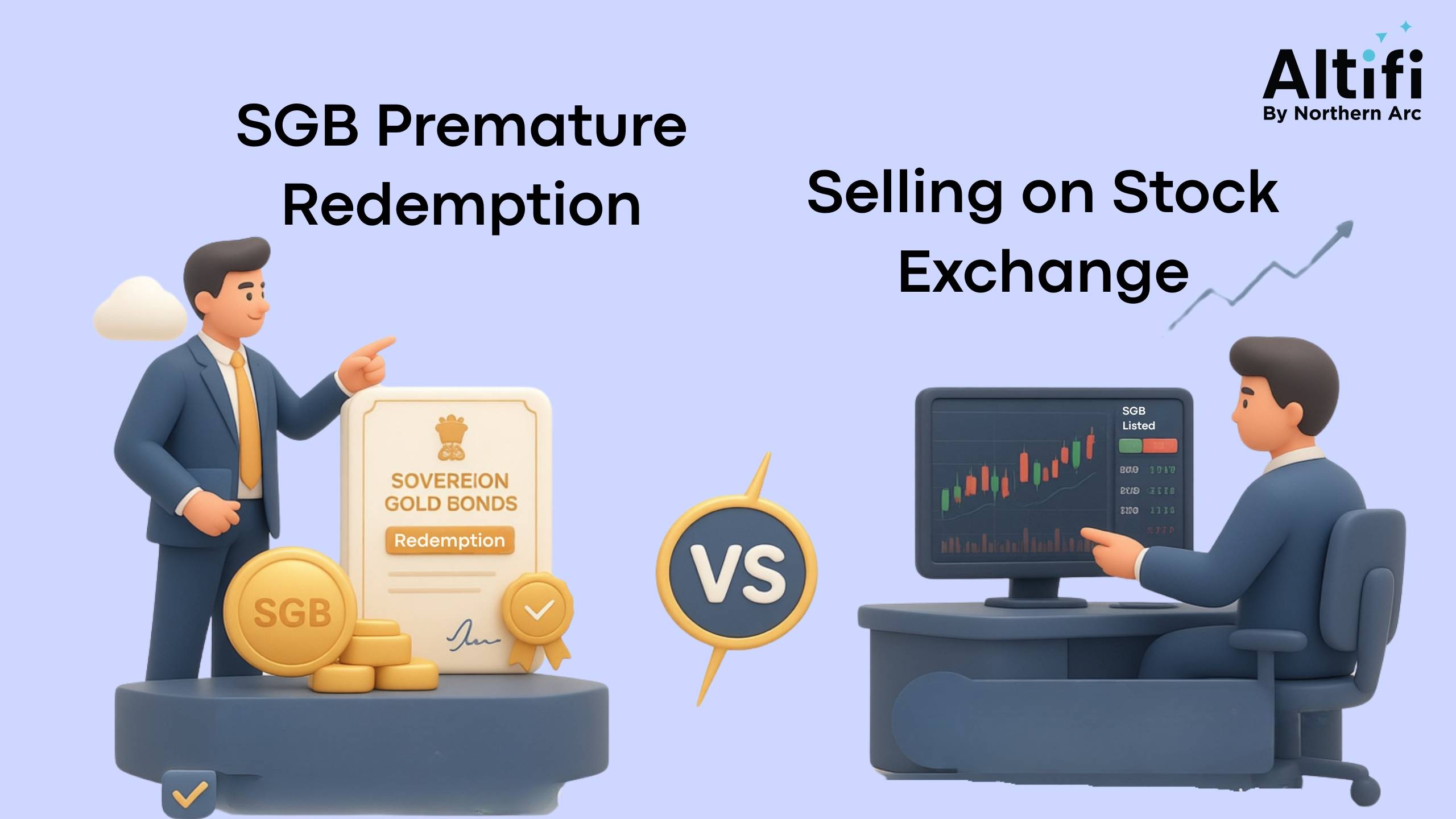
Buying a Sovereign Gold Bond is usually a long-term decision, but holding it until maturity isn't your only option. If you want to exit maturity, you can either seek premature redemption when eligible or sell the SGB on a recognised stock exchange, subject to market liquidity. The price you receive, the timing of your exit and even the tax implications can differ.
What is Premature Redemption of an SGB?
Premature redemption allows investors to redeem their SGBs before maturity under the RBI's prescribed process. However, this option is available only after the fifth year from the date of issue and on the interest payment dates specified for that tranche.
The redemption amount is calculated using the simple average of the closing price of 999 purity gold published by the India Bullion and Jewellers Association (IBJA) for the three business days preceding the redemption date. The proceeds are credited directly to the investor's registered bank account.
What Does Selling an SGB on the Stock Exchange Mean?
SGBs are listed on recognised stock exchanges, allowing investors to sell them before maturity.
Unlike premature redemption, there's no minimum holding period. You can sell whenever the market is open, provided there's sufficient trading activity and a buyer is available.
The sale price depends on market demand and supply. As a result, an SGB may trade at a premium or discount relative to the value depending on gold prices, interest rates and liquidity.
SGB Premature Redemption vs Stock Exchange Sale: Key Differences
Here are the differences between premature redemption of SGBs and selling them on stock exchanges.
Factor | Premature Redemption | Stock Exchange Sale |
Exit availability | After 5 years on eligible interest payment dates | Anytime after listing |
Price received | RBI redemption price | Prevailing market price |
Price basis | 3-day average IBJA gold price | Demand and supply on the exchange |
Liquidity required | No | Yes |
Buyer required | No | Yes |
Settlement | RBI through bank/intermediary | Through the exchange |
Best suited for | Investors eligible for RBI redemption | Investors seeking flexibility |
Factors to Consider Before Choosing an Exit Option
The better exit option depends on more than just the gold price. Here are a few factors worth comparing before making a decision.
Liquidity and Ease of Exit
If you need funds immediately, selling on the stock exchange offers greater flexibility because you don't have to wait for the RBI's redemption window. However, a successful sale depends on finding buyers in the market.
Redemption Price vs Market Price
The RBI redemption price is linked directly to the average IBJA gold price over three business days. Exchange prices are market-driven and can trade at a premium or discount to the value implied by prevailing gold prices.
Tax Implications
Tax treatment can vary depending on whether the bond is redeemed through the RBI or sold on the stock exchange, as well as the applicable tax provisions at the time of exit. Reviewing the latest tax rules before making a decision is advisable.
Timing and Eligibility
Premature redemption is available only after five years and on specified interest payment dates. Selling on the exchange doesn't have this restriction, making it the only exit option for investors who need funds earlier.
Market Demand and Discount/Premium
Not every SGB trades close to its fair value. Some tranches enjoy healthy trading volumes and premiums, while others may trade at a discount because of limited liquidity. Comparing the market price with the expected RBI redemption value can help determine the better exit route.
When Might Premature Redemption Be Suitable?
Premature redemption may be worth considering if you've completed the five-year holding period and don't need immediate liquidity. Since the redemption price is based on the RBI's prescribed formula rather than market demand, it removes the uncertainty of selling at a discount on the stock exchange.
It may also suit investors who prefer a straightforward exit process through their bank or authorised intermediary.
When Might Selling in the Secondary Market Be Suitable?
Selling on the stock exchange may be a better option if you need to exit before becoming eligible for RBI redemption.
It can also work in your favour when the bond is trading at a premium to its intrinsic value. However, before placing a sell order, it's worth checking trading volumes and bid-ask spreads, as some SGB series may have limited liquidity.
Common Mistakes to Avoid When Exiting an SGB
Before choosing an exit route, avoid these common mistakes:
- Ignoring Eligibility Rules: Premature redemption is available only after five years and on specified interest payment dates.
- Not Comparing Prices: Check the exchange price against the expected RBI redemption value before deciding.
- Overlooking Liquidity: A quoted market price doesn't always guarantee enough buyers for your order.
- Ignoring Tax Implications: The tax treatment may differ depending on how and when you exit.
- Waiting until the last minute: If you're opting for premature redemption, submit your request within the timeline specified by your bank or intermediary.
Conclusion
Both premature redemption and selling on the stock exchange allow investors to exit an SGB before maturity, but they're designed for different situations. Premature redemption offers a structured exit linked to the RBI's redemption formula, while a stock exchange sale provides greater flexibility but depends on market prices and liquidity. Comparing the expected proceeds, timing and applicable tax rules can help you choose the option that fits your investment needs.
Frequently Asked Questions (FAQs)
Is SGB premature redemption tax-free after Budget 2026?
The tax treatment depends on the applicable provisions at the time of redemption. Investors should refer to the latest government notifications or consult a tax adviser before exiting.
Which is better SGB premature redemption or selling on the stock exchange?
It depends on your investment objective. Premature redemption offers a formula-based payout, while a stock exchange sale provides flexibility and immediate liquidity.
Can I sell my SGB on the stock exchange before completing 5 years?
Yes. Listed SGBs can be sold on the stock exchange at any time, subject to market liquidity and buyer availability.
How is the SGB premature redemption price calculated?
The RBI uses the simple average of the closing price of 999 purity gold published by the IBJA for the three business days preceding the redemption date.
Does liquidity affect the price of an SGB on the stock exchange?
Yes. Low trading volumes can result in wider bid-ask spreads, causing an SGB to trade at a discount or premium to its intrinsic value.
How to apply for SGB premature redemption in 2026?
Eligible investors can submit a redemption request through the bank, post office or authorised intermediary where the SGB is held, within the prescribed timeline before the relevant interest payment date.
What is the SGB premature redemption price calculation formula?
Redemption Amount = RBI Redemption Price per gram × Quantity of SGBs held
Here the RBI redemption price is based on the three-business-day average of the IBJA gold price.
Can I sell SGB before 5 years on the stock exchange?
Yes. The five-year condition applies only to RBI's premature redemption facility. It does not restrict selling listed SGBs on the stock exchange.
Disclaimer:
The information contained in this newsletter (“Newsletter”) is for general informational purposes only. Northern Arc Capital Limited (“Northern Arc”) does not make any warranties about the completeness, reliability, and accuracy of this information. Any action you take upon the information contained in this Newsletter is strictly at your own risk, and Northern Arc will not be liable for any losses and damages in connection with the use of our Newsletter.
The data included in this Newsletter has been obtained from sources that are believed to be reliable and accurate at the time of publication. However, Northern Arc does not guarantee the accuracy or completeness of any information, nor does it assume any responsibility or liability for any errors or omissions therein. Any opinions expressed herein are subject to change without notice and Northern Arc is under no obligation to update or keep current the information contained in this Newsletter.
This Newsletter is not intended to constitute, and should not be construed as, investment advice or a recommendation to purchase, sell, or hold any security or to engage in any investment strategy or transaction. Readers should not rely solely on the information provided in this Newsletter for making investment decisions and should conduct their own due diligence or seek the advice of a qualified professional.
The content of this Newsletter is for informational purposes only and is not a solicitation or an offer to buy or sell any securities or financial instruments. Northern Arc is not responsible for any investment decisions made by the recipients of this Newsletter. Readers should take independent financial advice from a qualified professional in connection with, or independently research and verify, any information that is provided in this Newsletter and wish to rely upon, whether for the purpose of making an investment decision or otherwise.
Northern Arc and its affiliates, directors, employees, and agents expressly disclaim any and all liability for any direct or indirect losses, damages, or expenses of any kind arising out of or relating to the use of this Newsletter, including but not limited to, any losses related to the accuracy, completeness, timeliness, or reliability of such information.
This Newsletter may contain forward-looking statements that are based on current expectations, estimates, forecasts, and projections about the markets in which Northern Arc operates, as well as management’s beliefs and assumptions. Forward-looking statements are not guarantees of future performance and involve certain risks and uncertainties, which are difficult to predict. Past performance is not indicative of future results.
This report is intended solely for the recipient and is not for further circulation. Any distribution, modification, reproduction, or disclosure of the contents of this Newsletter, in whole or in part, without the prior written consent of Northern Arc, is strictly prohibited.