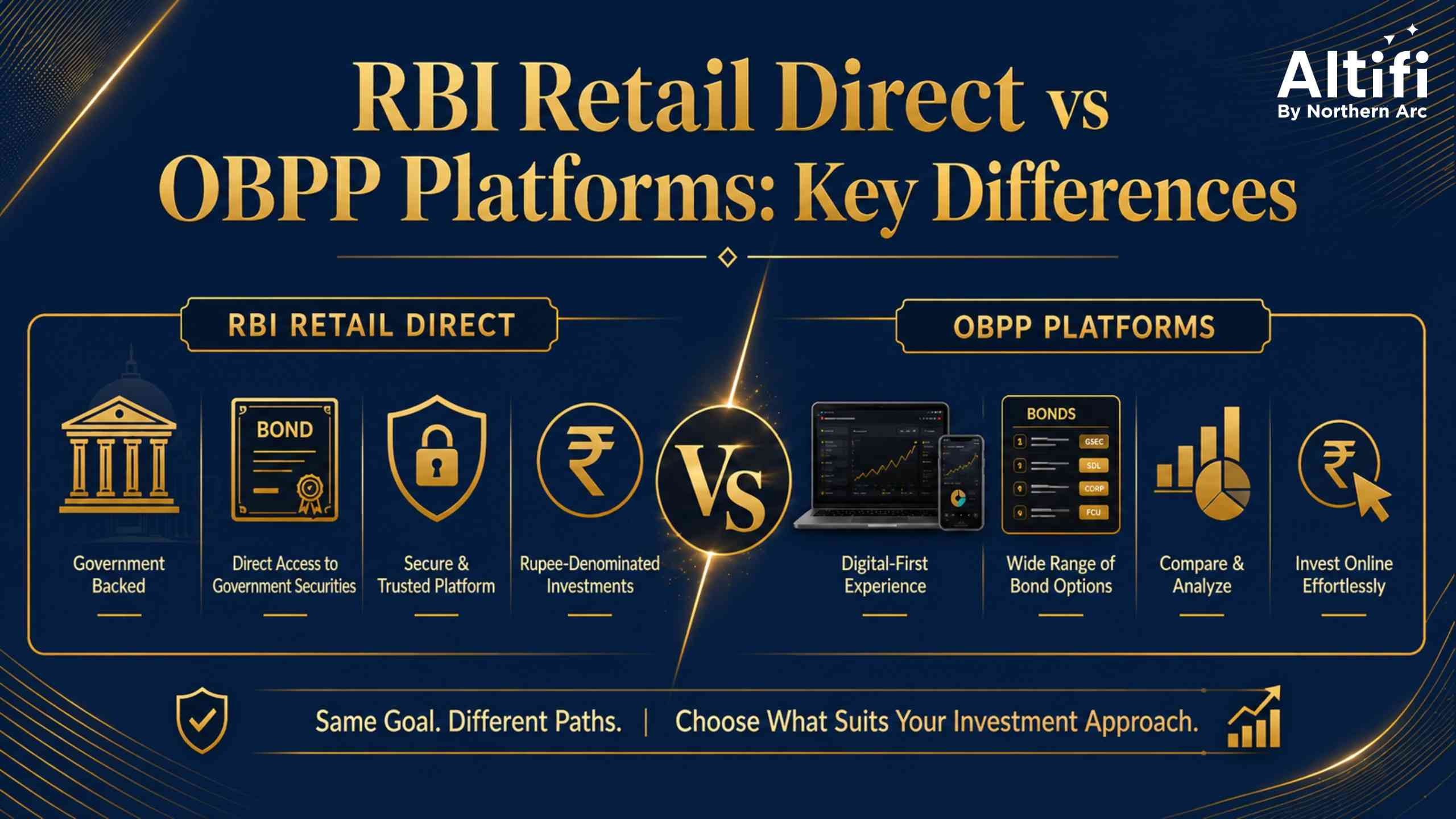
Investors now have multiple digital options for accessing bond markets in India. Two commonly discussed platforms are RBI (Reserve Bank of India) Retail Direct and Online Bond Platform Providers (OBPPs). Both platforms facilitate investors' online access to fixed-income options. However, their characteristics, access strategies, investment options, and organisational structures vary. Understanding these differences may allow investors to assess available platforms more effectively.
What is RBI Retail Direct?
RBI Retail Direct provides retail investors with direct access to government security. The platform was introduced by the Reserve Bank of India to simplify participation in government bond markets. It allows individuals to open a Retail Direct Gilt account online.
Through this account, investors can purchase government securities issued by central and state governments. These include Treasury Bills, dated government securities, and other eligible instruments. The platform reduces dependence on intermediaries for government securities transactions. Investors may participate in primary auctions and manage their holdings digitally.
What is an OBPP Platform?
OBPP (online bond platform) provides investors access to different bond investment opportunities. The platform provider serves as a digital marketplace for a variety of fixed-income securities. They typically sell government securities, corporate bonds, non-convertible debentures (NCDs), and other financial instruments. The platform and legal requirements determine the investing options that are offered. Bonds may be compared by investors according to credit information, issuer data, and maturity.
Unlike RBI Retail Direct, OBPP platforms usually provide access to bonds from different issuers. These issuers may include companies, financial institutions, and other entities. OBPP platforms aim to simplify bond investing through digital features. They provide investors with information required for evaluating available opportunities.
Investors should review bond details, risks, and terms before making investment decisions.
RBI Retail Direct vs OBPP: Key Differences
Bond investments of various kinds are supported by the RBI Retail Direct and OBPP platforms. Their variations have an impact on market participation, costs, account access, and investment decisions.
| Metric | RBI Retail Direct | OBPP Platform |
|---|---|---|
| Investment Options Available | Mainly provides government securities including Treasury Bills and government bonds | Provides corporate bonds, NCDs, government securities, and other fixed-income products |
| Account Setup and Access | Investors open a Retail Direct Gilt account directly through RBI | Investors register through an online bond platform provider |
| Pricing and Charges | Direct access to government securities with applicable transaction-related charges | Charges depend on the platform and services offered |
| Liquidity and Secondary Market Access | Access depends on government securities market activity and demand | Liquidity varies based on bond type, issuer, and investor participation |
Let’s understand the differences in detail.
Investment Options Available
Investment options differ significantly across both platforms. RBI Retail Direct mainly provides access to government securities. These instruments are issued by central and state governments. OBPP platforms generally offer a wider range of fixed-income products. Investors may find corporate bonds and other debt instruments through these platforms.
The broader range allows investors to explore different issuers and structures. However, each bond may have different characteristics and risks.
Account Setup and Access
Both platforms provide digital access through online registration. RBI Retail Direct requires investors to create a Retail Direct Gilt account. The account allows investors to manage government securities holdings directly.
OBPP platforms require investors to complete registration before investing. These platforms provide access to available bond offerings. The process and features may vary depending on the platform selected.
Pricing and Charges
Pricing structures may differ between RBI Retail Direct and OBPP platforms. RBI Retail Direct provides direct access to government securities. Investors should review applicable charges before completing transactions.
OBPP platforms may include different costs based on their services. These may relate to platform facilities or transaction processes. Understanding charges helps investors compare available investment routes.
Liquidity and Secondary Market Access
Liquidity refers to how easily investors may sell investments before maturity. Government securities available through RBI Retail Direct may be traded in the secondary market. The actual ease of selling depends on market demand.
OBPP platforms provide access to bonds with different liquidity levels. Corporate bonds may have varying market participation depending on issuer quality and demand. Investors should consider liquidity needs while evaluating bond investments.
Can Investors Use Both Platforms?
Investors may use both RBI Retail Direct and OBPP platforms. The two platforms provide access to different areas of the bond market. RBI Retail Direct focuses mainly on government securities, while OBPP platforms provide broader bond options.
Investors may assess various fixed-income prospects by using both sites. Investors can examine various instruments according to investment requirements, issuer type, and maturity. Every platform has unique capabilities and limits. It becomes easier for investors to select appropriate investment options when they are aware of these differences.
Prior to making an investment, investors should also take maturity, liquidity, and credit quality into account.
Conclusion
RBI Retail Direct and OBPP platforms provide digital access to bond markets. RBI Retail Direct focuses on government securities and allows direct participation in government bond markets. It provides access to instruments issued by government entities. OBPP platforms offer a wider range of bond investment opportunities. These may include corporate bonds, NCDs, and other fixed-income products. Neither platform is designed for every investor requirement. The choice depends on available options, investment preferences, and individual considerations. Investors should evaluate platform features, bond details, and applicable risks before making investment decisions.
FAQs About RBI Retail Direct and OBPP
What is RBI Retail Direct?
RBI Retail Direct is a platform that allows retail investors to invest in government securities directly.
What is an OBPP platform?
An OBPP platform is an online platform that provides access to various bond investment opportunities.
Can I invest in corporate bonds through RBI Retail Direct?
RBI Retail Direct mainly provides government securities. Corporate bonds are generally available through other platforms.
Which platform is better for retail investors?
The suitable platform depends on investment preferences, available options, and individual requirements.
Can I use both RBI Retail Direct and OBPP platforms?
Yes, investors may use both platforms to access different fixed-income investment opportunities.
Disclaimer:
The information contained in this Article (“Article”) is for general informational purposes only. Northern Arc Capital Limited (“Northern Arc”) does not make any warranties about the completeness, reliability, and accuracy of this information. Any action you take upon the information contained in this Article is strictly at your own risk, and Northern Arc will not be liable for any losses and damages in connection with the use of our Article.
The data included in this Article has been obtained from sources that are believed to be reliable and accurate at the time of publication. However, Northern Arc does not guarantee the accuracy or completeness of any information, nor does it assume any responsibility or liability for any errors or omissions therein. Any opinions expressed herein are subject to change without notice and Northern Arc is under no obligation to update or keep current the information contained in this Article.
This Article is not intended to constitute, and should not be construed as, investment advice or a recommendation to purchase, sell, or hold any security or to engage in any investment strategy or transaction. Readers should not rely solely on the information provided in this Article for making investment decisions and should conduct their own due diligence or seek the advice of a qualified professional.
The content of this Article is for informational purposes only and is not a solicitation or an offer to buy or sell any securities or financial instruments. Northern Arc is not responsible for any investment decisions made by the recipients of this Article. Readers should take independent financial advice from a qualified professional in connection with, or independently research and verify, any information that is provided in this Article and wish to rely upon, whether for the purpose of making an investment decision or otherwise.
Northern Arc and its affiliates, directors, employees, and agents expressly disclaim any and all liability for any direct or indirect losses, damages, or expenses of any kind arising out of or relating to the use of this Article, including but not limited to, any losses related to the accuracy, completeness, timeliness, or reliability of such information.
This Article may contain forward-looking statements that are based on current expectations, estimates, forecasts, and projections about the markets in which Northern Arc operates, as well as management’s beliefs and assumptions. Forward-looking statements are not guarantees of future performance and involve certain risks and uncertainties, which are difficult to predict. Past performance is not indicative of future results.
This report is intended solely for the recipient and is not for further circulation. Any distribution, modification, reproduction, or disclosure of the contents of this Article, in whole or in part, without the prior written consent of Northern Arc, is strictly prohibited.