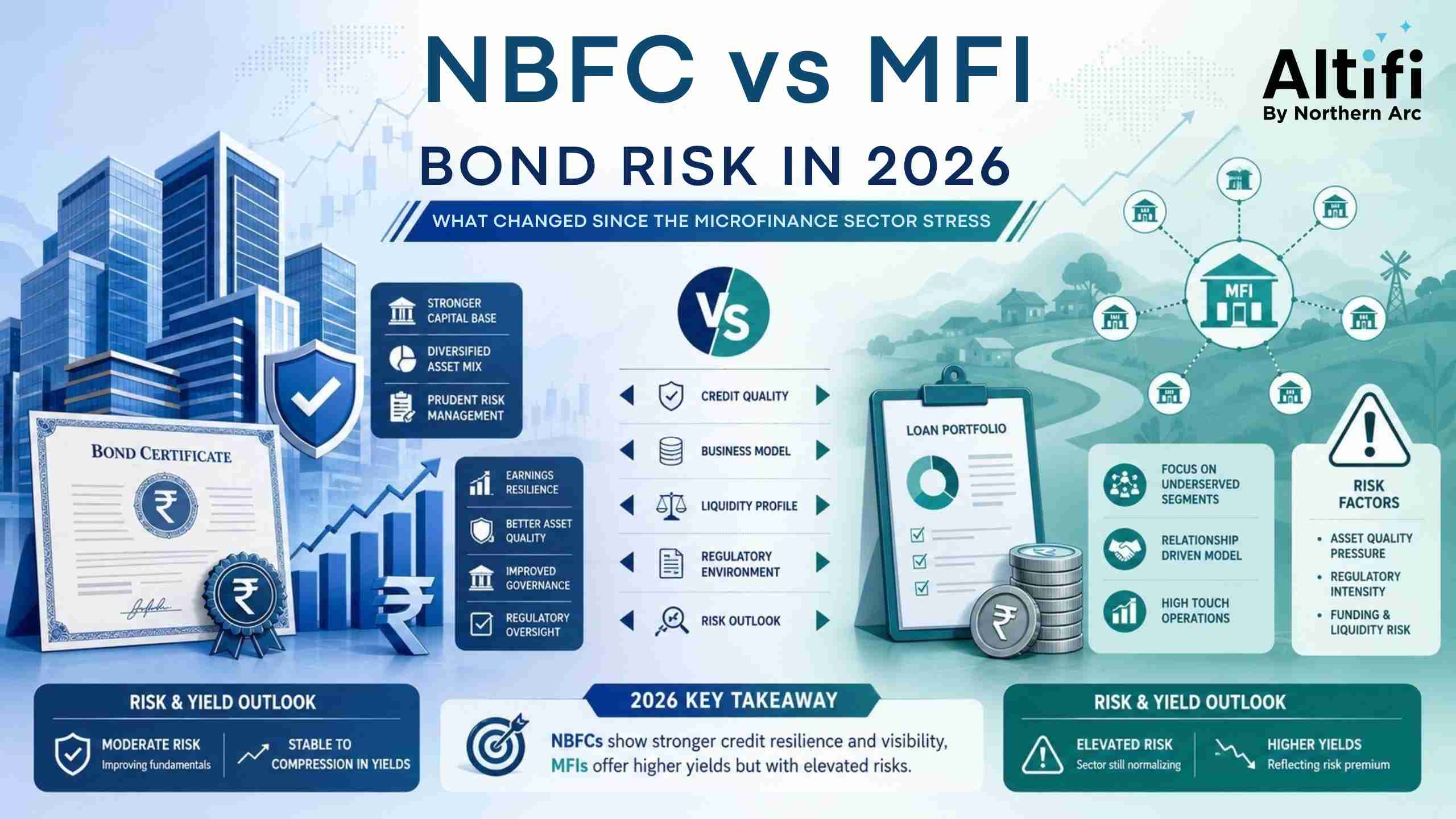
India's microfinance sector went through one of its toughest phases in FY2025, when stress in the NBFC-MFI sector surged due to borrower overleveraging, sociopolitical disruptions, and operational challenges, causing assets under management to decline 12 per cent. Many investors cautious toward MFI debt during this period. But Market conditions improved during FY2026, with collections improving and overdue loans falling sharply even as lenders remain cautious on growth. This raises a fair question for fixed-income investors: has the extra yield on MFI bonds over standard NBFC bonds become more attractive, or is the risk still too high? This article looks at the data to help you decide.
NBFCs and MFIs: Similar Models, Different Risk Profiles
Both are non-banking financial companies, but an NBFC-MFI must lend at least 60% of its assets as small, unsecured loans to low-income borrowers, mostly rural women, under RBI's qualifying assets norm. A general-purpose NBFC (like a consumer finance or vehicle finance company) has diversified loan books, mortgages, gold loans, vehicle loans, SME credit — and typically better access to bank funding and larger balance sheets. MFIs depend heavily on wholesale bank borrowing and have smaller, less diversified ticket sizes, making them more sensitive to a single shock, like a bad monsoon or a regional loan waiver.
What Triggered the Microfinance Sector Stress?
The following factors led to the issues India’s micarofinance sector was facing.
- Borrower Overleveraging: Many borrowers took loans from multiple lenders simultaneously, pushing debt levels beyond repayment capacity.
- Collection disruptions: Simultaneous stress across lenders led to a breakdown in group-lending discipline and rising loan defaults.
- Pressure on profitability: Provision cover of NBFC-MFIs rose to about 4.8% of on-book portfolio as of March 2025, up from 2.8% a year earlier, squeezing earnings sector-wide.
What Has Changed in 2026?
- Asset quality is improving: 30+ days-past-due payment defaults fell to 2.1% as of May 2026, compared with 6.3% a year earlier.
- Borrower leverage has moderated: A ₹2 lakh cap on total microfinance exposure per borrower and a limit of three lenders per borrower now govern the industry, and 96.4% of loans were within RBI and self-regulatory norms as of December-end.
- Collections have strengthened: Loan recovery increased, though legacy stress remains. Loans overdue by more than 180 days stands at 16.3%, showing older, weaker loans are still being cleaned up.
- Growth is returning, but measured: After seven quarters of contraction, industry portfolio rose over 3% quarter-on-quarter in Q4FY26, aided by the highest quarterly disbursement in seven quarters at ₹77,524 crore. ICRA had earlier projected sector AUM growth resuming to 10–15% in FY2026 after the FY2025 contraction.
How Do NBFC Bonds and MFI Bonds Compare Today?
Parameter | NBFC Bonds | MFI Bonds |
Credit quality | Mostly AA to AAA rated | Typically BBB+ to A− rated |
Business diversification | High — multiple loan segments | Low — largely unsecured microloans |
Rural income sensitivity | Moderate | High |
Asset quality trend | Stable to improving | Improving, but legacy stress remains |
Funding profile | Broad bank and market access | Narrower, more bank-dependent |
Indicative yield (2026) | AAA: ~50–140 bps over G-Sec; AA: ~100–260 bps | BBB/A category issuers around 10–12.4% coupons |
Liquidity | Better in secondary market | Thinner secondary trading |
Does the Additional Yield Adequately Compensate for the Risk?
When it may be justified:
- Improving fundamentals, falling loan default ratios and rising disbursements support the case for stronger issuers.
- Diversified, well-capitalised MFIs with pan-India presence and consistent SRO compliance carry comparatively lower tail risk.
When caution is warranted:
- Monsoon dependence and rural income volatility can still trigger localised repayment stress.
- Regulatory changes, such as tighter qualifying-asset norms, can affect funding costs suddenly.
- Concentrated lending models mean a single state or region's disruption can impact an issuer's book disproportionately.
Rather than looking for the highest coupon, investors can consider in terms of risk-adjusted return. The extra yield is divided by the additional probability of stress, not yield alone. Investors should assess whether the additional yield adequately compensates for the incremental credit and liquidity risks
Key Indicators to Monitor Before Investing
Check the following while investing.
- Collection efficiency ratios (ideally above 98%)
- Gross NPA and PAR (31–180 days) trends
- Provisioning coverage ratio
- Capital adequacy ratio (CRAR)
- Funding mix, dependence on a few banks versus diversified sources
- Portfolio diversification across states and products
- Rating agency outlook (stable, positive, or negative)
- Management commentary on growth versus asset-quality trade-offs
Which Bond Suits Which Investor?
Different bonds may suit different types of investors.
- Conservative investors: Stick to AAA/AA-rated NBFC bonds for capital safety and steady, moderate income.
- Income-focused investors: May consider a small allocation to well-rated MFI bonds for higher running yield, provided the issuer shows strong collection of metrics.
- Experienced investors comfortable with sector risk: Can evaluate select MFI papers as a tactical, smaller allocation, understanding that legacy 180+ day stress is still being resolved industry wide.
Note that you should always assess your own risk appetite before investing.
Conclusion
The microfinance sector has moved beyond its peak stress phase, supported by tighter borrower-leverage norms, reducing short-term loan defaults, and returning disbursement growth. But legacy stress in the 180+ day timeframe shows the cleanup isn't complete. The risk gap between NBFC and MFI bonds has narrowed somewhat, not disappeared. Selectivity, based on issuer quality, portfolio resilience, and credit fundamentals, remains essential.
FAQs on NBFC vs MFI Bonds in 2026
1. Are MFI bonds safe to invest in now?
The bonds are much safer as compared to FY2025 peak stress levels but still more risky compared to conventional NBFC bonds because of unsecured, rural income-based lending.
2. What is the current GNPA level in India's microfinance sector?
The sector GNPA spiked from nearly 2% in FY24 to 8% in FY26 until an improvement in recent short-term delinquency measures.
3. Why do MFI bonds offer higher interest rates than NBFC bonds?
The reason behind it is that the rating agencies provide lower ratings (BBB+ to A−) due to concentrated and unsecured lending along with rural income sensitivity. As a result, issuers offer a wide margin above the G-Sec benchmark rate.
4. Has government support helped the microfinance sector recover?
Indeed, there is no denying that government support and regulation have played a vital part in helping the microfinance industry overcome its ongoing problem with a shortage of finance and maintaining good asset quality.
5. Should retail investors avoid MFI bonds entirely?
Not necessarily. Investors comfortable with sector-specific risk may consider a small, diversified allocation to well-rated issuers, but conservative investors should look for higher-rated NBFC bonds.
Disclaimer:
The information contained in this newsletter (“Newsletter”) is for general informational purposes only. Northern Arc Capital Limited (“Northern Arc”) does not make any warranties about the completeness, reliability, and accuracy of this information. Any action you take upon the information contained in this Newsletter is strictly at your own risk, and Northern Arc will not be liable for any losses and damages in connection with the use of our Newsletter.
The data included in this Newsletter has been obtained from sources that are believed to be reliable and accurate at the time of publication. However, Northern Arc does not guarantee the accuracy or completeness of any information, nor does it assume any responsibility or liability for any errors or omissions therein. Any opinions expressed herein are subject to change without notice and Northern Arc is under no obligation to update or keep current the information contained in this Newsletter.
This Newsletter is not intended to constitute, and should not be construed as, investment advice or a recommendation to purchase, sell, or hold any security or to engage in any investment strategy or transaction. Readers should not rely solely on the information provided in this Newsletter for making investment decisions and should conduct their own due diligence or seek the advice of a qualified professional.
The content of this Newsletter is for informational purposes only and is not a solicitation or an offer to buy or sell any securities or financial instruments. Northern Arc is not responsible for any investment decisions made by the recipients of this Newsletter. Readers should take independent financial advice from a qualified professional in connection with, or independently research and verify, any information that is provided in this Newsletter and wish to rely upon, whether for the purpose of making an investment decision or otherwise.
Northern Arc and its affiliates, directors, employees, and agents expressly disclaim any and all liability for any direct or indirect losses, damages, or expenses of any kind arising out of or relating to the use of this Newsletter, including but not limited to, any losses related to the accuracy, completeness, timeliness, or reliability of such information.
This Newsletter may contain forward-looking statements that are based on current expectations, estimates, forecasts, and projections about the markets in which Northern Arc operates, as well as management’s beliefs and assumptions. Forward-looking statements are not guarantees of future performance and involve certain risks and uncertainties, which are difficult to predict. Past performance is not indicative of future results.
This report is intended solely for the recipient and is not for further circulation. Any distribution, modification, reproduction, or disclosure of the contents of this Newsletter, in whole or in part, without the prior written consent of Northern Arc, is strictly prohibited.