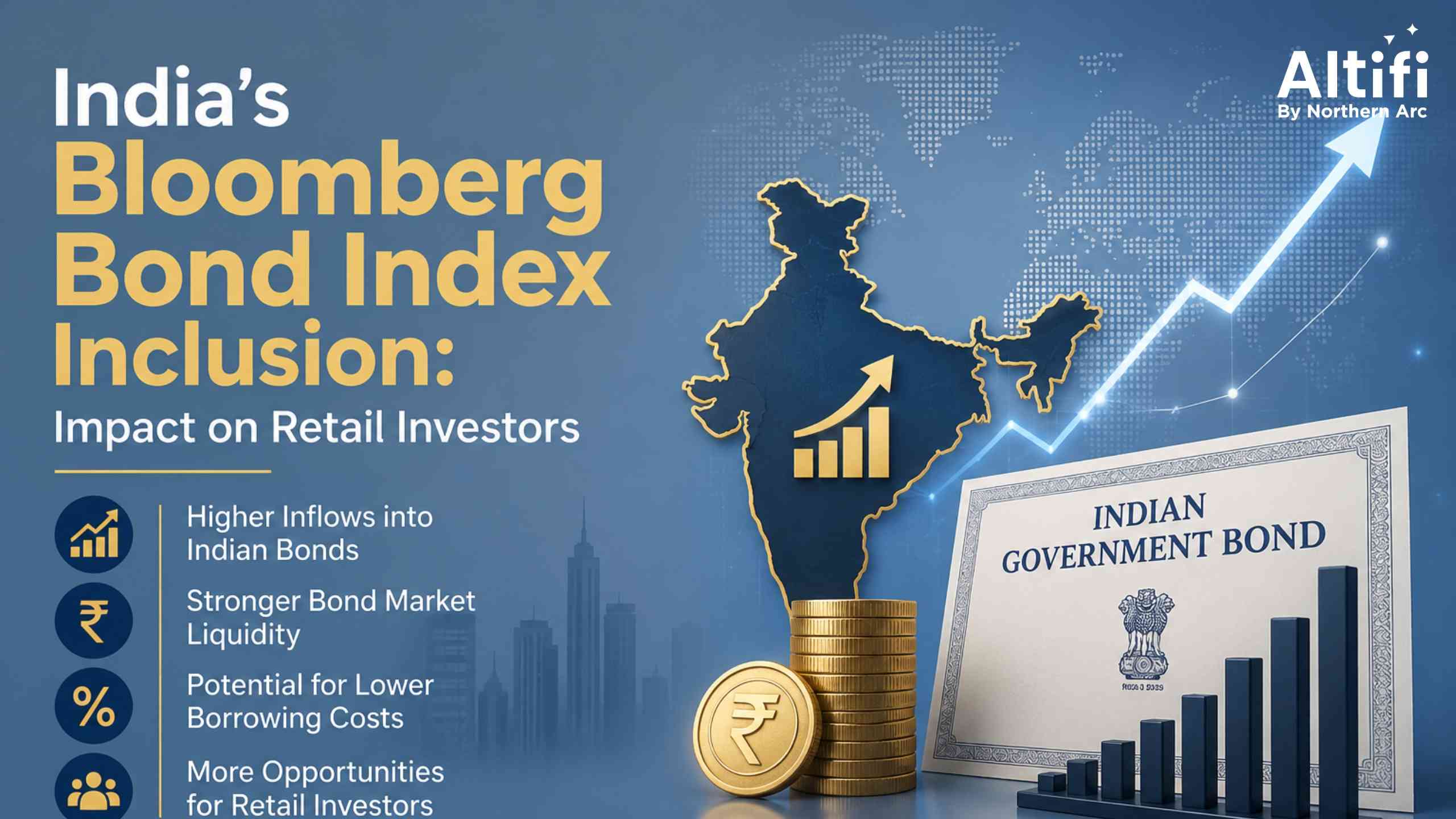
According to the Reserve Bank of India (RBI), June 2026, India's government securities (G-Sec) market has grown to approximately ₹123.5 trillion. Yet foreign investors hold less than 3% of it. The push to include India in global bond indices is one of the most important structural changes in the country’s debt markets. It is already having a real impact on bond yields and market liquidity. This, in turn, also affects retail investors. Let’s explore in detail.
What is the Bloomberg Bond Index?
The Bloomberg Bond Index is not a single index but fixed-income benchmarks published by Bloomberg Index Services Limited (BISL). Among these, two are directly relevant to India:
Bloomberg Emerging Market (EM) Local Currency Government Index
This index tracks government bonds issued in local currencies across emerging economies. India’s FAR (Fully Accessible Route) government bonds were included in this index in January 2025.
Bloomberg Global Aggregate Index
This is one of the most comprehensive global fixed-income benchmarks, covering investment-grade bonds across multiple countries, currencies, and issuers. India’s potential inclusion in this index is currently under review, with a decision expected by mid-2026.
For global fund managers, these indices serve two key purposes. First, passive investment vehicles such as index funds and ETFs track the indices by replicating their bond weightings. Second, active fund managers use them as performance benchmarks to evaluate returns. In both cases, index inclusion can lead to actual capital inflows into the underlying bond markets.
Why Was India Included?
India's entry into global bond indices followed years of market reforms. The key structural change was the FAR framework, which removed investment caps on designated government securities and opened them to unrestricted foreign participation.
In March 2024, Bloomberg Index Services announced inclusion of India's FAR bonds in the Bloomberg EM Local Currency Government Index, phased in over ten months beginning January 31, 2025. Indian FAR bonds entered at an initial weight of 10% of their full market value, with the weight increments of 10% every month, reaching full market-value weight by October 2025.
That inclusion brought India into a select group. Once fully phased in, India joined China and South Korea as markets that reached the 10% country cap in the Bloomberg EM Local Currency Government Index.
How Index Inclusion Affects the Bond Market
Bond markets can be impacted by index listings through three main factors: foreign investments, bond yields, and liquidity. The combination of these will affect the overall demand, prices, and transactions involving government bonds.
Foreign Investment Flows
Index inclusion creates automatic demand. Passive funds tracking the Bloomberg EM Local Currency Government Index must hold India's bonds in proportion to their index weight once included. This is not optional, it is a mechanical allocation.
India's inclusion in JPMorgan's Government Bond Index-Emerging Markets began on June 28, 2024, and was phased in over roughly 10 months, generating approximately ₹2,21,450 crore (US$25 billion) in expected inflows.
A potential Bloomberg Global Aggregate inclusion carries similar expectations. India was being evaluated for around 1% weight in the index, an allocation that could translate into $25 billion in inflows spread over roughly 10 months, starting from April 2027.
Bond Yields
When foreign capital flows into Indian government securities, demand for those bonds rises. Higher demand pushes bond prices up, and yield (the return an investor receives relative to price) moves inversely to price. This is the fundamental bond price–yield relationship.
Analysts at PNB Gilts estimated the Bloomberg Global Aggregate inclusion announcement alone could put 4–5 basis points of downward pressure on yields, with around $20–25 billion expected in subsequent inflows.
Yield to Maturity (YTM), the total annualised return an investor receives if a bond is held to its maturity date, accounting for the coupon rate, face value, and purchase price, may compress as index inflows push prices upward. For existing bondholders, that compression reflects a capital gain. For new investors buying at higher prices, it means accepting a lower YTM going forward.
Market Liquidity
FPI holdings in G-secs under the FAR route rose from ₹3.23 trillion on June 3, 2026, to ₹3.32 trillion on June 10, 2026, following the government's tax exemption announcement, a measurable near-term response in a matter of days.
Deeper foreign participation improves secondary market liquidity, the ability to buy or sell bonds without significantly affecting their price. Improved liquidity tends to narrow bid-ask spreads, making it less costly to transact.
What Does It Mean for Retail Investors?
While retail investors do not directly participate in global bond index allocations, index inclusion can still influence bond yields, liquidity, and overall market conditions. These changes can create both opportunities and risks for fixed-income investors.
Benefits for Investors
- Yield curve improvement: Higher foreign demand for government securities (G-secs) can reduce government borrowing costs and improve overall market efficiency. This may also help corporate issuers access funds at lower interest rates.
- Better market liquidity: Increased participation from global investors can deepen the bond market, making it easier for retail investors to buy and sell bonds in the secondary market.
- Currency and macro stability: Sustained foreign inflows can strengthen forex reserves and support rupee stability, contributing to a more stable inflation and interest-rate environment.
- Potential capital gains: Rising bond demand can push prices higher, allowing existing bondholders to benefit from mark-to-market gains.
Risks to Consider
- Lower yields on new investments: As bond prices rise due to higher demand, yields decline, which may result in lower YTMs for new investors entering the market.
- Risk of foreign outflows: Index-based investments can reverse if global conditions change or India’s index weight is reduced, leading to price volatility and rising yields.
- Unchanged credit risk: Lower government bond yields do not reduce credit risk in corporate bonds. Investors must still evaluate issuer fundamentals carefully.
- No credit rating impact: Index inclusion does not improve sovereign or corporate credit ratings. Default risk remains unchanged and depends on financial strength, not index participation.
Conclusion
The inclusion of India in the Bloomberg Emerging Markets Local Currency Index since January 2025, along with the aim of being included in the Bloomberg Global Aggregate Index, signifies the structural strengthening of India's debt markets. The short-term impact includes foreign capital flows, yield changes, and increased secondary market liquidity. From the investor's point of view, the long-term impact may be indirect as investors will benefit from an altogether new yield environment, along with macroeconomic consequences for foreign involvement in the debt market.
FAQs on India's Bloomberg Bond Index Inclusion
What is the Bloomberg Bond Index?
The Bloomberg Bond Index is a suite of fixed income indices run by Bloomberg Index Services Ltd. The main index in this group is the Bloomberg Global Aggregate Index, which covers investment-grade bonds issued by governments and corporations in various nations and currencies and is considered one of the most recognised bond indices in the world.
Why was India included in the Bloomberg EM Index?
India got included in the Bloomberg Emerging Market (EM) Local Currency Government Index since the RBI launched the Fully Accessible Route (FAR), which permits foreign participants to participate in Indian government securities without any investment restriction. The process of inclusion started on January 31, 2025, and went into full implementation by October 2025.
How does bond index inclusion affect bond yields?
When a country's bonds are added to a global index, passive funds tracking that index must purchase those securities. This increased demand can raise bond prices and lower yields, as bond prices and yields move in opposite directions. Existing bondholders may benefit from price appreciation, while new investors may face lower yields.
Will retail investors benefit from bond index inclusion?
Yes, there would be indirect benefits for retail investors too. Increased foreign interest would mean greater market liquidity, bond market growth, and lower borrowing costs in general. In addition, the bond yields of both the government and private firms might eventually be affected.
What is the current status of India's inclusion in the Bloomberg Global Aggregate Index?
The Bloomberg Company has postponed its decision regarding India’s inclusion in the Global Aggregate Index up till January 2026 and has hinted that this matter will be revisited before mid-2026. India has adopted several measures aimed at meeting investor concerns, such as tax exemptions for qualified foreign investors and the expansion of FAR-eligible securities.
What is the Fully Accessible Route (FAR)?
The Fully Accessible Route (FAR) is the scheme adopted by RBI which provides FPIs with access to designated Indian government securities without any investment limits. FAR-eligible bonds are mainly the securities considered for inclusion in international bond indices.
Why was India's inclusion in the Bloomberg Global Aggregate Index delayed?
Certain international investors were worried regarding technical problems such as the process of settlement, taxes after transactions, trading facilities, and registration time periods. Although some policies have resolved some tax-related problems, Bloomberg is still examining the entire accessibility framework of the market.
How much foreign investment could India attract through Bloomberg Global Aggregate Index inclusion?
In case India gets listed in the Bloomberg Global Aggregate Index, then analysts predict that the country would receive close to $25 billion in foreign investments.
Disclaimer:
The information contained in this Article (“Article”) is for general informational purposes only. Northern Arc Capital Limited (“Northern Arc”) does not make any warranties about the completeness, reliability, and accuracy of this information. Any action you take upon the information contained in this Article is strictly at your own risk, and Northern Arc will not be liable for any losses and damages in connection with the use of our Article.
The data included in this Article has been obtained from sources that are believed to be reliable and accurate at the time of publication. However, Northern Arc does not guarantee the accuracy or completeness of any information, nor does it assume any responsibility or liability for any errors or omissions therein. Any opinions expressed herein are subject to change without notice and Northern Arc is under no obligation to update or keep current the information contained in this Article.
This Article is not intended to constitute, and should not be construed as, investment advice or a recommendation to purchase, sell, or hold any security or to engage in any investment strategy or transaction. Readers should not rely solely on the information provided in this Article for making investment decisions and should conduct their own due diligence or seek the advice of a qualified professional.
The content of this Article is for informational purposes only and is not a solicitation or an offer to buy or sell any securities or financial instruments. Northern Arc is not responsible for any investment decisions made by the recipients of this Article. Readers should take independent financial advice from a qualified professional in connection with, or independently research and verify, any information that is provided in this Article and wish to rely upon, whether for the purpose of making an investment decision or otherwise.
Northern Arc and its affiliates, directors, employees, and agents expressly disclaim any and all liability for any direct or indirect losses, damages, or expenses of any kind arising out of or relating to the use of this Article, including but not limited to, any losses related to the accuracy, completeness, timeliness, or reliability of such information.
This Article may contain forward-looking statements that are based on current expectations, estimates, forecasts, and projections about the markets in which Northern Arc operates, as well as management’s beliefs and assumptions. Forward-looking statements are not guarantees of future performance and involve certain risks and uncertainties, which are difficult to predict. Past performance is not indicative of future results.
This report is intended solely for the recipient and is not for further circulation. Any distribution, modification, reproduction, or disclosure of the contents of this Article, in whole or in part, without the prior written consent of Northern Arc, is strictly prohibited.