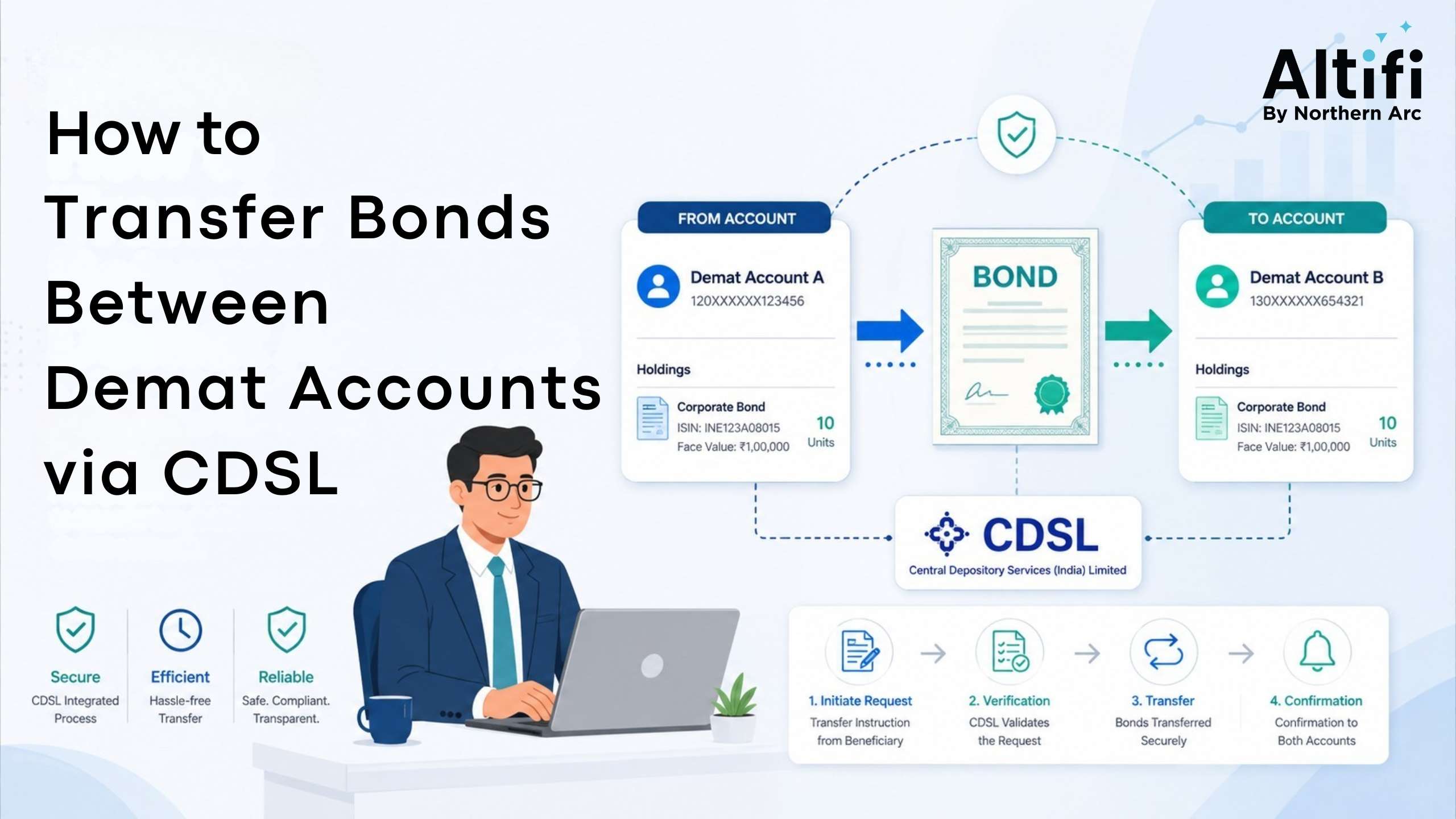
Bonds held in a Demat account can generally be transferred to another eligible Demat account without selling them through the market. A transfer of bonds between Demat accounts is known as an off-market transfer when it takes place outside the stock exchange. CDSL provides facilities such as CDSL Easiest for eligible account holders to submit electronic transfer instructions.
What is an Off-Market Bond Transfer?
An off-market bond transfer refers to the transfer of securities from one Demat account to another outside a stock exchange transaction. The securities are debited from the source Demat account and credited to the receiving account based on the applicable transfer instruction. The depository records the debit of securities from the existing account and credits them to the receiving account based on the transfer instruction.
A bond held in a CDSL Demat account can generally be transferred to another eligible CDSL Demat account through the applicable off-market transfer process. Transfers between CDSL and NSDL accounts are known as inter-depository transfers and follow the applicable process of the respective depositories and Depository Participants (DPs).
Such transfers may be used when an investor wants to consolidate holdings, move securities between eligible accounts or transfer bonds for purposes such as a gift, subject to applicable rules and procedures.
What Do You Need Before Transferring Bonds?
Before initiating an off-market transfer CDSL process, the following details and requirements may need to be checked:
- Active Demat Account: The account holding the bonds needs to be active and eligible for the proposed transfer.
- Receiving Account Details: Keep the recipient's Depository Participant (DP) ID, Client ID or Beneficiary Owner (BO) ID available, as applicable.
- ISIN: The International Securities Identification Number (ISIN) of each bond needs to be entered correctly.
- Quantity of Bonds: Confirm the exact quantity to be transferred before submitting the instruction.
- Transfer Reason: Select or provide the relevant reason, such as self-transfer, gift or account consolidation.
- CDSL Easiest Registration: For online transfers through CDSL Easiest, the account holder needs to complete the applicable registration process.
- DP Approval: Certain transfer arrangements require approval from the Depository Participant before execution.
- Authentication Details: Online instructions may require the applicable CDSL authentication method, such as a PIN and One-Time Password (OTP).
- Sufficient Balance for Applicable Charges: The account may need sufficient funds to meet applicable transfer-related charges or stamp duty, where relevant.
Checking the receiving account details and ISIN before submission can help reduce errors in the transfer instruction.
How to Transfer Bonds Through CDSL Easiest
CDSL Easiest is an internet-based facility that allows eligible CDSL account holders to submit securities transfer instructions electronically. CDSL states that the facility supports off-market and inter-depository instructions, among other transactions.
The broad process for CDSL Easiest registration and transferring bonds can be understood through these steps:
1. Register for CDSL Easiest
The account holder can register for CDSL Easiest through the CDSL website using the applicable Demat account details. The registration process includes entering the required account and contact information and completing the formalities specified by the Depository Participant.
Depending on the type of Easiest facility selected, additional requirements may apply.
2. Add the Receiving Account
For a trusted-account transfer, the receiving CDSL Demat account needs to be added as a trusted account and approved through the applicable DP process. It A trusted-account setup is intended for transfers to pre-notified beneficiary accounts, subject to the applicable CDSL and DP requirements.
CDSL's Easiest facility allows transfers to pre-notified CDSL accounts under the trusted-account option. The permitted account arrangements depend on the facility and account type.
3. Create an Off-Market Transfer Instruction
After registration and applicable approval, enter the details required for the transfer. These can include:
- Execution date
- Receiving BO ID
- Bond ISIN
- Quantity of bonds
- Relevant transfer reason
Review these details carefully before submitting the instruction.
4. Authenticate the Instruction
The transfer request needs to be authenticated through the method applicable to the Easiest account. CDSL's facility provides electronic authentication for eligible transactions.
5. Obtain DP Approval and Complete the Transfer
Where DP approval is applicable, the Depository Participant processes the instruction after submission. Once the required checks are completed, the depository processes the transfer and the bonds are credited to the receiving Demat account.
For investors who do not use the online facility, an offline route using a Delivery Instruction Slip (DIS) may also be available through the Depository Participant.
How to Transfer Bonds Between CDSL and NSDL Accounts
A transfer between CDSL and NSDL is an inter-depository transfer. The process depends on the depository where the source and receiving Demat accounts are held, along with the applicable procedures of the Depository Participant.
For example, certain securities can be transferred from a CDSL account to an NSDL account through CDSL Easiest or an offline Delivery Instruction Slip (DIS). For NSDL target accounts, the transfer process may permit transfers to the investor's own account, subject to the applicable requirements.
Check the Receiving Account Details
Keep the receiving account's DP ID, Client ID and other required details ready. For an NSDL transfer, additional requirements may apply. For example, the receiving account may need the applicable verification or bonafide status before the transfer can be processed.
Submit the Transfer Instruction
The transfer can be initiated through the applicable online facility or by submitting a DIS to the Depository Participant. Enter the bond's ISIN, quantity and receiving account details accurately.
Complete Verification
The Depository Participant and depository may carry out the required checks before processing the instruction. The transfer is completed after the applicable requirements are met.
When Can You Transfer Bonds Between Demat Accounts?
A transfer bonds between Demat accounts facility may be useful in several situations:
- Consolidating Holdings: An investor may move bonds into one Demat account to organise holdings across multiple accounts.
- Changing Account Arrangements: Bonds may be transferred when an investor changes the Demat account used for holding securities, subject to applicable procedures.
- Transferring a Gift: Bonds may be transferred as a gift where permitted under the applicable rules and documentation requirements.
- Managing Family Holdings: An eligible transfer may be used to move securities between accounts held by family members, where the relevant requirements are satisfied.
- Moving Between Depositories: An investor may need an inter-depository transfer when the source and receiving accounts are maintained with different depositories.
Common Reasons Bond Transfers Get Rejected
A transfer request may require correction or may not be processed when important details do not match. Common issues include:
1. Incorrect ISIN
Different bond series or tranches may have different ISINs. Entering the wrong ISIN can cause the instruction to fail.
2) Incorrect Account Details
Errors in the DP ID, Client ID or BO ID can prevent the securities from being credited.
3. Pending Account Approval
A trusted account may need DP approval before the transfer instruction can be executed.
4) Insufficient Funds for Applicable Charges
The account may require sufficient funds for applicable transfer charges or stamp duty.
5. Signature Mismatch
For physical DIS instructions, a signature that does not match the records can result in rejection.
6) Incomplete Information
Missing or inconsistent details in the transfer instruction can delay processing.
Checking the receiving account details, ISIN and quantity against the applicable account records before submission can help identify such errors.
Conclusion
Transferring bonds between Demat accounts can generally be completed without selling the securities on an exchange. CDSL provides electronic facilities such as Easiest for eligible account holders, while a DIS can provide an offline route through the Depository Participant. The exact process, verification requirements, charges and timelines can vary based on the accounts and transfer type. Investors can check the applicable requirements with their DP before initiating a transfer.
Frequently Asked Questions (FAQs)
Can I transfer bonds from one Demat account to another?
Yes, bonds held in dematerialised form can generally be transferred between eligible Demat accounts through the applicable depository process.
What is CDSL Easiest?
CDSL Easiest enables eligible account holders to submit securities transfer instructions electronically.
Are there charges for transferring bonds through CDSL?
Depository Participants may levy charges for transfers. Applicable fees can vary by DP and the type of transfer requested.
How long does a CDSL bond transfer take?
Processing time depends on the transfer method, account verification and DP procedures. Investors can confirm the expected timeline with their DP.
Can I transfer bonds from a CDSL account to an NSDL account?
Yes, inter-depository transfers can be possible, subject to the applicable procedures, account eligibility and requirements of the concerned depositories.
Is stamp duty applicable on self-transfer or gift of bonds via CDSL?
Stamp duty treatment depends on the nature of the transfer and applicable rules. The relevant charges can be confirmed with the DP.
What documents do I need to transfer bonds via CDSL?
Requirements can vary by transfer method. Online transfers require applicable account details, while offline transfers may require a completed DIS.
What is CDSL Easiest and how does it work for bond transfers?
CDSL Easiest enables eligible CDSL account holders to submit electronic debit instructions for applicable off-market and inter-depository securities transfers.
Disclaimer:
The information contained in this newsletter (“Newsletter”) is for general informational purposes only. Northern Arc Capital Limited (“Northern Arc”) does not make any warranties about the completeness, reliability, and accuracy of this information. Any action you take upon the information contained in this Newsletter is strictly at your own risk, and Northern Arc will not be liable for any losses and damages in connection with the use of our Newsletter.
The data included in this Newsletter has been obtained from sources that are believed to be reliable and accurate at the time of publication. However, Northern Arc does not guarantee the accuracy or completeness of any information, nor does it assume any responsibility or liability for any errors or omissions therein. Any opinions expressed herein are subject to change without notice and Northern Arc is under no obligation to update or keep current the information contained in this Newsletter.
This Newsletter is not intended to constitute, and should not be construed as, investment advice or a recommendation to purchase, sell, or hold any security or to engage in any investment strategy or transaction. Readers should not rely solely on the information provided in this Newsletter for making investment decisions and should conduct their own due diligence or seek the advice of a qualified professional.
The content of this Newsletter is for informational purposes only and is not a solicitation or an offer to buy or sell any securities or financial instruments. Northern Arc is not responsible for any investment decisions made by the recipients of this Newsletter. Readers should take independent financial advice from a qualified professional in connection with, or independently research and verify, any information that is provided in this Newsletter and wish to rely upon, whether for the purpose of making an investment decision or otherwise.
Northern Arc and its affiliates, directors, employees, and agents expressly disclaim any and all liability for any direct or indirect losses, damages, or expenses of any kind arising out of or relating to the use of this Newsletter, including but not limited to, any losses related to the accuracy, completeness, timeliness, or reliability of such information.
This Newsletter may contain forward-looking statements that are based on current expectations, estimates, forecasts, and projections about the markets in which Northern Arc operates, as well as management’s beliefs and assumptions. Forward-looking statements are not guarantees of future performance and involve certain risks and uncertainties, which are difficult to predict. Past performance is not indicative of future results.
This report is intended solely for the recipient and is not for further circulation. Any distribution, modification, reproduction, or disclosure of the contents of this Newsletter, in whole or in part, without the prior written consent of Northern Arc, is strictly prohibited.