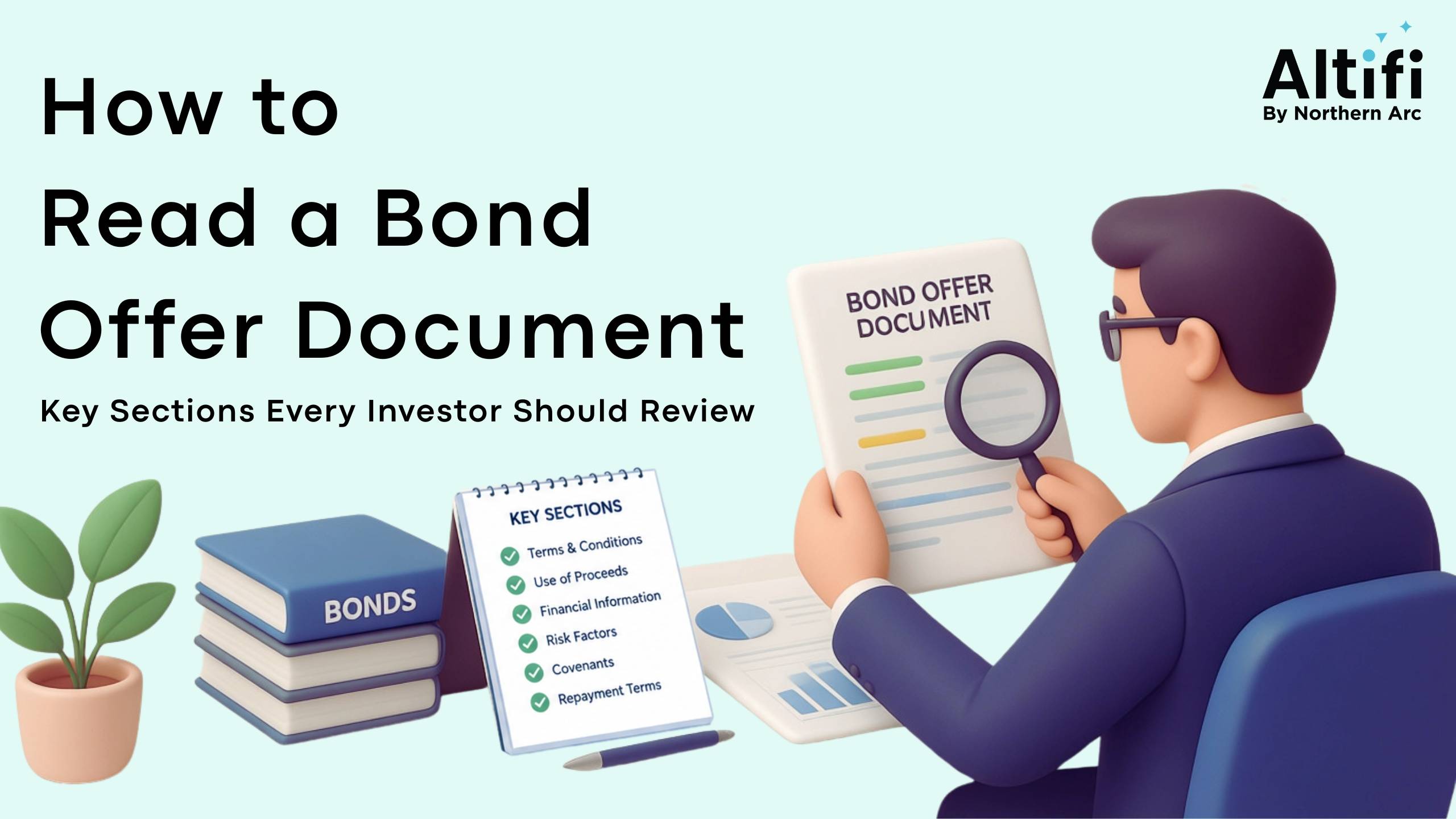
A bond offer document includes important details regarding the issuer and the debt instrument. The issuance terms, interest rate, maturity, repayment schedule, credit rating, and related risks may be included, depending on the type of issue and applicable framework. The document may also include financial statements, legal disclosures, and information on the usage of funds. Before purchasing a bond, investors can utilise these disclosures to comprehend the terms and risks. Depending on the securities type, issuer, and relevant regulatory requirements, different information may be supplied.
What is a Bond Offer Document (Prospectus) and Where Can You Find?
A bond offer document, commonly known as a prospectus, provides important information about a debt securities issue. It helps investors understand the terms of the issue, risks, financial position of the issuer, security structure, and other relevant information before investing.
An NCD Offer Document includes information related to non-convertible debentures. These could include the terms of redemption, security, credit rating, tenure, interest rate, and repayment schedule.
For listed debt issues, the relevant offer documents may be available through the issuer's website, the stock exchange website, SEBI's filings, and other channels specified for the issue. SEBI's framework requires offering documents to be made available for download through specified websites.
Key Sections of a Bond Offer Document
A Bond Prospectus India investor reviews can contain several sections. The following things deserve particular attention.
1. Details of the Issuer
Start by understanding who is issuing the bond. Assess the company's operations, ownership structure, management, subsidiaries, and business. This gives background information about the company that will be responsible for debt repayment and interest payments.
2. Purpose of the Issue
The document outlines the issuer's intended use of the funds raised by the bond offering. Money can be utilised for purposes such as working capital, business expansion, debt refinancing, and general corporate needs, depending on the terms disclosed in the offer document.
3. Key terms of the Bond
This section explains the basic structure of the investment. Check the following details carefully:
- Face value and issue price
- Interest or coupon rate
- Interest payment frequency
- Maturity date
- Tenure
- Redemption terms
- Secured or unsecured status
- Listing details
- Call or put options, where applicable
4. Credit Rating
A credit rating indicates the credit rating agency's assessment of the issuer's ability to meet its debt obligations. A higher rating generally indicates lower assessed credit risk than a lower rating. However, a credit rating is an opinion on credit risk and is not a guarantee that the issuer will make every payment on time.
5. Risk Factors
Risk factors are among the most important parts of a prospectus. They cover business risks, financial risks, regulatory changes, industry conditions, repayment risks, and other factors.
6. Financial Information
Examine the financial statements and important financial metrics of the issuer. Keep an eye on income, earnings, cash flows, borrowing, and interest payments. Even if an issuer reports profits, it may still be under pressure if its operating cash flows are poor.
7. Security and Repayment Structure
For secured bonds, check what assets or security has been provided to support the issue. Also review the terms relating to the debenture of the trustee and security creation. Understand when and how the principal will be repaid. Yet, a secured bond does not mean that repayment is guaranteed. Investors should review the nature of the collateral, security cover, ranking of the security, and the terms governing enforcement and recovery in the event of default.
8. Legal and Regulatory Information
Significant lawsuits, regulatory proceedings, defaults, related-party transactions, and other legal issues may be disclosed in the document. Investors may use this information to spot problems that might have an impact on the issuer's operations or financial standing.
How to Evaluate a Bond Offer Document Before Investing
Use the following checklist when reviewing a bond offer document:
- Check the Return: Assess whether the interest rate is reasonable for the credit and liquidity risks involved.
- Review the Issuer’s Debt: Check existing borrowings, interest expenses, and repayment obligations.
- Assess Cash Flows: Review operating cash flows and recent financial performance to understand debt-servicing capacity.
- Verify Security: Find out if the bond is secured or not and understand the applicable security terms.
- Examine the Credit Rating: To comprehend the main contributing variables, check the rating and study the rating rationale.
- Examine the Terms of Repayment: Verify the repayment schedule, maturity date, and any redemption requirements.
- Check Liquidity: Examine the bond's liquidity by determining whether there is enough trading activity and whether it can be sold when needed.
- Compare Risks and Returns: Take into account security, liquidity, repayment structure, return, and credit risk all at once.
Common Mistakes Investors Make While Reading a Prospectus
Investors may overlook important information when they focus only on selected details in a prospectus.
- Focusing only on the interest rate can lead investors to overlook the credit and liquidity risks associated with the bond.
- Ignoring the risk factors can result in important business, financial, regulatory, and repayment risks being missed.
- Treating a credit rating assurance can create a misleading view of the issuer's ability to repay.
- Not checking whether the bond is secured or unsecured can leave investors unclear about the security available for the issue.
- Overlooking the issuer's existing borrowings and cash flows can make it difficult to assess its debt-servicing capacity.
- Relying only on the abridged prospectus can mean missing detailed information available in the complete offer document.
Conclusion
The information required to comprehend a debt investment prior to subscribing is provided in a bond offer document. The issuer's financial standing, bond terms, credit rating, risks, security, and repayment schedule should all be of interest to investors. Reading every page with equal attention is not the aim. Instead, identify and thoroughly analyse the areas that have the potential to significantly damage the investment. This may assist investors in determining if the possible return justifies the associated risks.
Frequently Asked Questions (FAQs)
What is the difference between a prospectus and an abridged prospectus?
The offering, issuer, financial status, risks, and terms are all covered in depth in a prospectus. In an abridged prospectus, key information is provided concisely for simple review.
Is it mandatory to read the prospectus before investing in an NCD?
Before applying, investors should carefully go through the offer document and make sure they are satisfied with the information.
What does the credit rating in a bond prospectus mean for an investor?
The rating agency's evaluation of the issuer's creditworthiness and capacity to pay off debt is reflected in the credit rating. It is not a repayment promise; rather, it is an assessment.
What are the most important sections to read in a bond offer document?
Investors should prioritise the issuer's financial information, bond terms, risk factors, credit rating, security details, repayment structure, and legal disclosures.
How long does it take to read a bond offer document?
The time depends on the document's length and complexity. Investors can first review the key terms, risks, rating, financial information, and repayment structure before studying other sections.
What should I do if I don't understand a section of the prospectus?
Do not rely on assumptions. Look up unfamiliar financial terms and seek guidance from a qualified financial professional when necessary. Investors should understand the key risks and terms before investing.
What are the biggest red flags in a bond prospectus?
Warning signs can include weak cash flows, high borrowings, repeated losses, repayment concerns, adverse legal matters, low credit ratings, or risks that could materially affect the issuer.
What is a bond offer document?
A bond offer document is a detailed document containing material information about a bond issue. It explains the issuer, investment terms, risks, financial information, repayment structure, and other details investors need before subscribing.
Disclaimer:
The information contained in this newsletter (“Newsletter”) is for general informational purposes only. Northern Arc Capital Limited (“Northern Arc”) does not make any warranties about the completeness, reliability, and accuracy of this information. Any action you take upon the information contained in this Newsletter is strictly at your own risk, and Northern Arc will not be liable for any losses and damages in connection with the use of our Newsletter.
The data included in this Newsletter has been obtained from sources that are believed to be reliable and accurate at the time of publication. However, Northern Arc does not guarantee the accuracy or completeness of any information, nor does it assume any responsibility or liability for any errors or omissions therein. Any opinions expressed herein are subject to change without notice and Northern Arc is under no obligation to update or keep current the information contained in this Newsletter.
This Newsletter is not intended to constitute, and should not be construed as, investment advice or a recommendation to purchase, sell, or hold any security or to engage in any investment strategy or transaction. Readers should not rely solely on the information provided in this Newsletter for making investment decisions and should conduct their own due diligence or seek the advice of a qualified professional.
The content of this Newsletter is for informational purposes only and is not a solicitation or an offer to buy or sell any securities or financial instruments. Northern Arc is not responsible for any investment decisions made by the recipients of this Newsletter. Readers should take independent financial advice from a qualified professional in connection with, or independently research and verify, any information that is provided in this Newsletter and wish to rely upon, whether for the purpose of making an investment decision or otherwise.
Northern Arc and its affiliates, directors, employees, and agents expressly disclaim any and all liability for any direct or indirect losses, damages, or expenses of any kind arising out of or relating to the use of this Newsletter, including but not limited to, any losses related to the accuracy, completeness, timeliness, or reliability of such information.
This Newsletter may contain forward-looking statements that are based on current expectations, estimates, forecasts, and projections about the markets in which Northern Arc operates, as well as management’s beliefs and assumptions. Forward-looking statements are not guarantees of future performance and involve certain risks and uncertainties, which are difficult to predict. Past performance is not indicative of future results.
This report is intended solely for the recipient and is not for further circulation. Any distribution, modification, reproduction, or disclosure of the contents of this Newsletter, in whole or in part, without the prior written consent of Northern Arc, is strictly prohibited.