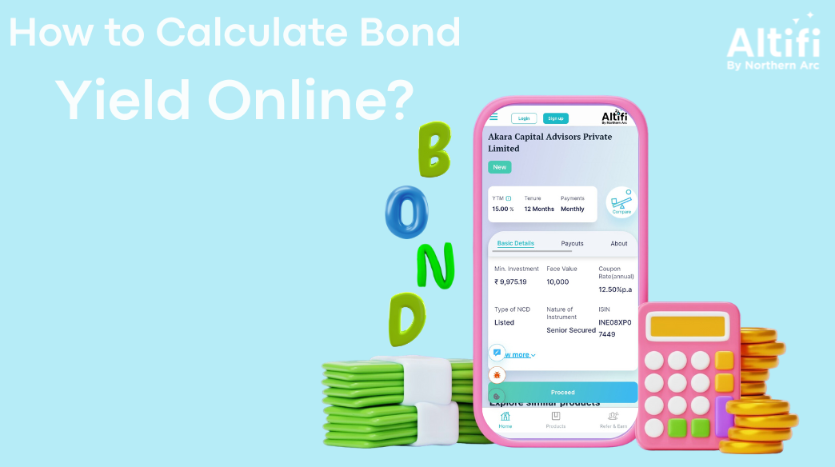
When you put money into a bond, the question isn’t complicated.
You simply want to know: What am I actually earning from this investment?
That answer comes down to bond yield.
Bonds are often seen as predictable and steady, especially when compared to equities. But once prices start moving in the secondary market, understanding the real return can get tricky. Two bonds with the same coupon can deliver very different outcomes depending on the price you pay.
This is where bond yield and online yield calculators become genuinely useful. They help translate numbers into clarity without requiring you to wrestle with financial formulas.
This article walks through what bond yield really means, how it is calculated, how Yield to Maturity (YTM) works, and how investors can calculate bond returns online with ease.
What Does Bond Yield Really Mean?
Bond yield is simply the return you earn on a bond, shown as a percentage.
Instead of focusing on the bond’s face value, yield looks at how much income the bond generates relative to its current market price. That distinction matters.
Bond prices don’t stay fixed. They rise and fall based on interest rates, demand, and credit perception. When the price changes, the yield changes too even though the coupon payment stays the same.
That’s why yield is a far better indicator than coupon rate when comparing bonds available in the market.
How Bond Yield Is Calculated
Calculating bond yield isn’t complicated once you break it down. You only need two numbers.
1. Annual Coupon Payment
This is the interest the bond pays every year.
For example, if a bond has a face value of ₹1,000 and a coupon rate of 8%, it pays ₹80 annually.
2. Current Market Price
This is the price at which the bond is trading today. It may be higher or lower than the face value.
Bond Yield Formula
Bond Yield = (Annual Coupon ÷ Current Market Price) × 100
Example
- Annual coupon: ₹80
- Market price: ₹950
Bond Yield = (80 ÷ 950) × 100 = 8.42%
So even though the coupon is 8%, buying the bond at a discount pushes the actual return higher.
Understanding Yield to Maturity (YTM)
Current yield tells you what the bond earns today.
Yield to Maturity (YTM) tells you what the bond earns over its entire life.
YTM assumes:
- You hold the bond until maturity
- You receive all coupon payments on time
- Coupons are reinvested at the same rate
Because it includes both interest income and any gain or loss between purchase price and face value, YTM gives a more complete picture of returns.
This is why YTM is the most commonly used metric in bond investing.
How Yield to Maturity Is Calculated
YTM takes into account:
- Annual interest
- Face value
- Current market price
- Remaining years to maturity
YTM Formula
YTM = [Annual Interest + (Face Value − Price) ÷ Years to Maturity] ÷ [(Face Value + Price) ÷ 2] × 100
Example
- Annual interest: ₹80
- Face value: ₹1,000
- Market price: ₹950
- Time to maturity: 5 years
Using the formula, the YTM works out to approximately 9.23% per year.
In simple terms, if you hold the bond until maturity, your average annual return will be around 9.23%.
Why Most Investors Prefer Online Yield Calculators
While the formulas are useful for understanding, calculating yields manually every time isn’t practical—especially for YTM.
Online bond yield calculators remove that complexity. They do the math instantly and reduce the risk of errors.
On platforms like Altifi, investors can quickly calculate:
- Current yield
- Yield to maturity
- Accrued interest
- Total settlement value
All without spreadsheets or manual calculations.
How to Calculate Bond Yield Online Using Altifi
The process is designed to be simple:
- Create an account on Altifi
- Open the bond calculator
- Select the bond you want to analyse
- Enter either the price or expected yield
- Choose the settlement date and quantity
- View yield, price, and settlement amount instantly
If the bond is available, you can take the next step without switching platforms.
Benefits of Using a Bond Yield Calculator
Easy to Use
Works for first-time investors as well as experienced professionals.
Clear Visibility
You see cash flows, accrued interest, and final settlement values upfront.
Saves Time
Evaluate multiple bonds in seconds instead of minutes.
Always Available
Accessible 24×7, whenever you need it.
Detailed Breakdown
Shows interest, principal, and settlement adjustments clearly.
Compare Options Quickly
Side-by-side comparisons across issuers and maturities.
Accurate Calculations
Precision up to multiple decimal places.
Cashflow-Based Logic
Calculations are based on actual bond cash flows, not estimates.
Conclusion
Bond yields don’t need to feel complicated. Once you understand the difference between current yield and yield to maturity, bond evaluation becomes much clearer.
Online calculators take care of the heavy lifting and let investors focus on what truly matters—choosing bonds that match their income needs, risk comfort, and investment horizon.
With the right tools and a basic understanding, bond investing becomes less intimidating and far more approachable.
Frequently Asked Questions (FAQs)
What’s the difference between bond yield and YTM?
Bond yield shows the current annual return, while YTM reflects the average
return over the bond’s full life.
Do bond yields change?
Yes. When market prices change, yields move in the opposite direction.
Are higher yields always better?
Not always. Higher yields often indicate higher credit or liquidity risk.
Who should consider investing in bonds?
Bonds are suitable for investors seeking steady income, diversification, and
lower volatility compared to equities.
Disclaimer:
The information contained in this Article (“Article”) is for general informational purposes only. Northern Arc Capital Limited (“Northern Arc”) does not make any warranties about the completeness, reliability, and accuracy of this information. Any action you take upon the information contained in this Article is strictly at your own risk, and Northern Arc will not be liable for any losses and damages in connection with the use of our Article.
The data included in this Article has been obtained from sources that are believed to be reliable and accurate at the time of publication. However, Northern Arc does not guarantee the accuracy or completeness of any information, nor does it assume any responsibility or liability for any errors or omissions therein. Any opinions expressed herein are subject to change without notice and Northern Arc is under no obligation to update or keep current the information contained in this Article.
This Article is not intended to constitute, and should not be construed as, investment advice or a recommendation to purchase, sell, or hold any security or to engage in any investment strategy or transaction. Readers should not rely solely on the information provided in this Article for making investment decisions and should conduct their own due diligence or seek the advice of a qualified professional.
The content of this Article is for informational purposes only and is not a solicitation or an offer to buy or sell any securities or financial instruments. Northern Arc is not responsible for any investment decisions made by the recipients of this Article. Readers should take independent financial advice from a qualified professional in connection with, or independently research and verify, any information that is provided in this Article and wish to rely upon, whether for the purpose of making an investment decision or otherwise.
Northern Arc and its affiliates, directors, employees, and agents expressly disclaim any and all liability for any direct or indirect losses, damages, or expenses of any kind arising out of or relating to the use of this Article, including but not limited to, any losses related to the accuracy, completeness, timeliness, or reliability of such information.
This Article may contain forward-looking statements that are based on current expectations, estimates, forecasts, and projections about the markets in which Northern Arc operates, as well as management’s beliefs and assumptions. Forward-looking statements are not guarantees of future performance and involve certain risks and uncertainties, which are difficult to predict. Past performance is not indicative of future results.
This report is intended solely for the recipient and is not for further circulation. Any distribution, modification, reproduction, or disclosure of the contents of this Article, in whole or in part, without the prior written consent of Northern Arc, is strictly prohibited.