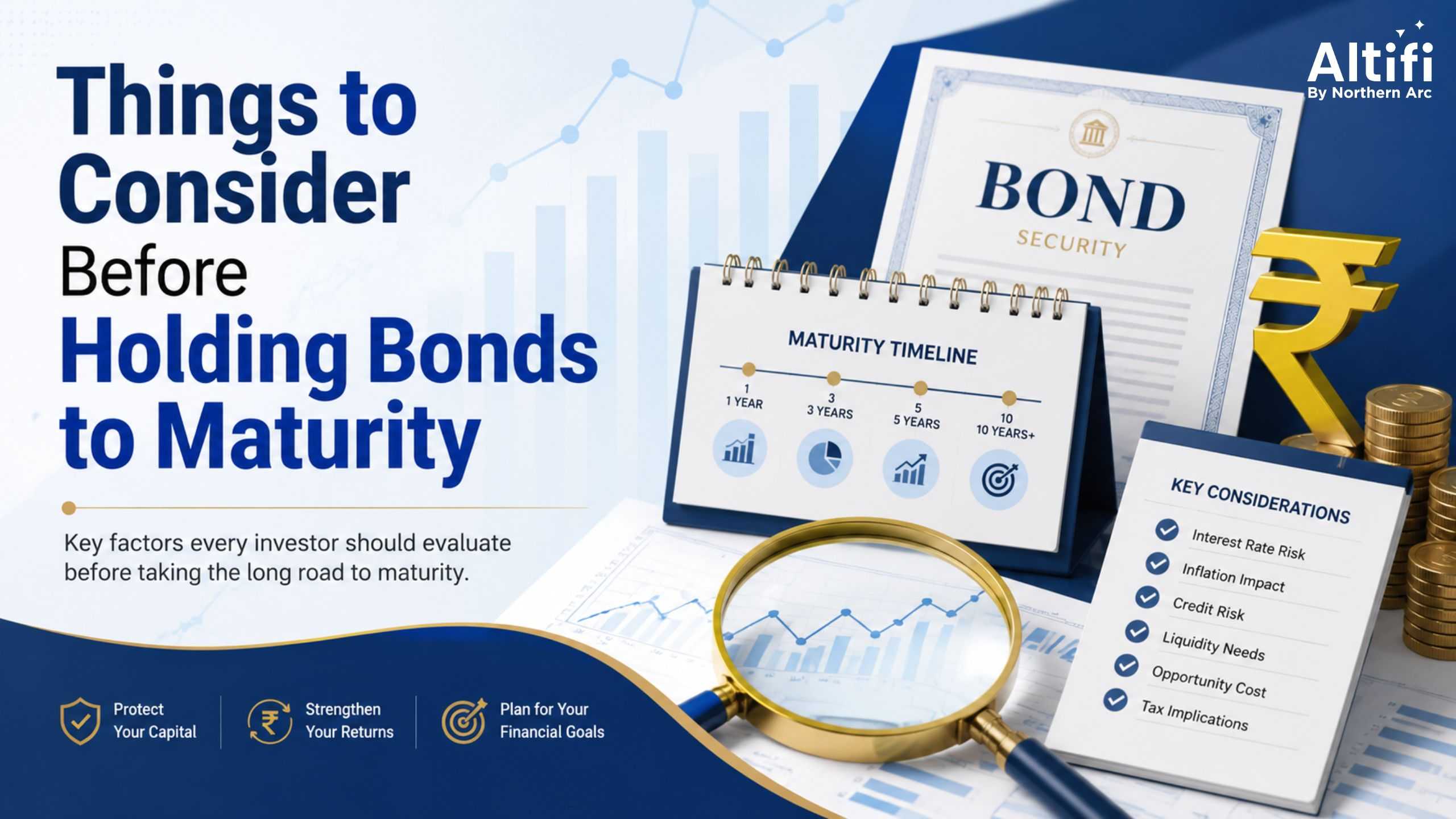
Investors can get consistent coupon payments throughout the investment period by holding bonds to maturity. If issuers fulfil their repayment obligations in full, investors might also recover the bond's face value at maturity. This may offer more clarity about projected future cash flows and profits.
However, investors cannot eliminate the risks of fixed-income investments by holding bonds until maturity. Over time, credit quality, taxation, reinvestment opportunities and liquidity requirements may still impact overall investment returns. Total profits from bond investments are also affected by inflation and changing interest rates.
What Does Holding a Bond to Maturity Mean?
The date on which the issuer is anticipated to return to the principal (face value) of a bond is known as the bond maturity date, or redemption date. The investor might get recurring coupon payments up until that point.
When a bond is held to maturity, it is retained for the whole of its term as opposed to being sold in the secondary market before it expires.
For example, consider a Bond having a face value of ₹1,000, a 9% coupon rate, and a 5-year duration. This Bond offers an annual coupon payment of ₹90 for five years and a face value of ₹1,000 upon maturity, if the issuer meets its obligations.
1. Credit Risk and Long-term Holding Exposure
Credit risk refers to the possibility that the issuer may not meet its coupon or principal repayment obligations. Holding bonds till maturity means investors rely on issuer's ability to repay principal and interest fully. Credit risk remains present throughout the entire tenure until the bond reaches its maturity date. Investors must track issuer’s financial condition over time to avoid unexpected repayment issues or defaults.
Selling before maturity may reduce exposure to long-term default risk from the bond issuer. Also, investors need to market demand and prevailing credit sentiment at the time of sale. Investors may still face losses if bond prices fall before they decide to exit.
2. Interest Rate Changes and Yield Impact
Interest rate changes do not affect the final maturity value of the bond investment. Investors continue receiving fixed coupon payments until the bond completes its maturity period fully. However, rising rates may create opportunity loss compared to newer higher yielding bonds available in the market.
Rising interest rates may cause capital loss if bonds are sold before the maturity period. Investors can switch to newer bonds, offering higher yields available in the market. Returns depend on the timing of exit and interest rate movement during the investment period.
3. Liquidity Needs Before Maturity
There is no liquidity risk involved if a bond is held till maturity without any plans to sell them in the secondary market. The investors may receive full repayment at maturity date. However, funds remain locked until redemption, so proper planning of cash flow is necessary.
On the other hand, selling the bonds in the secondary market may lead to liquidity risk depending on market demand for that specific bond. Low trading activity may reduce selling price and overall returns. Exit value depends on market conditions and availability of buyers at that time.
4. Reinvestment Risk on Coupon Income
Coupon payments received during the holding period must be reinvested to maintain portfolio returns. Reinvestment returns may vary depending on prevailing interest rate conditions in the market. Overall returns depend on how efficiently coupon income is reinvested over time.
Investors may exit early and miss remaining coupon payments from the bond. Shorter holding periods reduce may dependency on reinvestment of coupon income over time. Return stability may be reduced due to interrupted income streams from bond investment.
5. Taxation Impact on Returns
Returns from bonds are taxed as per applicable income tax slab throughout holding period. Capital gains tax applies only at maturity when bond is redeemed fully. Post-tax planning becomes important for accurate long term return estimation.
However, selling bonds in the secondary market before maturity may attract capital gains tax depending on holding duration and bond type. Tax outcomes vary based on classification and timing of bond sale. Frequent exits may increase tax complexity and reduce net returns overall.
6. Bond Features and Early Exit Risk
Callable and puttable features may still allow early redemption before maturity date arrives. Such features can change the expected holding period even in long term investments. Investors must review bond terms carefully before committing maturity-based strategy.
Bond features matter less if investors exit before maturity in secondary markets. Market price already reflects callable or puttable conditions in most cases.
Hold-to-Maturity vs Secondary Market Sale
| Factor | Hold to Maturity | Secondary Market Sale |
|---|---|---|
| Price volatility | Interim price changes do not affect final return if held till redemption | Direct impact on realised yield |
| Coupon income | Received until maturity | Received until sale |
| Credit exposure | Entire tenure | Until exit |
| Taxation | Coupon + redemption impact | Coupon + capital gains/loss |
Figures are indicative and subject to change based on market conditions.
When Should Investors Hold Bonds to Maturity?
A hold-to-maturity strategy may suit investors with defined time horizons because it aligns cash flows with financial goals. This reduces the need for frequent trading.
It may also support structured portfolio strategies such as bond laddering, where investments are spread across different maturities to manage reinvestment and coupon rate risk.
However, shorter-duration securities or active portfolio strategies might be of interest to investors with erratic liquidity requirements or worries about future coupon rate fluctuations.
This content is for informational purposes only and does not constitute investment advice.
Conclusion
Holding the bonds till maturity may assist investors to get regular coupon payment and planned redemption value over the period. Many investors prefer this approach as it gives better visibility on the expected future cash flows and returns. It may also reduce concerns about temporary swings in bond prices as market conditions change. However, long-term investors should not believe that holding bonds to maturity is free from any investment risk. Investors should carefully consider their financial objectives, investment horizons, and liquidity needs before making any investment decision.
Frequently Asked Questions
1. What will happen if I hold a bond to maturity?
The issuer is likely to repay the face value at maturity. During the tenure, the investor receives the scheduled coupon payments subject to the issuer’s performance.
2. Can you lose money by holding a bond until maturity?
Certainly. Risks include credit risk, reinvestment risk, opportunity cost arising from changing coupon rates etc.
3. What does Yield to Maturity (YTM) mean?
YTM refers to the annualised rate of return an investor may receive if the bond is held to maturity. It assumes coupons are reinvested at a similar rate.
4. Is it possible to sell bonds early?
Yes, the listed bonds can be sold in the secondary market depending on its liquidity and price.
5. How is tax imposed on bond yields?
Coupon income usually gets taxed as per the investor's slab rate. The treatment of capital gains is dependent upon the holding duration and instrument.
Disclaimer:
The information contained in this Article (“Article”) is for general informational purposes only. Northern Arc Capital Limited (“Northern Arc”) does not make any warranties about the completeness, reliability, and accuracy of this information. Any action you take upon the information contained in this Article is strictly at your own risk, and Northern Arc will not be liable for any losses and damages in connection with the use of our Article.
The data included in this Article has been obtained from sources that are believed to be reliable and accurate at the time of publication. However, Northern Arc does not guarantee the accuracy or completeness of any information, nor does it assume any responsibility or liability for any errors or omissions therein. Any opinions expressed herein are subject to change without notice and Northern Arc is under no obligation to update or keep current the information contained in this Article.
This Article is not intended to constitute, and should not be construed as, investment advice or a recommendation to purchase, sell, or hold any security or to engage in any investment strategy or transaction. Readers should not rely solely on the information provided in this Article for making investment decisions and should conduct their own due diligence or seek the advice of a qualified professional.
The content of this Article is for informational purposes only and is not a solicitation or an offer to buy or sell any securities or financial instruments. Northern Arc is not responsible for any investment decisions made by the recipients of this Article. Readers should take independent financial advice from a qualified professional in connection with, or independently research and verify, any information that is provided in this Article and wish to rely upon, whether for the purpose of making an investment decision or otherwise.
Northern Arc and its affiliates, directors, employees, and agents expressly disclaim any and all liability for any direct or indirect losses, damages, or expenses of any kind arising out of or relating to the use of this Article, including but not limited to, any losses related to the accuracy, completeness, timeliness, or reliability of such information.
This Article may contain forward-looking statements that are based on current expectations, estimates, forecasts, and projections about the markets in which Northern Arc operates, as well as management’s beliefs and assumptions. Forward-looking statements are not guarantees of future performance and involve certain risks and uncertainties, which are difficult to predict. Past performance is not indicative of future results.
This report is intended solely for the recipient and is not for further circulation. Any distribution, modification, reproduction, or disclosure of the contents of this Article, in whole or in part, without the prior written consent of Northern Arc, is strictly prohibited.