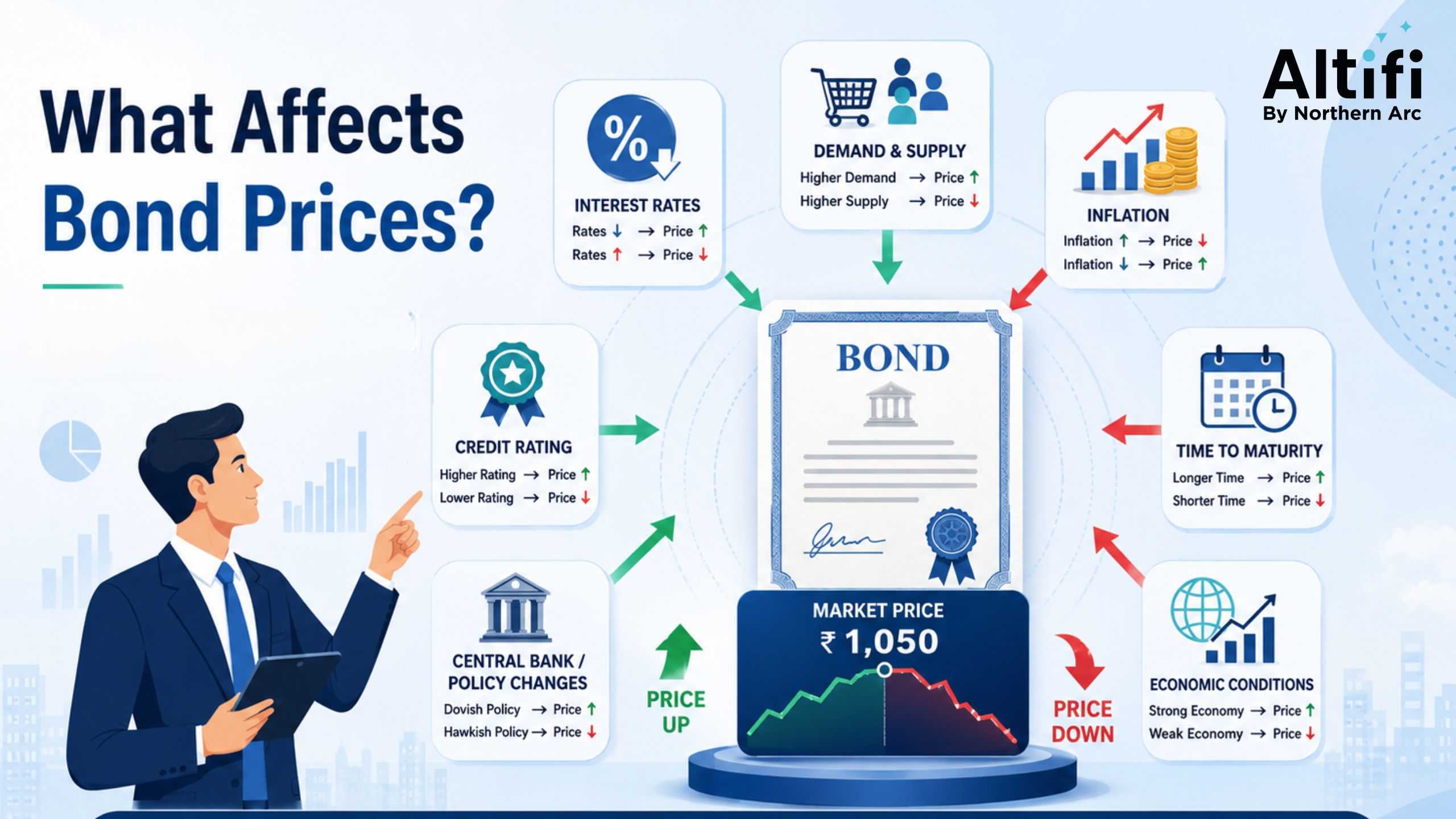
Bond prices in the secondary market fluctuate continuously. These price movements are influenced by several factors, including changes in interest rates, inflation expectations, the issuer's credit profile, market liquidity, and overall investor sentiment. Understanding these factors is important because they affect not only a bond's market value but also the yield available to investors.
What Determines a Bond's Price?
A bond's price is influenced by a combination of market-related and issuer-specific factors. These may include prevailing interest rates, the issuer's credit rating, the bond's maturity, inflation expectations, overall market conditions, and the bond's structural features. As these factors change, investor perceptions of risk and return may also change, which can affect the bond's market price.
Understanding the Relationship Between Bond Prices and Yields
Bond prices and bond yields generally move in opposite directions. When a bond's market price rises, its yield falls. Conversely, when the bond's market price falls, its yield rises.
This relationship exists because the coupon payment on a bond is usually fixed. If market interest rates decline, existing bonds with higher coupon rates may become more preferable. As demand for these bonds increases, their market prices may rise. Since investors are paying a higher price for the same coupon payment, the yield decreases.
On the other hand, when interest rates rise, newly issued bonds may offer higher coupon rates. Existing bonds with lower coupon rates may become less preferable, leading to a reduction in prices. As the purchase price decreases while the coupon payment remains unchanged, the yield increases.
Example:
Suppose a bond has a face value of ₹1,000 and pays an annual coupon of ₹70. If the bond trades at its face value, the yield is 7%. However, if demand pushes the bond's market price to ₹1,100, the annual coupon remains ₹70, but the yield falls to around 6.4%. If the bond's price drops to ₹900, the same ₹70 coupon results in a yield of about 7.8%.
This inverse relationship between bond prices and yields is one of the most important concepts in the bond market and helps explain why bond prices change over time.
Key Factors That Affect Bond Prices
The following are some factors affecting bond prices:
Changes in Interest Rates
Interest rate movements are widely regarded as one of the most direct influences on bond prices. When prevailing market interest rates rise, newly issued bonds are generally issued with higher coupon rates to remain competitive with prevailing market yields. As a result, the prices of existing bonds in the secondary market may fall to align their yields more closely with prevailing market rates. When interest rates decline, existing bonds with relatively higher coupons may become more preferable, and their prices may appreciate in the secondary market.
Time to Maturity
The time remaining until a bond's maturity date may also influence how sensitive its price is to interest rate changes. A bond that is closer to its maturity date has a shorter period over which interest rate fluctuations may affect it, so its price tends to be comparatively less volatile. A bond with a longer time to maturity is exposed to market conditions over a longer period, which may make its price more responsive to rate movements.
Credit Rating and Credit Risk
A bond's credit rating reflects the assessed ability of the issuer to meet its coupon payment obligations and repay the principal.
When an issuer's rating is downgraded, market participants may perceive elevated default risk, which may lead to a fall in that bond's market price. A rating upgrade, on the other hand, may support a spread compression and price appreciation.
Inflation Expectations
Inflation affects the real value of capital over time. When inflation expectations rise, the real purchasing power of future coupon cash flows declines, as the purchasing power of each payment decreases. This may reduce the demand for fixed-income securities and exert downward pressure on their prices. When inflation expectations ease, the reverse may apply.
Demand and Supply in the Bond Market
Bond prices are also influenced by the broader dynamics of demand and supply. When demand for bonds is high, prices may rise. When supply exceeds demand, or when investor interest reduces, prices may come under pressure.
Issuer Financial Health
Beyond the assigned credit rating, the financial condition of the issuing company may also have a bearing on its bond's market price. Market participants track indicators such as revenue performance, debt levels, interest coverage ratios, and sector-specific developments. If a company's financial profile shows signs of stress, bond prices may begin to reflect that concern even before a formal rating change is announced.
Significant events such as changes in regulatory standing, major operational developments, or material shifts in the company's business environment may also introduce price movements. Staying informed about issuer-level developments is, therefore, a relevant part of monitoring a bond's market performance.
How Economic Conditions Impact Bond Prices
Economic conditions may influence bond prices by affecting interest rates, inflation expectations, and investor sentiment. During periods of strong economic growth, central banks may raise interest rates to manage inflation*. Higher interest rates may lead to newly issued bonds offering higher yields, which may reduce demand for existing bonds and put downward pressure on their prices.
Conversely, during periods of slower economic growth, interest rates may remain stable or decline. In such situations, existing bonds with higher coupon rates may have higher demand, which may support or increase their market prices.
Economic conditions may also influence how investors allocate their funds between fixed-income securities and other asset classes, contributing to changes in bond prices over time.
Bond Price Movements: A Simple Example
To understand how these factors interact in practice, consider the following scenario.
Two corporate bonds are available in the secondary market, both issued by companies with similar credit ratings. Bond A was issued two years ago at a coupon rate of 7.5% per annum and has a remaining tenure of five years. Bond B is a freshly issued bond offering a coupon rate of 8.25% per annum, in line with the current interest rate environment.
If both bonds carry similar credit quality and remaining tenure, Bond A would likely trade at a price below its face value. A buyer comparing the two bonds would require Bond A to be priced lower so that its effective yield to maturity (YTM) becomes comparable to the 8.25% offered by Bond B. At face value, Bond A offers a lower coupon payment and is therefore comparatively less preferable. This price adjustment is how the secondary market reflects the effect of rising interest rates on existing bonds.
How Investors Can Use Bond Price Trends
Understanding bond price trends may offer useful context for evaluating fixed-income opportunities. The following are some ways in which this knowledge may be applied when assessing bonds.
Comparing Yields Across Tenure Options
Observing price variations across bonds with different tenures may help assess whether the additional return on longer-tenure bonds is proportionate to the associated exposure.
Tracking Credit Spread Movements
The difference in yield between a corporate bond and a government security of similar tenure is referred to as the credit spread. A widening credit spread may indicate that market participants perceive increased risk in a particular issuer or sector.
Evaluating Secondary Market Entry Points
A bond trading below its face value may offer a comparatively higher YTM. Analysing YTM in conjunction with the bond's credit profile and remaining tenure may help in forming a view on the opportunity.
Monitoring Issuer and Rating Updates
Since an issuer's financial health and credit rating changes may affect bond prices, staying informed about relevant developments related to the issuing company is a meaningful step for those maintaining a bond portfolio.
Publicly available data from the National Stock Exchange of India (NSE), Bombay Stock Exchange (BSE), and SEBI filings may serve as accessible starting points for this kind of ongoing analysis.
Conclusion
Bond prices are influenced by a combination of interest-rate expectations, inflation trends, issuer credit quality, market liquidity, and broader economic conditions. These factors may ultimately affect how investors price risk and determine the yield required from a bond. Understanding these drivers may help investors interpret secondary-market price movements, assess interest-rate and credit risk, and make more informed fixed-income investment decisions.
FAQs on Bond Prices
Why do bond prices fall when interest rates rise?
When interest rates rise, newly issued bonds offer higher coupon payments, making existing lower-coupon bonds comparatively less attractive, which may cause their secondary market prices to fall.
What is the relationship between bond yield and bond price?
Bond yield and bond price move in opposite directions. When a bond's market price rises, its yield falls, and when the price falls, its yield rises proportionally.
Does inflation affect bond prices?
Yes. Rising inflation may reduce the real value of fixed coupon payments.
Do credit ratings impact bond prices?
Yes. When an issuer's rating is downgraded, its bonds may fall in price due to increased perceived credit risk. A rating upgrade may have a supportive effect on price.
How can investors evaluate bond price risk?
It is important for investors to assess a combination of factors, including the bond's remaining tenure, issuer credit rating, prevailing interest rate trends, and the issuing company's financial health.
Disclaimer
The information contained in this newsletter (“Newsletter”) is for general informational purposes only. Northern Arc Capital Limited (“Northern Arc”) does not make any warranties about the completeness, reliability, and accuracy of this information. Any action you take upon the information contained in this Newsletter is strictly at your own risk, and Northern Arc will not be liable for any losses and damages in connection with the use of our Newsletter.
The data included in this Newsletter has been obtained from sources that are believed to be reliable and accurate at the time of publication. However, Northern Arc does not guarantee the accuracy or completeness of any information, nor does it assume any responsibility or liability for any errors or omissions therein. Any opinions expressed herein are subject to change without notice and Northern Arc is under no obligation to update or keep current the information contained in this Newsletter.
This Newsletter is not intended to constitute, and should not be construed as, investment advice or a recommendation to purchase, sell, or hold any security or to engage in any investment strategy or transaction. Readers should not rely solely on the information provided in this Newsletter for making investment decisions and should conduct their own due diligence or seek the advice of a qualified professional.
The content of this Newsletter is for informational purposes only and is not a solicitation or an offer to buy or sell any securities or financial instruments. Northern Arc is not responsible for any investment decisions made by the recipients of this Newsletter. Readers should take independent financial advice from a qualified professional in connection with, or independently research and verify, any information that is provided in this Newsletter and wish to rely upon, whether for the purpose of making an investment decision or otherwise.
Northern Arc and its affiliates, directors, employees, and agents expressly disclaim any and all liability for any direct or indirect losses, damages, or expenses of any kind arising out of or relating to the use of this Newsletter, including but not limited to, any losses related to the accuracy, completeness, timeliness, or reliability of such information.
This Newsletter may contain forward-looking statements that are based on current expectations, estimates, forecasts, and projections about the markets in which Northern Arc operates, as well as management’s beliefs and assumptions. Forward-looking statements are not guarantees of future performance and involve certain risks and uncertainties, which are difficult to predict. Past performance is not indicative of future results.
This report is intended solely for the recipient and is not for further circulation. Any distribution, modification, reproduction, or disclosure of the contents of this Newsletter, in whole or in part, without the prior written consent of Northern Arc, is strictly prohibited.