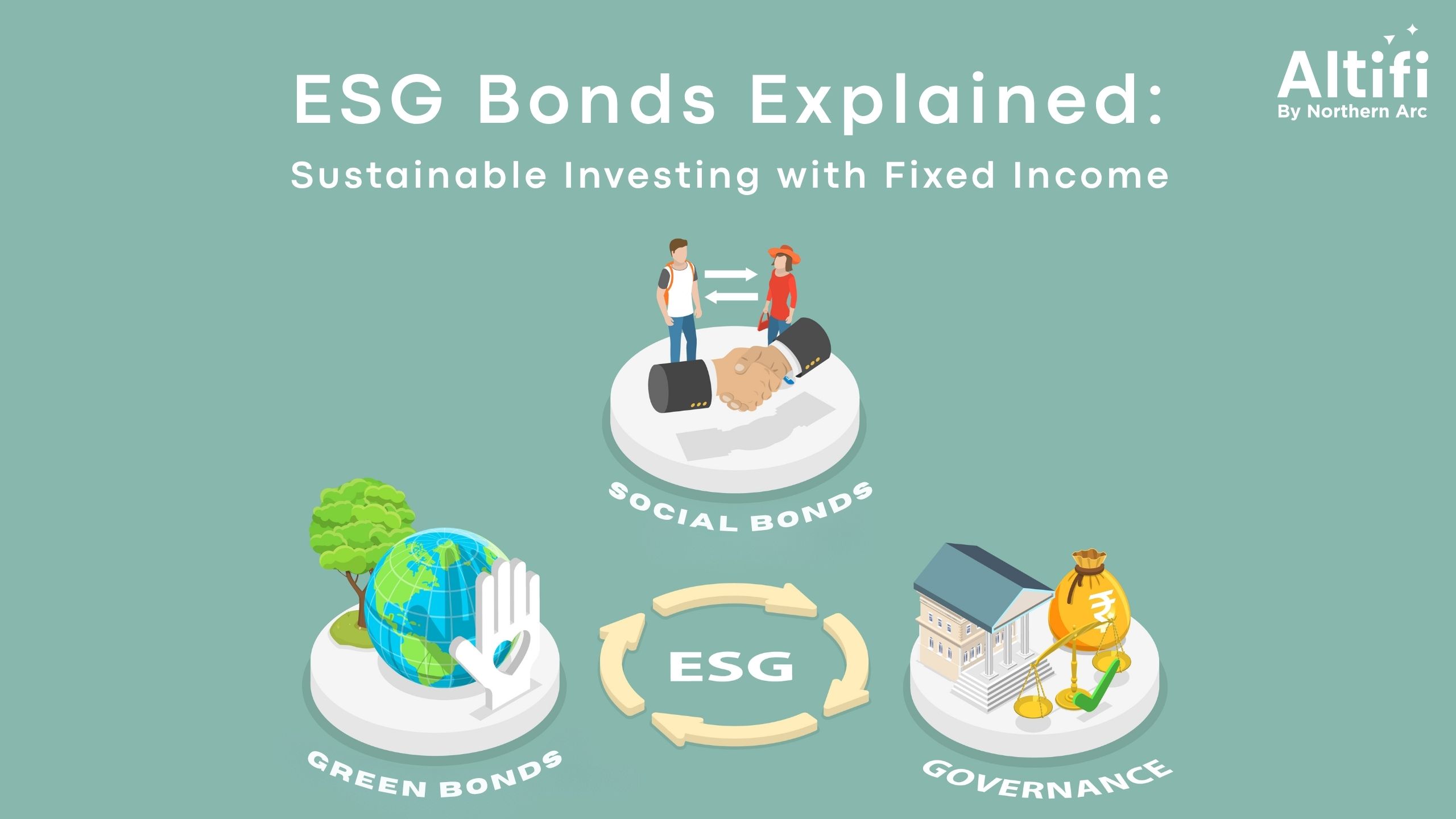
ESG Bonds are fixed-income instruments through which governments, corporations, and institutions raise capital for projects with environmental, social, or governance (ESG) objectives. In India, issuers such as SBI, REC and IREDA have utilised these instruments for financing sustainable projects, renewable energy and social infrastructure. This article covers the types, benefits, risks, investment methods, regulatory landscape, and comparison of ESG bonds with traditional bonds and fixed deposits.
What are ESG Bonds?
ESG bonds are debt instruments that raise money for projects linked to environmental, social, or governance objectives. The issuer commits to use proceeds for some sustainable projects. Like traditional bonds, investors lend money to the issuer and receive periodic interest payments along with principal repayment at maturity. The key difference is that the funds raised are intended for specific sustainability-related purposes. Moreover, independent bodies supervise the use of proceeds.
| ESG Bond Type | Purpose |
|---|---|
| Green Bonds | Finance environmental projects such as renewable energy, pollution control, and clean transportation. |
| Social Bonds | Fund projects that support social objectives, including healthcare, education, and affordable housing. |
| Sustainability Bonds | Support a combination of environmental and social projects. |
| Sustainability-Linked Bonds | Bond terms are linked to the issuer's sustainability performance targets. |
ESG Pillars Table (E, S, G breakdown)
ESG bond proceeds are ring-fenced, which distinguishes them from conventional bond proceeds. Only designated ESG projects may receive funding.
| Pillar | Focus Areas | Indian Example |
|---|---|---|
| Environmental (E) | Climate change, renewable energy, pollution control | IREDA green bonds funding renewable energy |
| Social (S) | Housing, healthcare, education, employment | REC bonds supporting social infrastructure |
| Governance (G) | Transparency, board diversity, anti-corruption | SEBI ESG disclosure requirements |
Investors receive regular coupon payments and principal repayment at maturity, similar to any other bond.
Key Benefits of ESG Bonds
ESG bonds provide financial advantages while funding initiatives that improve the environment and society.
- Funds Significant Projects: ESG bonds finance projects that are good for the environment and the community. They include sustainable infrastructure, health care, education, and clean energy.
- Promotes Responsible Investing: Investors can back companies that adhere to ethical governance and environmental standards. This makes it possible for investments to represent more general sustainability objectives.
- Regular Income: Throughout the investment period, the majority of ESG bonds pay interest at predetermined periods. Investors may be able to create a steady stream of income as a result.
- Increases Portfolio Diversification: ESG bonds expose investors to a variety of industries and issuers. A more balanced investment portfolio may result from this.
- Focus on Long-Term Value: Many ESG-focused issuers champion sustainable growth and ethical business practices. This strategy could help ensure long-term financial stability.
- Provides More Investment Options: The market for ESG bonds is steadily growing on international markets. A greater variety of investing options are now available to investors.
How to Invest in ESG Bonds in India: Step-by-Step Guide
Investing in ESG bonds follows a process similar to investing in other listed bonds.
Step 1: Create a Demat account.
To hold bonds online, you must have a Demat account.Step 2: Check Bond Rating and SEBI Compliance
Before investing, check the bond’s credit rating and compliance with regulations.
Step 3: Review Issuers and ESG Bond Choices
Compare issuers, project categories, and ESG guidelines to understand how the funds will be used.
Step 4: Assess ESG Focus, Maturity, and Coupon Rate
Evaluate the project aims, term, and coupon rate in relation to your investment objectives.
Step 5: Buy and Monitor Your ESG Bond Portfolio
Purchase the bond through a broker or investment platform and review periodic issuer reports.
Conclusion
ESG bonds may enable investors to earn fixed income and back social and environmental issues. The growing legal environment and organisations such as IREDA, REC, NTPC and SBI have helped to grow the market for ESG bonds in India. ESG bonds are vulnerable to credit and interest rate risk, much like conventional bonds. ESG bonds may be incorporated into a diversified portfolio for investors looking for a combination of fixed income exposure and sustainability-focused investing.
Frequently Asked Questions About ESG Bonds
What are ESG bonds and how are they different from regular bonds?
ESG bonds are debt instruments where proceeds are allocated to environmental, social, or governance-related projects. Regular bonds do not restrict how funds are used.
Who issues ESG bonds in India?
The issuers include government-backed businesses such as IREDA, REC, NTPC, SBI, and the Government of India through sovereign green bonds.
Are ESG bonds safe for retail investors?
ESG bonds are vulnerable to credit and market risk, just like traditional bonds. Investors should assess the issuer's duration, rating, and credit quality prior to making an investment.
What returns can investors expect from ESG bonds?
Returns are influenced by the issuer, tenure, credit rating, and market conditions at the time of investment.
What is the difference between green bonds and sustainability bonds?
Green bonds exclusively fund environmental projects, while sustainability bonds fund both social and environmental programs.
How can investors verify that ESG funds are used properly?
Impact reports are released by issuers, and funding distribution and project results are examined by independent organisations.
Can investors sell ESG bonds before maturity?
Yes, subject to market pricing and liquidity, listed ESG bonds may be exchanged on the secondary market.
Are ESG bonds covered under any investor protection scheme?
DICGC insurance does not cover ESG bonds. These are debt products with a market connection that are governed by relevant SEBI regimes.
Disclaimer:
The information contained in this Article (“Article”) is for general informational purposes only. Northern Arc Capital Limited (“Northern Arc”) does not make any warranties about the completeness, reliability, and accuracy of this information. Any action you take upon the information contained in this Article is strictly at your own risk, and Northern Arc will not be liable for any losses and damages in connection with the use of our Article.
The data included in this Article has been obtained from sources that are believed to be reliable and accurate at the time of publication. However, Northern Arc does not guarantee the accuracy or completeness of any information, nor does it assume any responsibility or liability for any errors or omissions therein. Any opinions expressed herein are subject to change without notice and Northern Arc is under no obligation to update or keep current the information contained in this Article.
This Article is not intended to constitute, and should not be construed as, investment advice or a recommendation to purchase, sell, or hold any security or to engage in any investment strategy or transaction. Readers should not rely solely on the information provided in this Article for making investment decisions and should conduct their own due diligence or seek the advice of a qualified professional.
The content of this Article is for informational purposes only and is not a solicitation or an offer to buy or sell any securities or financial instruments. Northern Arc is not responsible for any investment decisions made by the recipients of this Article. Readers should take independent financial advice from a qualified professional in connection with, or independently research and verify, any information that is provided in this Article and wish to rely upon, whether for the purpose of making an investment decision or otherwise.
Northern Arc and its affiliates, directors, employees, and agents expressly disclaim any and all liability for any direct or indirect losses, damages, or expenses of any kind arising out of or relating to the use of this Article, including but not limited to, any losses related to the accuracy, completeness, timeliness, or reliability of such information.
This Article may contain forward-looking statements that are based on current expectations, estimates, forecasts, and projections about the markets in which Northern Arc operates, as well as management’s beliefs and assumptions. Forward-looking statements are not guarantees of future performance and involve certain risks and uncertainties, which are difficult to predict. Past performance is not indicative of future results.
This report is intended solely for the recipient and is not for further circulation. Any distribution, modification, reproduction, or disclosure of the contents of this Article, in whole or in part, without the prior written consent of Northern Arc, is strictly prohibited.