In the world of finance in 2026, it seems like corporate bonds have progressed from being a relatively narrow market to an increasingly established one in India. It is widely believed that the total size of this market exceeds ₹53.6 lakh crore. At the same time, the growing “retailisation” of debt has allowed companies to look beyond traditional bank borrowing and access a wider pool of investors. This shift is generally seen as part of a broader move towards market-linked funding and more diversified capital formation.
What is the Corporate Bond Issuance Process
The corporate bond issuance process is the method a company uses to raise money from investors by issuing bonds. Instead of depending only on bank loans, a company may go to the capital market and borrow from many investors at once. This may be useful when large funds are required, as it allows companies to access a broader investor base instead of relying solely on bank financing.
These bonds represent a formal obligation. The issuer agrees to pay periodic interest, known as the coupon, and return the principal at maturity. In practice, companies often use this route for expansion, refinancing existing liabilities, or managing working capital in a structured way.
Steps Involved in the Corporate Bond Issuance Process
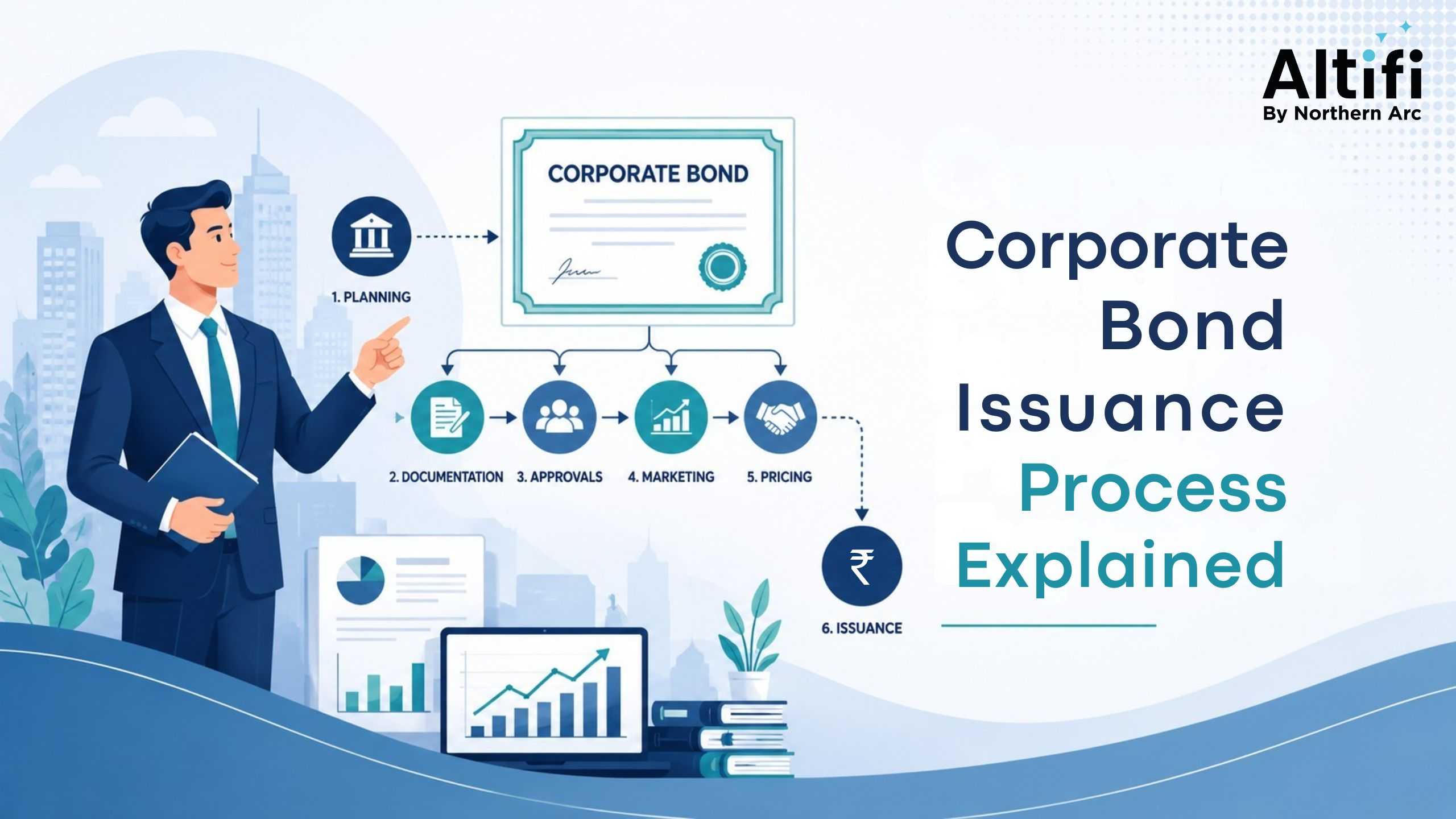
The corporate bond issuance process usually follows a set pattern. Though some steps may differ slightly across issuances.
Assessment of Funding Requirement
First, the company looks at how much fund it actually needs. It reviews its financial position and checks whether issuing bonds is required or not. Sometimes, bank loans may still be better, so this step is quite important.
Appointment of Intermediaries
Next, the company brings in experts. These include investment banks, legal advisers, and other professionals. They help manage the issue and ensure everything follows regulations. Without these intermediaries, the issuance process may become more complex and less efficient.
Credit Rating Assessment
A credit rating agency such as CRISIL, ICRA, CARE Ratings, or India Ratings evaluates the company. The rating gives an idea of the company’s ability to repay. It helps investors decide, though it does not remove the chances of defaults.
Structuring the Bond
Here, the company decides the key terms. This includes the interest rate, maturity period, and total issue size. Certain conditions, known as covenants, may also be added. These details may influence investor demand, which in turn may affect pricing and subscription levels.
Regulatory Filings and Disclosures
The issuer prepares disclosure documents in line with SEBI regulations. These documents outline financial details, associated risks, and the intended use of funds.
Pricing and Issuance
The bond is priced based on prevailing market conditions, comparable yields, and investor demand. It is then issued either through a public offer or a private placement.
Listing and Secondary Market Trading
Once issued, bonds may be listed on exchanges such as NSE or BSE. This enables secondary market transactions and may improve liquidity.
How Corporate Bonds Work
A corporate bond usually functions as a loan from investors to the issuing company. The issuer sets terms such as coupon rate, maturity date, and face value at the time of issuance.
Investors who subscribe to the bond may receive coupon payments periodically, subject to the issuer’s financial performance and bond structure. Over time, however, the market value of the bond may change.
This movement is influenced by factors such as interest rates, the issuer’s credit profile, and broader market conditions. Bond prices generally move inversely to interest rates, reflecting changes in market yield expectations. When interest rates rise, existing bond prices may see a price correction, and the reverse may also be observed.
Types of Corporate Bonds
Corporate bonds are issued in different forms, depending on structure and purpose.
Secured Bonds
These bonds are backed by specific assets of the issuing company. In case of financial stress, bondholders may have a claim on those assets. This structure is often associated with relatively lower credit risk compared to unsecured instruments, although risk of loss is not eliminated.
Unsecured Bonds (Debentures)
These are not backed by collateral and depend on the issuer’s creditworthiness. Their risk profile is typically assessed through credit ratings assigned by agencies such as CRISIL, ICRA, CARE Ratings, or India Ratings.
Convertible Bonds
These instruments may allow conversion into equity shares of the issuing company under predefined conditions. This feature may influence both pricing and yield structure.
Zero-Coupon Bonds
These are issued at a discount and do not provide periodic interest. The yeild is derived from the difference between the issue price and face value at maturity, subject to issuer performance.
Ways to Invest in Corporate Bonds
Investors may access corporate bonds through different routes, depending on their preferences and access.
Primary Market Participation
Investing in bonds at the time they are first issued by the issuer.
Secondary Market Purchase
Bonds that are already issued can be bought or sold on exchanges, depending on liquidity and pricing.
Debt Investment Platforms
Many platforms provide access to a range of fixed-income instruments, along with relevant disclosures and data for evaluation.
Mutual Funds and Bond Funds
Some investors prefer indirect exposure through professionally managed portfolios that invest in corporate debt.
Conclusion
Issuance of corporate bonds is a process that allows firms to obtain capital using capital markets. It is a structured process with many steps, such as credit evaluation, disclosure, price setting, and investor participation. Each of these aspects influences the process of issuance of such instruments and their performance over time. Understanding this process helps place corporate bonds within the broader fixed-income landscape. At the same time, outcomes may vary depending on interest rate movements and the issuer’s financial position, making it relevant to consider both income potential and associated risks.
Frequently Asked Questions
What is the process of issuing corporate bonds?
It involves assessing funding needs, appointing intermediaries, obtaining a credit rating, structuring the bond, completing disclosures, and issuing it to investors.
How do companies raise funds through corporate bonds?
Companies issue bonds to investors in exchange for capital and agree to make scheduled coupon payments and repay the principal at maturity.
What are the different types of corporate bonds?
They include secured, unsecured, convertible, zero-coupon, and investment-grade bonds, each with distinct features.
How do investors earn income from corporate bonds?
Investors may receive periodic coupon payments and repayment of principal at maturity, subject to issuer performance.
How are corporate bonds different from government bonds?
Corporate bonds are issued by companies, while government bonds are issued by sovereign entities. Their risk and yield characteristics may differ.
How can retail investors invest in corporate bonds in India?
Retail investors may participate through primary issuances, secondary markets, or debt investment platforms, depending on access.
Disclaimer:
The information contained in this Article (“Article”) is for general informational purposes only. Northern Arc Capital Limited (“Northern Arc”) does not make any warranties about the completeness, reliability, and accuracy of this information. Any action you take upon the information contained in this Article is strictly at your own risk, and Northern Arc will not be liable for any losses and damages in connection with the use of our Article.
The data included in this Article has been obtained from sources that are believed to be reliable and accurate at the time of publication. However, Northern Arc does not guarantee the accuracy or completeness of any information, nor does it assume any responsibility or liability for any errors or omissions therein. Any opinions expressed herein are subject to change without notice and Northern Arc is under no obligation to update or keep current the information contained in this Article.
This Article is not intended to constitute, and should not be construed as, investment advice or a recommendation to purchase, sell, or hold any security or to engage in any investment strategy or transaction. Readers should not rely solely on the information provided in this Article for making investment decisions and should conduct their own due diligence or seek the advice of a qualified professional.
The content of this Article is for informational purposes only and is not a solicitation or an offer to buy or sell any securities or financial instruments. Northern Arc is not responsible for any investment decisions made by the recipients of this Article. Readers should take independent financial advice from a qualified professional in connection with, or independently research and verify, any information that is provided in this Article and wish to rely upon, whether for the purpose of making an investment decision or otherwise.
Northern Arc and its affiliates, directors, employees, and agents expressly disclaim any and all liability for any direct or indirect losses, damages, or expenses of any kind arising out of or relating to the use of this Article, including but not limited to, any losses related to the accuracy, completeness, timeliness, or reliability of such information.
This Article may contain forward-looking statements that are based on current expectations, estimates, forecasts, and projections about the markets in which Northern Arc operates, as well as management’s beliefs and assumptions. Forward-looking statements are not guarantees of future performance and involve certain risks and uncertainties, which are difficult to predict. Past performance is not indicative of future results.
This report is intended solely for the recipient and is not for further circulation. Any distribution, modification, reproduction, or disclosure of the contents of this Article, in whole or in part, without the prior written consent of Northern Arc, is strictly prohibited.