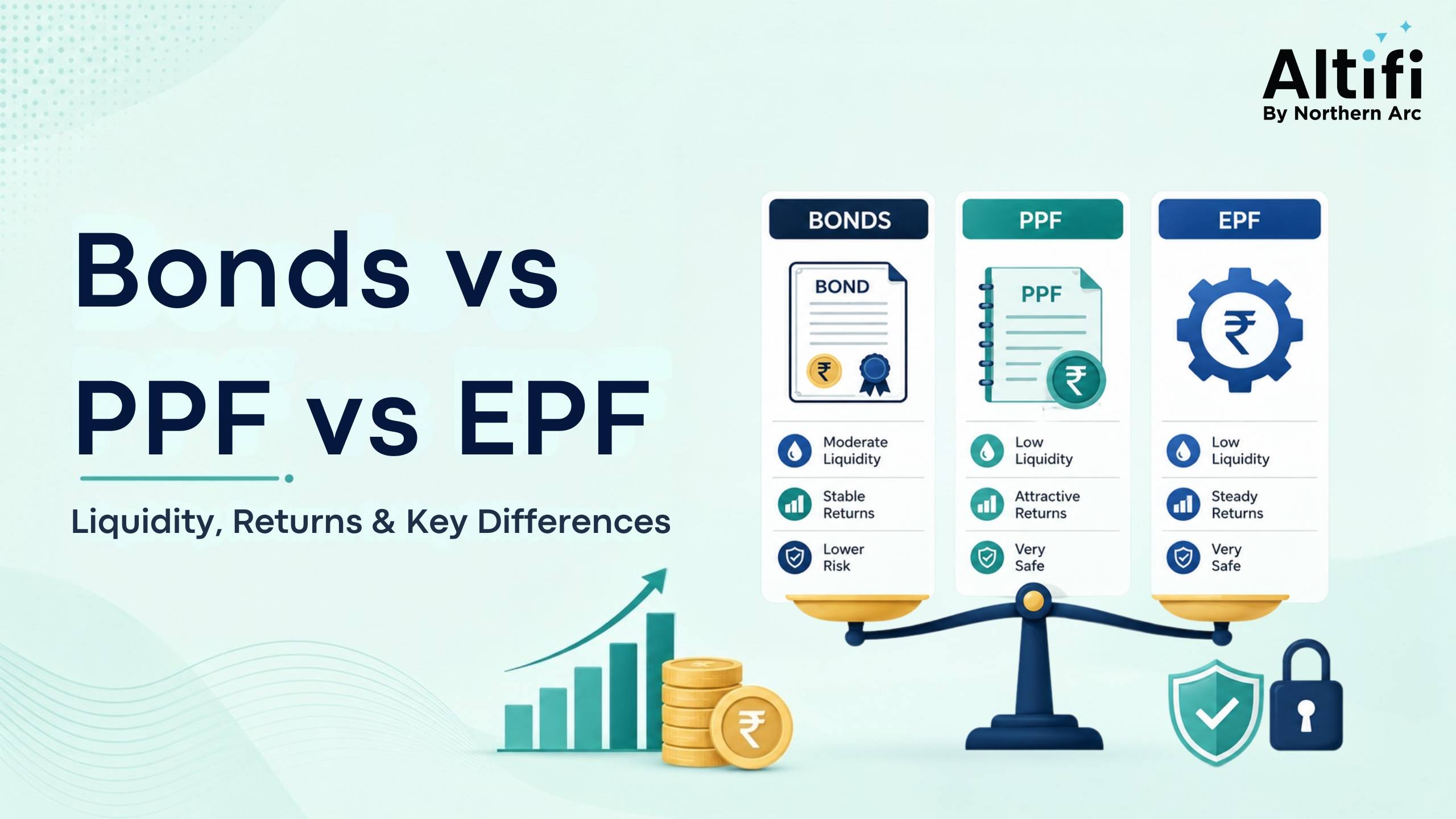
Choosing between bonds, Public Provident Fund (PPF), and Employees' Provident Fund (EPF) involves comparing more than the stated interest or coupon rate. These instruments differ in how they generate returns, how easily funds can be accessed, how long investments remain committed, and how they are taxed. PPF and EPF are government-backed savings and retirement-oriented schemes, while bonds are debt instruments issued by governments, companies, or other eligible entities.
What are Bonds?
Bonds are debt securities that provide funds from investors to the issuer for a specific period. As a result, the investor gets the coupon payment depending on the bond’s terms.
Bond issuers can include Government of India, State Governments, Public Sector Undertakings, financial institutions, and corporate companies. Features of bonds may differ based on the issuer, coupon type, maturity period, credit rating, and many other factors.
Unlike PPF and EPF, which have standardised features, bonds come in many types. A government security and a corporate bond, for instance, can differ significantly in terms of credit risk, liquidity, tax treatment, maturity, and interest-payment structure.
What is the Employees' Provident Fund (EPF)?
Employees' Provident Fund (EPF) is a retirement savings scheme for eligible salaried employees. Contributions are made by both the employee and the employer according to the applicable rules, with the employee's contribution credited to the EPF account.
The EPF interest rate is declared for each financial year. For FY 2025-26, an EPF interest rate is 8.25% per annum.
EPF also has specific withdrawal provisions. Access to the accumulated amount is linked to employment and applicable withdrawal rules, with provisions for certain partial withdrawals in specified circumstances.
What is the Public Provident Fund (PPF)?
Public Provident Fund (PPF) is a government-backed savings scheme with a long-term structure. An individual can open a PPF account through eligible banks or post offices, subject to the applicable rules.
The PPF interest rate is reviewed periodically, and it is 7.1% for Q2 FY 2025-26.
PPF has a 15-year maturity period, with provisions for partial withdrawals after the specified period and subject to applicable conditions. Contributions are also subject to an annual limit of ₹1.5 lakh.
PPF vs EPF vs bonds therefore involves comparing three different structures. PPF is an individual long-term savings account, EPF is linked to employment, and bonds are debt instruments issued under defined terms.
Bonds vs PPF vs EPF: Key Differences
Bonds, PPF, and EPF differ in their structure, liquidity, taxation, and access conditions. The comparison below focuses on these features rather than treating their stated rates as directly comparable.
Feature | Bonds | PPF | EPF |
Nature | Debt instrument issued by an eligible issuer | Government-backed savings scheme | Employment-linked provident fund scheme |
Return structure | Coupon or other interest structure depends on the bond | Interest rate is declared periodically | Interest rate is declared for the financial year |
Liquidity | Depends on the bond and whether it can be traded | Limited due to the long-term structure | Subject to employment and withdrawal rules |
Lock-in or holding structure | Varies by bond | 15-year maturity period | Linked to employment and applicable withdrawal conditions |
Tax treatment | Depends on the bond and applicable tax rules | Subject to the tax provisions applicable to PPF | Subject to applicable EPF tax provisions |
Risk factors | Depends on issuer credit quality and market conditions | Government-backed structure | Government-backed employment-linked structure |
Access | Available through eligible investment channels | Available through eligible banks and post offices | Generally linked to eligible employment |
The comparison shows why PPF vs EPF vs bonds cannot be assessed using a single measure such as the stated interest rate. Each instrument follows a different structure and set of rules.
Benefits of Bonds, PPF and EPF
Each instrument has features that may be relevant for different financial strategies. The key characteristics are outlined below.
Bonds
- Issue of Bonds: They may be issued by the government, financial intermediaries, public sector organisations, and corporations.
- Different Structures: Interest rates, maturity period, payment structure, and liquidity can be different in bonds.
- Tradability: Certain bonds can be traded in the secondary market, subject to market availability and applicable terms.
- Income Structure: Bonds may provide periodic coupon payments, depending on their terms.
PPF
- Long-Term Structure: PPF has a 15-year maturity period, with provisions for specified withdrawals under applicable conditions.
- Tax Treatment: PPF contributions and accumulated amounts are subject to the tax provisions applicable to the scheme.
- Contribution Limit: The annual contribution is capped at ₹1.5 lakh under the applicable rules.
- Government-Backed Scheme: PPF is operated under a government-backed framework.
EPF
- Employment-Linked Savings: EPF contributions are linked to eligible employment and are made by the employee and employer according to applicable rules.
- Declared Interest Rate: EPF interest is declared for each financial year.
- Withdrawal Provisions: Applicable rules allow certain withdrawals in specified circumstances.
- Account Tracking: Employees can track their EPF balance through the EPF portal using their Universal Account Number (UAN).
Factors to Consider Before Choosing Between Bonds, PPF and EPF
A comparison between PPF vs bonds or PPF vs EPF involves several factors. The relevant features can vary according to the instrument selected.
Liquidity
Bonds can offer different levels of liquidity depending on whether they are tradable and the availability of buyers in the secondary market. PPF and EPF follow specific withdrawal rules that can restrict access to funds.
Return Structure
PPF and EPF have declared interest rates, while bonds may carry a stated coupon or another interest structure. Bond returns can also depend on the purchase price and sale price when a bond is sold before maturity.
Taxation
Tax treatment differs across these instruments. PPF and EPF follow scheme-specific tax provisions, while interest and capital gains from bonds depend on the type of bond and prevailing tax rules.
Time Horizon
PPF has a defined 15-year maturity period. EPF is linked to employment and applicable withdrawal conditions. Bonds can have different maturity periods based on their individual terms.
Risk
PPF and EPF operate within government-backed frameworks. Bonds carry risks that depend on factors such as issuer credit quality, interest-rate movements, and liquidity. Corporate bonds can therefore have a different risk profile from government securities.
Who May Consider Bonds, PPF or EPF?
Choice among Bonds, PPF, and EPF can be made by considering the income, employment status, objectives, and duration of the investor. Each one has its own utility; therefore, people must take into account their needs before making the decision.
Bonds: For Investors Seeking Predictable Income
Bonds may suit investors seeking income through coupon payments and a defined maturity date, depending on the terms of the individual bond.
PPF: For Long-Term Wealth Creation and Tax Savings
PPF may suit individuals looking for a long-term savings option with a 15-year maturity period. It can also be considered by individuals seeking tax-saving opportunities under applicable tax rules. Its defined contribution structure makes it suitable for investors with long-term financial goals.
EPF: For Salaried Employees Focused on Retirement
EPF is primarily linked to eligible salaried employment, with contributions made by both the employee and employer. It may suit salaried employees who want to build retirement savings through regular contributions during their employment. The scheme is structured around long-term retirement planning.
Can You Invest in Bonds, EPF and PPF Together?
Yes, these instruments can be invested together because they work differently.
An eligible salaried employee may have an EPF account through employment and may also hold a PPF account subject to the applicable rules. The same individual can also invest in eligible bonds through the relevant investment channel.
Holding these instruments together does not change how each one works. Each continues to follow its own contribution limits, taxation, withdrawal conditions, interest or coupon structure, and maturity or holding terms.
Conclusion
Bonds, PPF, and EPF represent different approaches to debt-oriented saving and investing. Bonds can vary by issuer, coupon, maturity, liquidity, and credit profile, while PPF follows a defined long-term savings structure and EPF is linked to eligible employment. The PPF interest rate, EPF interest rate, taxation, withdrawal conditions, and bond terms therefore need separate consideration. A comparison based on liquidity, taxation, risk, and time horizon can help explain the differences between PPF vs EPF vs bonds without relying on headline rates alone.
Frequently Asked Questions (FAQs)
Which offers better returns: bonds, PPF or EPF?
Returns differ across instruments and time periods. PPF and EPF have declared interest rates, while bond returns depend on their specific terms.
Can I invest in bonds, PPF and EPF at the same time?
Yes, eligible individuals can hold these instruments together, subject to the contribution, employment, account-opening, and investment rules applicable to each.
Which investment offers better liquidity: bonds, PPF or EPF?
Liquidity depends on the specific bond and market availability. PPF and EPF have defined withdrawal conditions that can restrict access.
Are bonds riskier than PPF and EPF?
Risk depends on the bond type and issuer. PPF and EPF run on the government-backed framework, whereas the bonds come with credit and market risks.
How are bonds, PPF and EPF taxed in India?
Tax treatment differs across instruments. Bond interest and gains follow applicable tax rules, while PPF and EPF have scheme-specific provisions.
What is the lock-in period for bonds, PPF and EPF?
PPF has a 15-year maturity period. EPF follows employment and withdrawal rules, while bond holding periods depend on individual bond terms.
Disclaimer:
The information contained in this newsletter (“Newsletter”) is for general informational purposes only. Northern Arc Capital Limited (“Northern Arc”) does not make any warranties about the completeness, reliability, and accuracy of this information. Any action you take upon the information contained in this Newsletter is strictly at your own risk, and Northern Arc will not be liable for any losses and damages in connection with the use of our Newsletter.
The data included in this Newsletter has been obtained from sources that are believed to be reliable and accurate at the time of publication. However, Northern Arc does not guarantee the accuracy or completeness of any information, nor does it assume any responsibility or liability for any errors or omissions therein. Any opinions expressed herein are subject to change without notice and Northern Arc is under no obligation to update or keep current the information contained in this Newsletter.
This Newsletter is not intended to constitute, and should not be construed as, investment advice or a recommendation to purchase, sell, or hold any security or to engage in any investment strategy or transaction. Readers should not rely solely on the information provided in this Newsletter for making investment decisions and should conduct their own due diligence or seek the advice of a qualified professional.
The content of this Newsletter is for informational purposes only and is not a solicitation or an offer to buy or sell any securities or financial instruments. Northern Arc is not responsible for any investment decisions made by the recipients of this Newsletter. Readers should take independent financial advice from a qualified professional in connection with, or independently research and verify, any information that is provided in this Newsletter and wish to rely upon, whether for the purpose of making an investment decision or otherwise.
Northern Arc and its affiliates, directors, employees, and agents expressly disclaim any and all liability for any direct or indirect losses, damages, or expenses of any kind arising out of or relating to the use of this Newsletter, including but not limited to, any losses related to the accuracy, completeness, timeliness, or reliability of such information.
This Newsletter may contain forward-looking statements that are based on current expectations, estimates, forecasts, and projections about the markets in which Northern Arc operates, as well as management’s beliefs and assumptions. Forward-looking statements are not guarantees of future performance and involve certain risks and uncertainties, which are difficult to predict. Past performance is not indicative of future results.
This report is intended solely for the recipient and is not for further circulation. Any distribution, modification, reproduction, or disclosure of the contents of this Newsletter, in whole or in part, without the prior written consent of Northern Arc, is strictly prohibited.