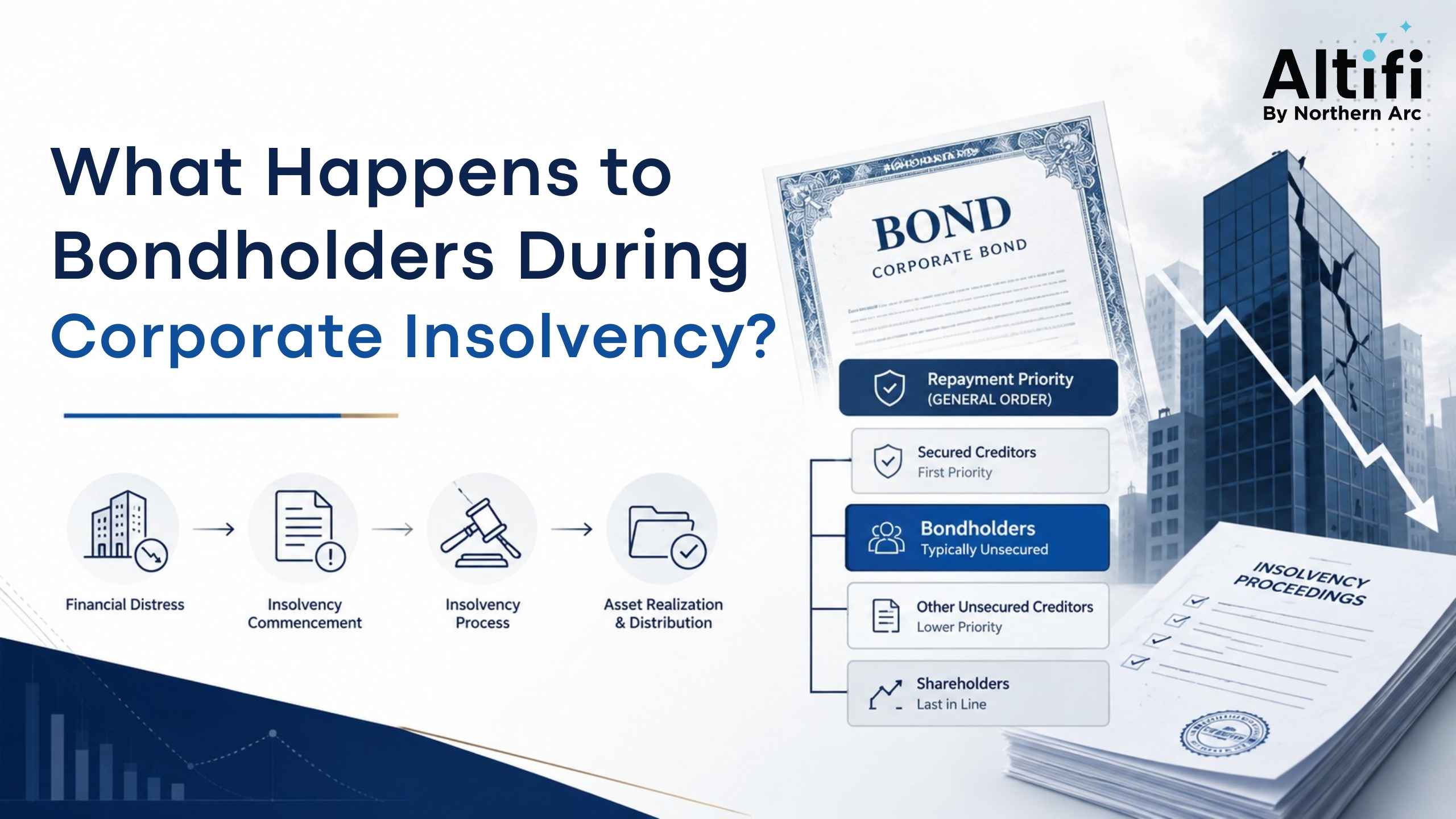
When a business entity fails to repay its debt obligations, the bondholders are entitled to inquire about the proceedings and the chances of receiving some returns on their investments. Such cases in India fall under the ambit of the Insolvency and Bankruptcy Code, 2016, which outlines the provisions for dealing with the insolvency of the firm or selling off the firm’s assets. Depending on several considerations, the amount of recovery for the bondholders may vary from case to case, and such considerations include the type of bond, the assets of the company, and the priority of the creditors, among others.
What is Corporate Insolvency?
Insolvency refers to a condition where a company is not in a position to fulfill its debts on time. As such, the company is subject to a process referred to as IBC, 2016. In this process, creditors are supposed to make claims. The reason behind this is to revive the company through a resolution plan or even liquidate it to satisfy the claims of the creditors.
What Happens to Bondholders During Corporate Insolvency?
The bondholders become creditors upon the insolvency of the company. They may be categorised as secured or unsecured financial creditors based on the conditions of the bond. It makes a huge difference in deciding where they are ranked in terms of repayment. The bondholders can make claims for payment to the resolution professional, who deals with the process. Moreover, under certain conditions, bondholders gain direct or representative membership on the Committee of Creditors (CoC). This committee determines the future course of the company. There are no guarantees of recovery; it depends on several factors.
How Does the Corporate Insolvency Resolution Process (CIRP) Work?
Here is how the corporate insolvency resolution process works:
Initiation
A creditor (or the company itself) files an application with the National Company Law Tribunal (NCLT) to start the CIRP.
Moratorium declared
Once admitted, a moratorium is imposed, freezing lawsuits, asset transfers, and debt recovery actions against the company.
Resolution professional appointed
An insolvency professional takes over management and invites claims from all creditors, including bondholders.
Committee of Creditors (CoC) formed
Financial creditors, including eligible bondholders, form the CoC to oversee the process and vote on resolution plans.
Resolution plan invited and evaluated
Potential investors submit plans to revive the company; the CoC evaluates and approves one with the required majority.
NCLT approval
The approved plan is submitted to the NCLT for final sign-off.
Liquidation (if no plan is approved)
If no viable resolution plan is approved within the timeline, the company moves into liquidation.
The entire CIRP is meant to be completed within 180 days, extendable up to 330 days in specified circumstances.
Creditor Priority in Corporate Insolvency
Not all creditors are repaid equally. The IBC follows a "waterfall mechanism" under Section 53, which lays out a strict order of priority during liquidation. Secured creditors and employees are typically paid before unsecured creditors, and equity shareholders are paid last, if anything remains.
Creditor Hierarchy Table
Priority | Category |
1 | Insolvency resolution and liquidation costs |
2 | Workmen's dues (24 months) and secured creditors (if they forgo security) |
3 | Employee wages and unpaid dues (12 months) |
4 | Unsecured financial creditors |
5 | Government dues and remaining secured creditor debt |
6 | Any remaining debt |
7 | Preference shareholders |
8 | Equity shareholders/partners |
Where Do Secured and Unsecured Bondholders Rank?
Aspect | Secured Bondholders | Unsecured Bondholders |
Backing | Bond is backed by a specific asset or collateral | No collateral backing the bond |
Priority | Ranked higher in the repayment waterfall | Ranked lower, after secured and employee dues |
Typical Recovery | Generally higher recovery rate | Generally lower recovery rate, higher risk |
Risk Level | Comparatively lower risk | Comparatively higher risk |
Factors That Affect Bondholder Recovery
Here are some factors that affect bondholder recovery:
Secured vs unsecured status
In the case of secured bonds, the bondholder has an asset that is specifically collateralised, allowing them priority in terms of the payment process. However, in the case of unsecured bonds, the bondholder has only the company's assets for recourse. This generally leads to smaller recoveries.
Remaining asset value
Recovery depends on the value of assets that remain at the disposal of the firm. The greater the remaining value of the assets of the firm, the greater the probability of recovering money from the company.
Resolution vs liquidation outcome
In case of resolution, the firm is not closed and there is greater recovery because of the fact that the firm is not distressed. In the liquidation process, the assets are sold off in distress.
Time taken to resolve the case
Delay in the process lowers the value of the assets due to several reasons, including operational problems and depreciation.
Position in the creditor hierarchy
Section 53 of the IBC fixes the repayment order. Bondholders ranked closer to the top, such as secured creditors, recover before those ranked lower, like unsecured financial creditors.
Number and size of competing claims
A larger pool of creditors, or the presence of large claims from other financial institutions, dilutes the amount available for each bondholder from the same asset pool.
Quality of the resolution plan
A well-structured resolution plan from a credible buyer, offering fair value and a viable turnaround strategy, tends to secure CoC approval faster and deliver stronger recovery than weak or opportunistic bids.
Recovery Mechanisms for Bondholders
Bondholders have a few structured ways to pursue recovery once a company enters insolvency. Filing a claim promptly and accurately with the resolution professional is the first and most important step, as claims not filed within the specified timeline may be excluded from consideration.
- Filing claims with the resolution professional using the prescribed format and supporting documents
- Participating in the CoC, either directly (for large holders) or through an authorised representative for retail bondholders
- Voting on resolution plans, since approval requires a specified majority of the CoC
- Pursuing recovery through liquidation proceeds if no resolution plan is approved
- Approaching the NCLT or NCLAT in case of disputes over claim admission or plan fairness
Liquidation vs Resolution: What Does It Mean for Bondholders?
Aspect | Resolution | Liquidation |
Company Status | Continues as a going concern under new ownership/management | Company is dissolved and assets are sold off |
Recovery Basis | Value comes from the approved resolution plan | Value comes from the sale of assets |
Typical Recovery Rate | Higher, data shows recoveries around 170% of liquidation value, business-standard in resolved cases | Lower recoveries are generally limited to actual liquidation value |
Bondholder Outcome | May recover more through a going-concern plan | Recovery often reduced due to distressed asset sale prices |
Role of the Insolvency and Bankruptcy Code (IBC)
The IBC provides the legal framework that governs the entire insolvency process for bondholders and other creditors in India. It sets clear timelines, defines creditor priority through Section 53, and establishes the CoC as the primary decision-making body. Data suggests the framework has meaningfully improved recovery outcomes over time: as of March 2026, creditors realised approximately Rs 4.32 lakh crore through approved resolution plans under the IBC, with recoveries exceeding 116.85% of liquidation value. The IBC has also contributed a significant share of total bank recoveries, outperforming other recovery channels such as SARFAESI and Debt Recovery Tribunals. That said, outcomes still vary widely by case, and only 14.4% of admitted cases have resulted in approved resolution plans as of March 2025, while 33.2% have ended in liquidation.
How Can Bond Investors Reduce Insolvency Risk?
While no investment is entirely risk-free, investors can take a few practical steps to reduce the impact of a potential issuer default and make more informed bond investment decisions.
- Check the issuer's credit rating and monitor rating downgrades closely
- Prefer secured bonds where possible, since they rank higher in the repayment order
- Diversify across issuers and sectors to avoid concentration risk
- Review the bond's covenants and collateral structure before investing
- Track the issuer's financial health periodically, not just at the time of investment
- Understand the asset cover ratio backing secured instruments
Conclusion
Insolvency within a business organisation can be quite difficult times for a bondholder, but through the IBC, there is an orderly and timely procedure to ensure that one recovers their money. Whether the bondholder is fully paid back, partially paid back or suffers a haircut will depend on whether the bond is secured, what position it holds among other creditors, and if the firm will be liquidated or reorganised. So, it is essential for both companies and investors to properly understand this process.
FAQs on Corporate Insolvency
Do bondholders get their money back during corporate insolvency?
Not always in full. Recovery depends on whether the bond is secured or unsecured, the company's remaining asset value, and whether the case ends in resolution or liquidation. Secured bondholders generally have a better chance of higher recovery.
Who gets paid first during corporate insolvency?
Insolvency resolution costs and liquidation costs are paid first, followed by workmen's dues and secured creditors, as per the priority order set under Section 53 of the IBC.
Can bondholders participate in the corporate insolvency process?
Yes. Bondholders classified as financial creditors can file claims with the resolution professional and participate in the Committee of Creditors, either directly or through an authorised representative.
Can bondholders sell their bonds after insolvency proceedings begin?
This depends on the bond's terms, listing status, and market liquidity at that time. Secondary market liquidity for bonds of a company under insolvency is usually very limited.
What should investors evaluate before investing in corporate bonds?
Investors should check the issuer's credit rating, whether the bond is secured or unsecured, the collateral structure, the financial health of the issuer, and diversification across issuers before investing.
Disclaimer:
The information contained in this newsletter (“Newsletter”) is for general informational purposes only. Northern Arc Capital Limited (“Northern Arc”) does not make any warranties about the completeness, reliability, and accuracy of this information. Any action you take upon the information contained in this Newsletter is strictly at your own risk, and Northern Arc will not be liable for any losses and damages in connection with the use of our Newsletter.
The data included in this Newsletter has been obtained from sources that are believed to be reliable and accurate at the time of publication. However, Northern Arc does not guarantee the accuracy or completeness of any information, nor does it assume any responsibility or liability for any errors or omissions therein. Any opinions expressed herein are subject to change without notice and Northern Arc is under no obligation to update or keep current the information contained in this Newsletter.
This Newsletter is not intended to constitute, and should not be construed as, investment advice or a recommendation to purchase, sell, or hold any security or to engage in any investment strategy or transaction. Readers should not rely solely on the information provided in this Newsletter for making investment decisions and should conduct their own due diligence or seek the advice of a qualified professional.
The content of this Newsletter is for informational purposes only and is not a solicitation or an offer to buy or sell any securities or financial instruments. Northern Arc is not responsible for any investment decisions made by the recipients of this Newsletter. Readers should take independent financial advice from a qualified professional in connection with, or independently research and verify, any information that is provided in this Newsletter and wish to rely upon, whether for the purpose of making an investment decision or otherwise.
Northern Arc and its affiliates, directors, employees, and agents expressly disclaim any and all liability for any direct or indirect losses, damages, or expenses of any kind arising out of or relating to the use of this Newsletter, including but not limited to, any losses related to the accuracy, completeness, timeliness, or reliability of such information.
This Newsletter may contain forward-looking statements that are based on current expectations, estimates, forecasts, and projections about the markets in which Northern Arc operates, as well as management’s beliefs and assumptions. Forward-looking statements are not guarantees of future performance and involve certain risks and uncertainties, which are difficult to predict. Past performance is not indicative of future results.
This report is intended solely for the recipient and is not for further circulation. Any distribution, modification, reproduction, or disclosure of the contents of this Newsletter, in whole or in part, without the prior written consent of Northern Arc, is strictly prohibited.