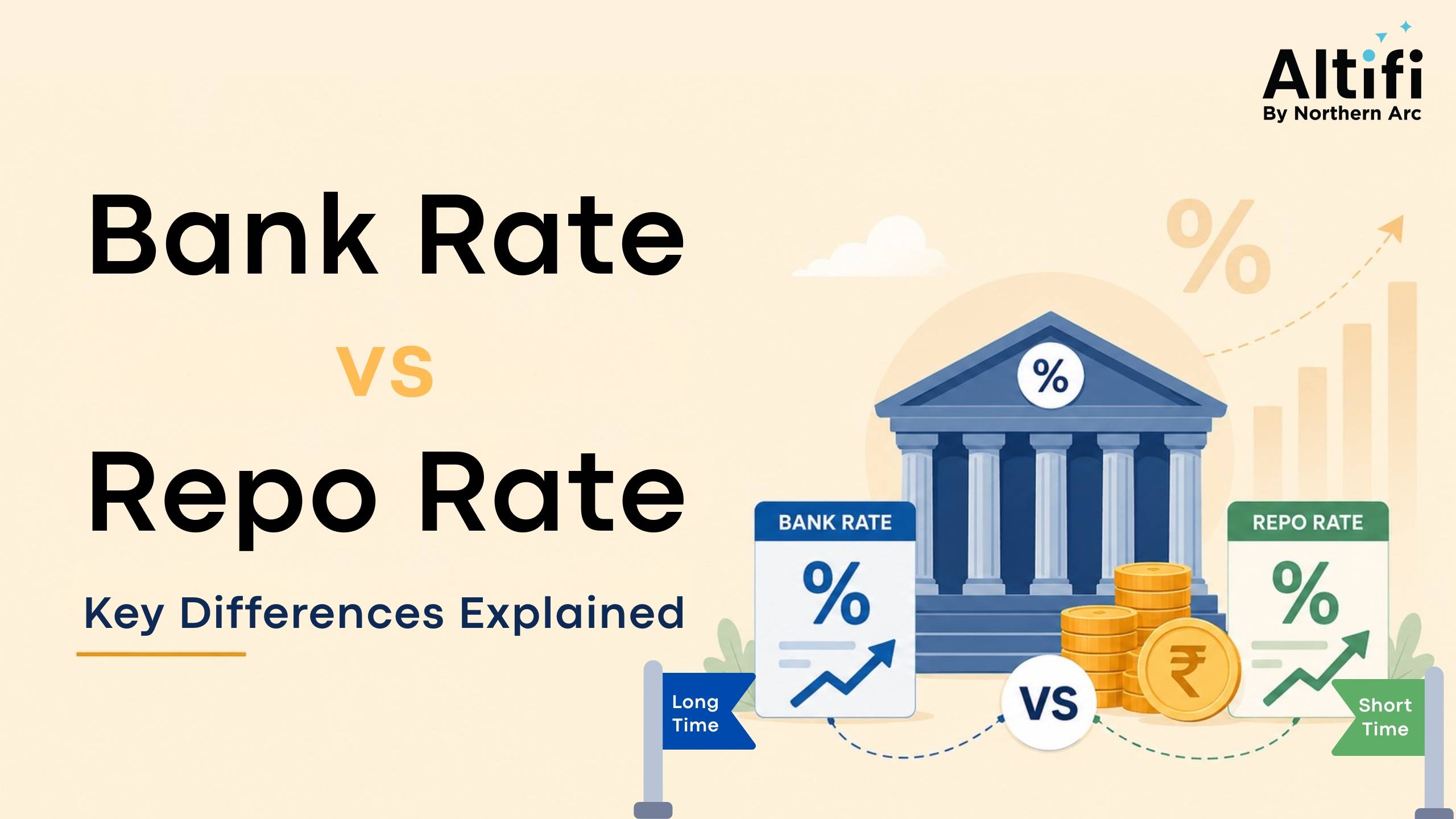
The Reserve Bank of India (RBI) uses several tools to manage the country's monetary policy, and two of the most important ones are the Bank Rate and the Repo Rate. Though both influence how much it costs banks to borrow money, they work differently and serve different purposes. Understanding these two rates helps you make sense of why your home loan EMI changes, why fixed deposit interest rates move up or down, and how the RBI controls inflation. This article breaks down the meaning, differences, and economic impact of the Bank Rate and Repo Rate in simple terms, along with the latest figures and RBI data, so you get a clear and complete picture.
What is the Bank Rate?
The Bank Rate refers to the interest rate at which the RBI loans to commercial banks without accepting any form of security. It is primarily employed to control the general borrowing cost in the economy. As such, when the RBI increases the Bank Rate, banks will find it more costly to borrow, while the cost is usually passed on to the customers in the form of an increased rate of interest on loans. If the Bank Rate is decreased, borrowing is made easier.
According to the recent figures from the RBI, the Bank Rate and the MSF Rate are both at 5.50% up to June 2026.
What Is the Repo Rate?
The Repo Rate, short for “Repurchase Agreement," is the rate at which the RBI lends short-term funds to commercial banks against government securities as collateral. Repo Rate refers to the rate at which commercial banks borrow funds from the RBI against security and bond collaterals. Once the loan tenure ends, banks repurchase these securities from the RBI at a predetermined price.
Repo Rate is the main monetary tool of the Reserve Bank of India to regulate liquidity, inflation, and economic growth. According to the recent MPC meetings of the RBI, the repo rate remains the same at 5.25% while the RBI maintains its neutral monetary policy stance. This rate has remained the same since RBI reduced rates by 25 bps during the MPC meeting in February 2026.
Bank Rate vs Repo Rate: Key Differences
While both rates are controlled by the RBI, they differ in purpose, tenure, and how they affect the banking system.
Feature | Bank Rate | Repo Rate |
Current Rate (2026) | 5.50% | 5.25% |
Nature | Long-term lending rate | Short-term lending rate |
Collateral required | No collateral needed | Government securities required |
Purpose | Influences overall cost of credit | Manages liquidity and inflation |
Frequency of Review | No fixed review schedule | Reviewed every two months by MPC |
Impact on Loans | Indirect, long-term impact | Direct, faster impact on EMIs |
Some additional points of difference:
- The Bank Rate applies to RBI lending without a repurchase agreement, while the Repo Rate is used for short-term borrowing by banks through repo transactions backed by government securities.
- Changes in the Repo Rate will influence floating rate loans (such as home loans based on the repo-linked lending rate) very quickly, unlike Bank Rate changes.
- No repurchase agreement is involved under the Bank Rate, but required for Repo Rate, which relies on the buy-back of securities.
- Bank Rate changes occur rarely and usually coincide with the changes of the MSF rate, the MPC reviews the Repo Rate every two months, but it may leave the rate unchanged.
To summarise, the Repo Rate can be considered as a short-term and quick loaning facility, while the Bank Rate is a long-term benchmark for borrowing.
How Do Bank Rate and Repo Rate Affect the Economy?
Both of them are very important factors used by the Reserve Bank of India to control inflation, credit supply, and economic growth.
If the RBI increases the Repo Rate, borrowing by banks from the RBI becomes more expensive, and the interest rates on loans also increase. Such a situation reduces spending and borrowing and controls inflation. If the Repo Rate decreases, then the process works vice versa.
Here is how these rates typically influence the economy:
Inflation control
A higher Repo Rate discourages excess borrowing, helping curb inflation. A lower rate stimulates demand when inflation is under control.
Loan and EMI impact
Home loans, personal loans, and business loans linked to the Repo Rate get costlier or cheaper depending on rate changes.
Liquidity management
The Repo Rate, along with CRR, SLR, and other liquidity management tools, helps the RBI manage liquidity.
Investment and growth
Lower rates encourage businesses to borrow and expand, supporting GDP growth.
Currency stability
Rate changes also influence the strength of the rupee by affecting foreign investment flows.
When Does the RBI Use the Bank Rate and Repo Rate?
Repo Rate is always the preferred tool by the RBI for its bi-monthly policy reviews to help control liquidity and act swiftly in case there are changes in inflation and growth. For example, the RBI kept reducing the repo rate throughout 2025 due to growth but held it constant in the first half of 2026.
Bank Rate is not as commonly used and acts as a penal rate or benchmark rate for long-term lending. The rate changes in lockstep with the MSF rate.
The Monetary Policy Committee of the RBI, responsible for setting these rates, holds meetings every two months, headed by the Governor of the RBI. The next Monetary Policy Committee (MPC) meeting is set for August 4-6, 2026.
Conclusion
The Bank Rate and Repo Rate both play an equally important role in managing the Indian economy by the RBI; however, they differ from each other in function. While the Repo Rate is a shorter term, secured rate that changes on frequent occasions to deal with the issues of liquidity and inflation, the Bank Rate is a longer term unsecured rate and changes occasionally. It plays an important role in shaping interest rates, EMIs, return on saving deposits, and economic growth.
FAQs on Bank Rate vs Repo Rate
How does the Repo Rate affect home loan EMIs?
When the RBI changes the Repo Rate, banks adjust their lending rates accordingly, especially for loans linked to the Repo Linked Lending Rate (RLLR). A rate hike increases EMIs, while a rate cut lowers them.
Who decides the Bank Rate and Repo Rate in India?
Both rates are decided by the RBI's Monetary Policy Committee (MPC), which meets every two months to review economic conditions and adjust rates accordingly.
Can the Bank Rate and Repo Rate change at the same time?
Yes. Since the Bank Rate is linked to the MSF rate, it often moves in the same direction as the Repo Rate, though not always by the same margin or on the same schedule.
What happens when the RBI reduces the Repo Rate?
A fall in the Repo Rate will make it cheaper for banks to borrow money from the RBI, and hence the interest rates on their loans fall too.
Do Bank Rate and Repo Rate affect personal loan interest rates?
Both do influence the cost of funding the bank which ultimately influences the interest rates of personal loans. But Repo Rate has a direct influence and that too, in a much shorter time period.
Which is higher: bank rate or repo rate?
Currently, Bank Rate is higher at 5.50% compared to the Repo Rate of 5.25%, as the Bank Rate is pegged to the MSF rate, which is higher than the Repo Rate.
Does a higher Repo Rate always mean higher loan EMIs?
An increase in the Repo Rate generally means an increase in the EMI of the loans that are linked to the Repo Rate. But there are other factors too that matter.
Disclaimer:
The information contained in this newsletter (“Newsletter”) is for general informational purposes only. Northern Arc Capital Limited (“Northern Arc”) does not make any warranties about the completeness, reliability, and accuracy of this information. Any action you take upon the information contained in this Newsletter is strictly at your own risk, and Northern Arc will not be liable for any losses and damages in connection with the use of our Newsletter.
The data included in this Newsletter has been obtained from sources that are believed to be reliable and accurate at the time of publication. However, Northern Arc does not guarantee the accuracy or completeness of any information, nor does it assume any responsibility or liability for any errors or omissions therein. Any opinions expressed herein are subject to change without notice and Northern Arc is under no obligation to update or keep current the information contained in this Newsletter.
This Newsletter is not intended to constitute, and should not be construed as, investment advice or a recommendation to purchase, sell, or hold any security or to engage in any investment strategy or transaction. Readers should not rely solely on the information provided in this Newsletter for making investment decisions and should conduct their own due diligence or seek the advice of a qualified professional.
The content of this Newsletter is for informational purposes only and is not a solicitation or an offer to buy or sell any securities or financial instruments. Northern Arc is not responsible for any investment decisions made by the recipients of this Newsletter. Readers should take independent financial advice from a qualified professional in connection with, or independently research and verify, any information that is provided in this Newsletter and wish to rely upon, whether for the purpose of making an investment decision or otherwise.
Northern Arc and its affiliates, directors, employees, and agents expressly disclaim any and all liability for any direct or indirect losses, damages, or expenses of any kind arising out of or relating to the use of this Newsletter, including but not limited to, any losses related to the accuracy, completeness, timeliness, or reliability of such information.
This Newsletter may contain forward-looking statements that are based on current expectations, estimates, forecasts, and projections about the markets in which Northern Arc operates, as well as management’s beliefs and assumptions. Forward-looking statements are not guarantees of future performance and involve certain risks and uncertainties, which are difficult to predict. Past performance is not indicative of future results.
This report is intended solely for the recipient and is not for further circulation. Any distribution, modification, reproduction, or disclosure of the contents of this Newsletter, in whole or in part, without the prior written consent of Northern Arc, is strictly prohibited.